49 works in this view — arrow keys or swipe to move between them.
Dance in Art
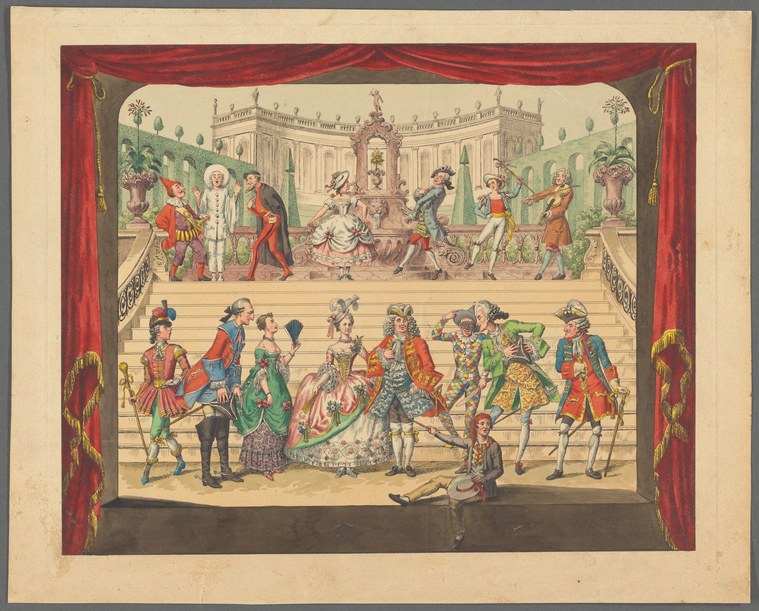
Das Geburtstagsfest des Duc de Roquelaure: [colored etching]
Unknown artist
- Collection:
- Prints depicting dance
- Source:
- New York Public Library
- Rights:
- Public domain — free to use, share and adapt.
- Recorded as:
- Public Domain
This image captures the social and aesthetic world of baroque court dance at a moment before the professionalization of ballet. It shows us how dance functioned as a mode of courtship, display, and social cohesion among the nobility, and how the body was dressed, positioned, and moved within rigid codes of decorum and elegance.
What you are looking at
A two-tiered theatrical scene framed by crimson velvet curtains, depicting an aristocratic fête. The upper level shows a grand palatial garden with a ornate pavilion, manicured topiary, and courtiers in formal dress scattered across an terrace; the lower level, on the main stage, presents the central spectacle: a large gathering of elaborately costumed dancers and musicians arranged in informal groups and pairs across a checkered floor. The figures wear the jewel-toned silks, gold brocades, and plumed hats characteristic of early 18th-century court dress. A woman in a pale gown stands prominently near the center. Musicians with instruments occupy the left side; dancers in contrasting reds, greens, and golds are distributed across the composition. The whole is rendered in a hand-colored etching technique, with careful attention to the texture of fabrics and the play of light on silk and metal trim.
The dancing
Dozens of figures stand, walk, and move in small clusters rather than in unified formation. Most appear to be in conversational or procession-like postures—upright, gesturing with hands, facing one another—rather than executing synchronized steps. A few figures suggest dancing posture: a woman in the center appears to be in motion, possibly turning; some couples seem to be in contact, though the distance and the print's resolution make precise holds difficult to discern. The overall impression is of social mingling and informal courtship dancing rather than formal choreography, with bodies oriented in multiple directions and individual rather than collective focus.
The dance depicted
This depicts a court ball or birthday celebration (the title references the Duc de Roquelaure), a hallmark of French aristocratic life in the early 18th century. The scene shows the social dance of the period—likely minuets, gavottes, or other baroque courtly dances performed in couples and small groups among the assembled nobility. The informality of grouping, the mix of standing and moving figures, and the presence of musicians all point to a real court ball rather than a staged ballet performance. The dominant gesture and posture suggest the stately, upright carriage and restrained movement vocabulary characteristic of baroque court dance, where elegance and decorum were paramount.
How it was made
This is a hand-colored etching—a print medium that allowed wide circulation among the educated public and court circles. Etching enabled fine detail in the architectural and costume elements while the hand coloring (applied after printing) provided the rich jewel tones, gold accents, and subtle modeling visible throughout. This technique was ideal for documenting court spectacles and social events: durable, reproducible, and sufficiently detailed to convey the grandeur and specifics of dress and setting. The work would have been issued as a commemorative or entertainment print, circulating in portfolios of similar society scenes.
About this work
This is a documentary-aesthetic record of an 18th-century French court ball, capturing both the architectural splendor of the setting and the bodies, dress, and social arrangement of a dancing assembly. It belongs to a rich tradition of court-scene prints that served as both souvenirs of notable events and models of courtly behavior for a broader audience. The artist has chosen to show dance not as virtuosity or formal performance but as an integral element of aristocratic sociability—the mingling, the music, the carefully orchestrated proximity of bodies in silk and jewels. For dance historians, the work documents the integration of dance into court life, the social composition of the dancing assembly, and the embodied norms of baroque courtly movement.
How to look at it
Study the two levels separately: the upper terrace is a static backdrop of architectural grandeur, while the lower stage is alive with informal motion and encounter. Notice how the artist has distributed figures across the floor in overlapping clusters, creating depth and a sense of social flux. Look at the costumes and props—the feathered hats, the ribbons, the instruments—which ground the scene in a specific place and time. The artist has captured not a climactic moment of choreography but a sustained social event, which is the truest image of how court dance actually functioned.
The period
In the early 18th century, court balls and ballets were central to the life and self-representation of European aristocracy, especially in France. The Duc de Roquelaure (1656–1738) was a prominent courtier and military figure, and a birthday celebration of his rank would have been a notable social and aesthetic event. This was the era of the grand ballet de cour and the refined minuet, when dance was shifting from an aristocratic amateur practice toward professional theatrical performance, yet remained deeply embedded in court ceremony. Prints documenting such events served to commemorate them and to circulate images of courtly fashion and behavior to a wider, if still elite, audience.
Where it lives
This colored etching is held by the New York Public Library in a collection of prints depicting dance. It is part of a wider genre of 18th-century European court scene documentation.
Dance in this work
Questions about this work
Is this a real event or an imagined scene?
The title references the Duc de Roquelaure, a real historical figure (1656–1738), and the work appears to commemorate an actual ball or fête, though the artist has stylized and arranged the scene for aesthetic effect. It is a documentary print meant to record a notable social occasion, not a purely fictional composition.
What dances are being performed?
The specific dances cannot be identified with certainty from the composition, but the formal dress, the paired and small-group arrangements, and the overall conduct suggest baroque courtly dances of the period—most likely the minuet, gavotte, or similar social dances of the French court in the early 18th century.
Why is the scene divided into two levels?
The two-level composition was a conventional device in theatrical and court scene prints of the period, separating the palatial setting (upper level) from the active social space (lower, stage level) where dancing occurs. This structure emphasizes both the architectural splendor and the human drama of the event.
How does this differ from a ballet performance?
This is a social court ball, not a staged ballet. The figures are arranged informally, moving in various directions and groups rather than executing unified choreography; there is no audience seated separately from the dancers. Dance here is embedded in courtship and social interaction, not separated as spectacle.
More dance artwork





