49 works in this view — arrow keys or swipe to move between them.
Dance in Art
Pepita la grenadine
Unknown artist
- Collection:
- Prints depicting dance
- Source:
- New York Public Library
- Rights:
- Public domain — free to use, share and adapt.
- Recorded as:
- Public Domain
This work documents a specific moment in the professionalization and popularization of Spanish/Iberian dance in theatrical contexts. For dance historians, it is evidence of how a regional or social form was staged, dressed, and marketed; the image shows the body, the costume, the music, and the social context together. For curators and collectors, it represents a significant category of 19th-century visual culture—the theatrical dance cover—which shaped how audiences imagined and consumed dance.
What you are looking at
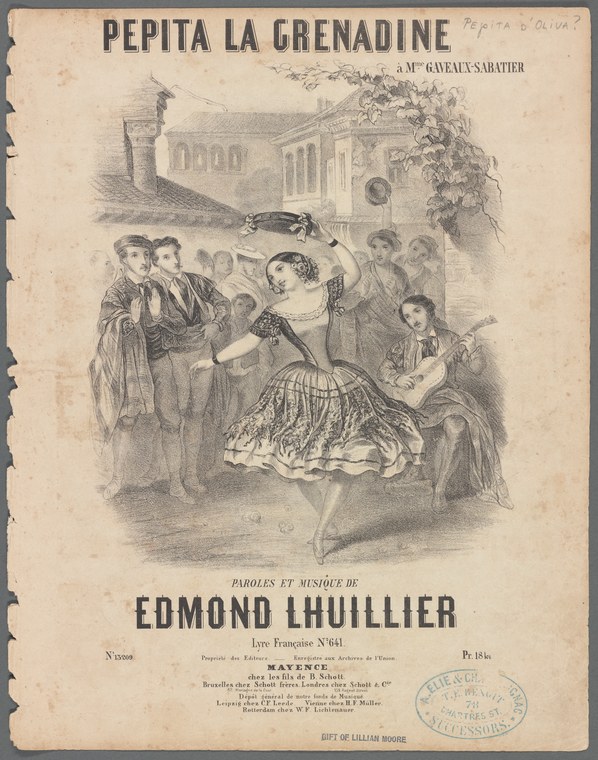
This is a lithographic sheet music cover for "Pepita la grenadine," a theatrical dance number with music by Edmond Lhuillier. The composition centers on a young woman in a full, tiered skirt of white linen with decorative trim, performing a dynamic pose in the foreground. She wears a fitted bodice and her arms are raised in an expressive gesture. Around her stand four watching figures—two men in dark coats to the left, a seated musician with a guitar on the right, and additional onlookers. The setting is a sunlit courtyard or garden with classical architecture visible in the background: a colonnade with arched openings and climbing vines. The scene has the character of a popular theatrical moment, capturing both the dancer's virtuosity and the attention of her admirers. The lithographic line is detailed and assured, with careful attention to the textures of fabrics and the play of light across the composition.
The dancing
The central dancer stands with her weight forward, one leg extended or about to move, her torso upright and arms lifted expressively—suggesting momentum and control. Her full skirt is rendered mid-swirl, lifting away from her body. The male figures flank her: one gestures toward her, the other observes. The guitarist sits to the right, integrated into the scene as both musician and audience. The proportions and anatomical rendering suggest a professional dancer, not a courtesan or street performer; the body is trained and the movement deliberate.
The dance depicted
The title identifies this as "Pepita la grenadine"—a reference to a specific dance number or possibly a famous dancer (grenadine may refer to the fabric or a regional style). The image and title suggest a Spanish or Iberian-influenced dance in a theatrical context, most likely a bolero, seguidilla, or similar social-theatrical form. The costume—white linen skirt with decorative tiers, fitted bodice—aligns with Spanish popular dress of the mid-19th century. The setting, music, and format (sheet music cover) place this in the tradition of theatrical dances that were adapted for concert and ballroom performance. The presence of the guitar player reinforces the Spanish/Iberian context. Without additional documentation, the specific steps and technique cannot be determined from the image alone.
How it was made
This is a lithograph, a process evident from the characteristic line quality, the way tone is achieved through crayon and wash rather than engraving, and the overall aesthetic of 19th-century music publishing. Lithography allowed rapid, affordable reproduction suitable for sheet music distribution. The print shows the skill typical of music-cover illustration of the period: fine detail in costume and architecture, expressive gesture, and composition that functions both as art and advertisement. The technique was popular for theatrical promotion and the sale of fashionable dance tunes to the middle-class domestic market.
About this work
This is a lithographed sheet-music cover documenting a mid-19th-century theatrical dance. It captures both the visual glamour of the dance and its embedding in a social and musical context—the presence of the musician, the watching admirers, the theatrical setting. The work belongs to the tradition of popular theatrical dance imagery that flourished after c. 1830, when lithography made it possible to disseminate images of stage dances to a mass audience. The dance itself sits at the intersection of Spanish popular tradition, ballroom fashion, and professional theatre—a social form adopted and celebrated in urban entertainment. For dancers and historians, the image offers concrete evidence of costume, proportions, and the cultural moment of the dance; for art historians, it exemplifies the role of lithography in the commercial theatre and in the circulation of movement imagery.
How to look at it
Observe the dancer's posture and arm position: the raised arms and lifted skirt suggest a moment of spin or flourish rather than a standing pose. The architectural frame—the colonnade behind her—gives scale and situates the dance in a plausible theatrical or garden setting. The guitar player's position is significant: he is not simply decorative but integrated into the scene as a necessary part of the performance. Notice the detail of the fabric: the tiered layers of the skirt are rendered to show both the construction and the movement it enables. The composition is balanced but dynamic, freezing a moment of motion rather than a static tableau.
The artist
The cover credits both Edmond Lhuillier (music and text) and an unsigned illustrator. Lhuillier was a minor composer and publisher active in Paris in the mid-19th century; the engraved credit line includes the publisher's address and a catalogue number (N°1880 or similar), suggesting a professional music-publishing house. The illustrator's hand is trained and professional but remains unattributed in the record, a common feature of commercial lithography where cover artists were often not credited.
The period
This work dates to approximately the 1840s–1860s, a period of intense enthusiasm for Spanish and Mediterranean dances in European ballrooms and theatres. The bolero and seguidilla had become fashionable among the middle and upper classes; theatrical versions were performed in Paris, London, and other major cities. Lithography had made illustrated sheet music affordable and collectable, encouraging the mass circulation of dance imagery. The Romantic era's fascination with folk and regional forms meant that Spanish dance was increasingly performed, adapted, and celebrated in urban theatrical contexts—often with an emphasis on the female dancer's elegance and sensuality.
Where it lives
This is a lithographed sheet-music cover from the NYPL collection of dance-related prints. It is an example of the commercial music publishing tradition of the 19th century, distributed for domestic and theatrical use. The object itself is both an artwork and a functional item: it advertised the music and the dance, and likely sold to households with piano or guitar and interest in fashionable theatrical repertory.
Dance in this work
Questions about this work
Was Pepita a real dancer?
The catalogue does not identify her. "Pepita la grenadine" may refer to a famous performer of the period, a character name, or a generic title; "grenadine" may denote the fabric, the region (Granada), or a style designation. Without additional sources, it cannot be determined whether this was a specific historical dancer or a type or fictional character.
What is the dance being shown?
The title, costume, and setting suggest a Spanish or Iberian-influenced theatrical dance from the mid-19th century, most likely related to the bolero or seguidilla family. The lithograph provides visual information—costume, proportions, the presence of a guitarist—but the specific choreography, music, and tradition cannot be determined from the image alone.
Who illustrated this?
The artist is not credited on the cover, which was common for commercial lithographic work. The quality and professional finish suggest an experienced illustrator working for a music publisher, but the name is not recorded in the archive.
How was this made?
This is a lithograph, a printing technique that allowed rapid reproduction on paper. The artist drew the design on a prepared stone, which was then inked and printed. Lithography was ideal for sheet-music covers because it was fast, affordable, and capable of fine detail—making it possible to sell illustrated dance music to the middle-class domestic market.
More dance artwork





