49 works in this view — arrow keys or swipe to move between them.
Dance in Art
Native American dancing in prints
Unknown artist
- Collection:
- Prints depicting dance
- Source:
- New York Public Library
- Rights:
- Public domain — free to use, share and adapt.
- Recorded as:
- Public Domain
This work is essential for understanding how 19th-century American print culture represented Indigenous dance and ceremony to a settler audience, and how visual media shaped colonial attitudes and misconceptions. For dance historians, it documents the circulation and reception of Native American movement practices in the context of American periodical culture, even as it reveals the mediation and distortion imposed by that circulation. It shows the stakes of representation: how technique, medium, and editorial choice frame bodies and movement as spectacle rather than as living cultural practice.
What you are looking at
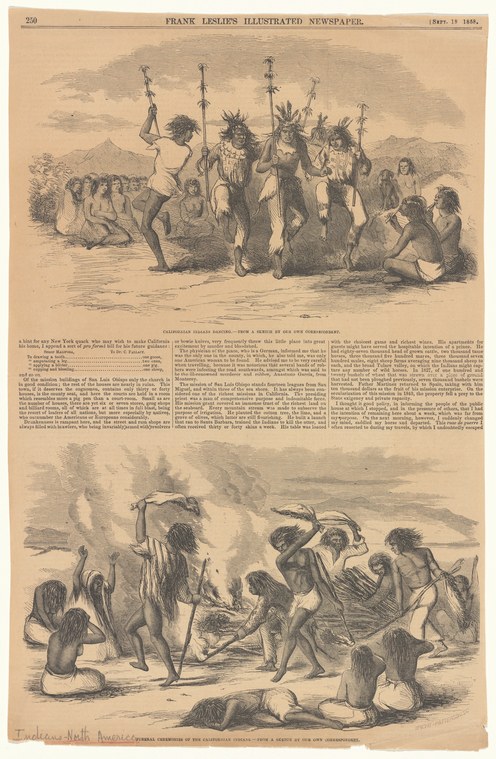
This is a two-panel engraving from Frank Leslie's Illustrated Newspaper, a 19th-century American periodical. The upper panel shows a group of Indigenous people gathered outdoors, with several figures wearing feathered headdresses and minimal clothing standing in a circle or loose formation. Some figures appear to be in active movement or gesture, while others sit or stand as observers. The setting is sparse, with hints of landscape behind them. The lower panel depicts what appears to be a continuation or related scene, with figures arranged around what may be a fire or central gathering point, again showing a mix of standing, moving, and seated participants. The style is characteristic of wood-engraved illustration: fine parallel lines create tone and texture, with strong contrasts of light and dark. The composition emphasizes the exotic spectacle of the scene for a 19th-century American audience unfamiliar with these practices.
The dancing
The upper scene shows multiple figures in varied postures: some stand with arms raised or extended, suggesting active participation or communication; others crouch, sit, or recline around the periphery. The figures lack the rigid body alignment of European dance; instead, their poses suggest spontaneous, individualized movement and gesture. Several wear feathered headdresses that rise significantly above the head. The lower scene similarly mixes standing figures in animated poses with seated onlookers, suggesting a participatory event rather than a formal, synchronized performance. No visible partnering or formation dancing is evident; the movement appears to be individual or loosely collective.
The dance depicted
This image documents or depicts ceremonial and social movement among Native American peoples, likely created for a non-Indigenous American newspaper audience in the 19th century. The specific nation, ceremony, and occasion cannot be determined from the image alone. The feathered regalia, the outdoor gathering, the mix of participants and observers, and the gestural vocabulary suggest sacred ceremony, social celebration, or gatherings tied to seasonal or spiritual observance—all of which incorporate movement as a central element. The artist's representation prioritizes visual spectacle and difference from Euro-American norms rather than accurate ethnographic documentation. Without additional context or inscription, the specific dance style cannot be identified with confidence.
How it was made
This is a wood engraving, a relief printing technique that produces fine parallel lines and strong tonal contrast. The technique was standard for newspaper and periodical illustration in the mid-to-late 19th century, allowing rapid reproduction and wide circulation. The parallel-line hatching visible throughout creates depth and form but also flattens and abstracts the figures, particularly affecting the rendering of light on skin and fabric. The technique was well-suited to mass production for a weekly newspaper, but the conventions of the medium—its reliance on pattern and simplified form—fundamentally shaped how Indigenous movement and bodies were presented to the American reading public.
About this work
This is a two-part wood engraving from Frank Leslie's Illustrated Newspaper documenting or depicting Native American ceremonial and social dance practices. It represents a significant body of 19th-century American visual culture: the illustrated newspaper's treatment of Indigenous peoples for a mass, largely non-Indigenous readership. The images are framed as exotic spectacle, with emphasis on costume and 'otherness,' rather than as authentic cultural documentation. The print belongs to a large archive of such images circulated in American periodicals, which shaped how settler Americans understood and imagined Indigenous cultures—often distortively and with implicit assumptions about primitivism and exoticism. For historians of dance, the image is valuable not as evidence of how the dances were actually performed, but as evidence of how 19th-century American visual media constructed and circulated representations of Indigenous movement.
How to look at it
Look at the contrast between the raised, extended gestures and the seated, observing figures: the composition suggests a performance or ceremony with participants and witnesses, rather than a unified group dance. Notice the feathered headdresses as the primary visual marker of 'Indianness' for the audience—they rise dramatically and catch the engraver's finest lines. Observe how the artist has rendered the figures' bodies without the anatomical idealization common in European figure drawing; instead, the emphasis is on movement, costume, and what the 19th-century viewer would have read as exotic or primitive physicality. The lower panel's arrangement around what may be a fire or ceremonial center suggests a spatial logic of gathering and participation rather than the formal patterns of ballroom or theatrical dance familiar to the newspaper's readers.
The artist
The catalogue record does not identify the artist or engraver. Frank Leslie's Illustrated Newspaper, founded in 1855 and published until 1922, employed a large staff of wood engravers, illustrators, and reporters. The newspaper was known for sending correspondents and artists to document major news events, conflicts, and 'scenes of interest,' including encounters with Indigenous peoples during the Indian Wars era. The images were often created from eyewitness sketches or secondhand accounts, then interpreted and engraved by staff artists who may have had no direct knowledge of the subject. Attribution to a specific hand or workshop would require additional research in the newspaper's archives or contemporary publishing records.
The period
This engraving was created during the period of intense American colonial expansion and military conflict with Indigenous nations (roughly 1860s–1880s). Frank Leslie's Illustrated Newspaper, like Harper's Weekly and other major American periodicals, provided a primary visual medium for circulating images of the 'Indian Wars' and Indigenous peoples to a mass American audience. These images served multiple functions: news reporting, entertainment, and ideological reinforcement of settler-colonial narratives about Indigenous peoples as exotic, primitive, and destined for disappearance. In the same era, ethnographic photography and collecting were also expanding, but newspaper engravings reached far larger audiences. Dance and ceremony were frequent subjects because they were visually distinctive and could be framed as evidence of cultural difference and 'savagery.' At the same time, many Indigenous communities were actively resisting removal and cultural suppression, making these newspaper images part of a broader visual warfare accompanying military and legal conflict.
Where it lives
This work is held in the New York Public Library's collection of prints depicting dance and is catalogued as part of the library's extensive holdings of Frank Leslie's Illustrated Newspaper. The newspaper was a major American periodical, widely circulated among middle-class and working-class readers, making this an artifact of mass visual culture and colonial representation.
Dance in this work
Questions about this work
What Native American nation or ceremony is shown here?
The catalogue record and the image do not identify the nation, tribe, or specific ceremony. The feathered regalia, outdoor setting, and gestural vocabulary suggest sacred or seasonal ceremony, but without inscription or additional documentation, precise identification is not possible. Such anonymity was typical of 19th-century newspaper coverage, which often erased tribal specificity in favor of generalizing 'Indian' identity.
Is this an eyewitness account or an invention?
Frank Leslie's Illustrated Newspaper did employ field correspondents, but many images were also created from secondhand descriptions, earlier sketches, or imaginative reconstruction. The wood-engraving process introduced further interpretation: the engraver translated the original sketch or account into the conventions of the medium. This is a representation of a representation, shaped by multiple layers of artistic choice and editorial framing.
What does the clothing and regalia tell us?
The feathered headdresses, body paint or natural skin tones, and minimal clothing were rendered as markers of cultural difference and 'primitiveness' for the American newspaper audience. Whether the artist accurately recorded specific regalia or imposed generalizations cannot be determined from the image alone. The emphasis on these visual markers served the ideological function of marking Indigenous peoples as exotic and other.
Why is this in a dance gallery?
Ceremonial movement, gesture, and gathered performance are central to Indigenous cultural practice, and these images were among the primary visual documents circulating in American culture to represent such practices. The work belongs in a dance archive as evidence of both the dances themselves (as filtered through colonial representation) and of the visual media and attitudes that shaped American understanding of Indigenous movement.
More dance artwork





