49 works in this view — arrow keys or swipe to move between them.
Dance in Art
Native American dancing in prints
Unknown artist
- Collection:
- Prints depicting dance
- Source:
- New York Public Library
- Rights:
- Public domain — free to use, share and adapt.
- Recorded as:
- Public Domain
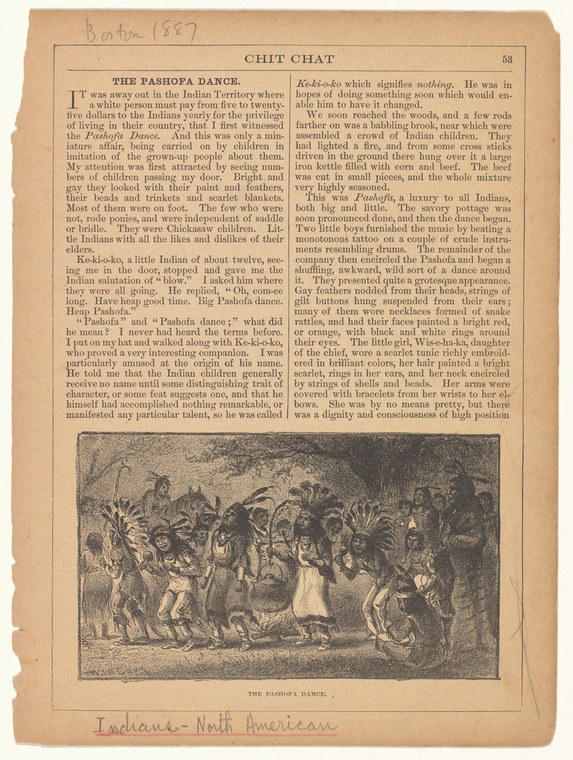
This image is a rare visual record of Native American social or ceremonial dance from a period when such traditions were actively being suppressed or displaced. It documents the gathering, communal nature of the dance and the importance of regalia, fire, and collective participation. For historians of Native American dance and culture, it provides evidence of how these practices were understood and represented in the wider culture, while also serving as a window into actual practice despite the limitations of the engraver's perspective.
What you are looking at
A group of Native American dancers in traditional dress perform together in a wooded setting at night. The scene is lit by firelight from a central fire, which casts dramatic shadows across the figures. The dancers wear feathered headdresses, body ornaments, and what appear to be traditional garments. They are arranged in a loose circle or gathering around the fire, with some figures more prominently positioned in the foreground. The composition suggests movement and celebration, with the natural woodland setting and dancing figures creating a sense of ceremonial or social gathering. The engraving technique creates strong contrasts between light and shadow, emphasizing the drama of the firelit scene.
The dancing
The dancers display varied postures and positions rather than a uniform formation, suggesting spontaneous or individual movement within a group context. Some figures appear to have their arms raised or extended, indicating expressive upper-body movement. The dancers are positioned at different depths in the composition, creating a sense of spatial complexity. The variety of stances—some more upright, others bent or leaning—suggests the dancers are captured mid-movement rather than in a static pose, though the specific footwork cannot be determined from the engraving.
The dance depicted
This depicts a Native American ceremonial or social dance, most likely a powwow or intertribal gathering dance based on the group composition, firelit setting, and traditional regalia. The scene suggests a nocturnal celebration, possibly a social gathering where multiple dancers participate together in communal movement. The loose, non-linear arrangement of the figures and the emphasis on individual expression within the group setting is consistent with many Native American dance traditions where participants move in relation to drumming and singing rather than in rigid formations. The presence of fire and the outdoor woodland setting are typical elements of historic Native American dance gatherings.
How it was made
This is an engraving, likely a wood engraving or steel engraving given the fine detail and high contrast characteristic of 19th-century print media. The technique allows for precise rendering of the dancers' ornaments and regalia while the bold blacks and whites create dramatic atmosphere. The medium suggests this was a published illustration, likely from a periodical, book, or travel narrative about Native Americans. Engravings of this type had wide circulation in the 19th century and shaped European and American audiences' visual understanding of Indigenous peoples, though often filtered through the aesthetics and biases of the engraver rather than documentary accuracy.
About this work
This engraving documents a Native American dance gathering, rendered with attention to the ceremonial context—the firelit night setting, the diversity of dancers, and the traditional regalia. The work sits within a long tradition of European and American artists depicting Native American life, particularly in the 19th century when such imagery was popular in periodicals and illustrated books. The image belongs in a dance history archive both as a record of Indigenous dance practice and as evidence of how those practices were visualized and circulated in Western art and print culture. The work is significant not only for what it shows about Native American dance but also for what it reveals about the conventions, perspectives, and limitations of how Indigenous dancers were represented to audiences of the era.
How to look at it
Attend to the spatial arrangement of the dancers—the lack of rigid formation or unison movement suggests a different organizational logic than European ballroom or theatrical dance. Notice how the artist has used the firelight to create drama and movement through shadow and contrast rather than through the bodies' positions alone. The variety of headdresses and ornaments visible in the engraving indicates that regalia was individual or family-specific rather than standardized, a detail that speaks to the social and personal meanings embedded in the dress. The wooded setting and the circle around the fire are key contextual elements that shaped both the dance itself and its ceremonial or social meaning.
The period
This engraving dates to the 19th century, a period of intense documentation—and exploitation—of Native American life by European and American artists, writers, and illustrators. Such images circulated widely in newspapers, magazines, and books aimed at non-Indigenous audiences curious about or fascinated by Native American culture. The engraving style and composition suggest it may be based on a sketch or narrative account rather than direct observation. This was an era when Native American dance traditions were under pressure from U.S. government policies that restricted or prohibited ceremonial practices, making visual records like this both valuable historical documentation and products of the colonial gaze.
Where it lives
This engraving is held in the New York Public Library's collection of prints depicting dance, part of a broader holdings documenting movement and performance across cultures and eras. The object is catalogued as part of a series on Native American dancing in prints, indicating it was selected or collected as documentation of Indigenous dance practices.
Dance in this work
Questions about this work
How do we know this is Native American dance and not invented by the artist?
The specific details of regalia—the feathered headdresses, ornaments, and body decorations—correspond to documented elements of Native American dress across multiple tribes. The firelit gathering and loose circular arrangement are consistent with historical accounts of Native American ceremonial and social dances. However, the engraver's interpretation is filtered through 19th-century European aesthetic conventions and may not be entirely literal. The work should be read as evidence of both actual Native American practice and how that practice was perceived and represented by non-Indigenous artists.
What type of Native American dance is this?
The image lacks sufficient context to identify a specific tribal tradition or named dance form. The group composition, firelit setting, and mixed participation suggest it could be a social gathering dance or an intertribal celebration. Without more information about the source or publication context of the engraving, it is safest to classify this as a generic Native American ceremonial or social dance gathering rather than attributing it to a specific tradition.
Why was this engraved and published?
Throughout the 19th century, images of Native American life were popular in European and American periodicals, travel narratives, and illustrated books. They satisfied public curiosity about Indigenous peoples and often appeared in the context of colonial narratives or 'ethnographic' interest. This engraving likely served a similar purpose, circulating among audiences who had little direct contact with Native American communities.
More dance artwork





