49 works in this view — arrow keys or swipe to move between them.
Dance in Art
Mr. F. C. Labbe's ball
Unknown artist
- Collection:
- Prints depicting dance
- Source:
- New York Public Library
- Rights:
- Public domain — free to use, share and adapt.
- Recorded as:
- Public Domain
This invitation preserves the visual language and social ritual of English Regency ballroom culture and shows how the ball itself was marketed and memorialized as an event of refined pleasure. For historians of dance, such documents reveal the venues, participants, and social frames within which the period's most significant dances took place. The engraving's idealized female figures also illustrate contemporary aesthetic ideals of feminine grace and deportment that shaped how dances of the period were performed and valued.
What you are looking at
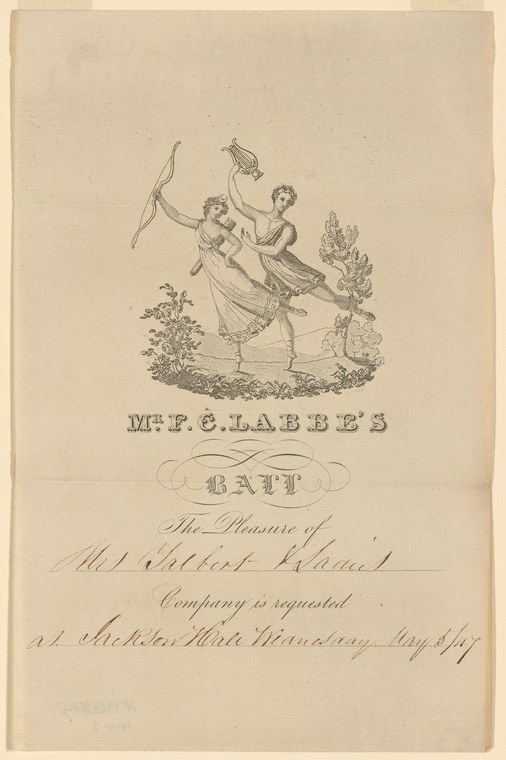
This is a printed invitation to a ball, rendered as an engraving with a decorative vignette at the top. The central image shows two female figures in Regency-era dress, positioned in an elegant pose above a garden setting with flowering plants and foliage. The woman on the left wears a high-waisted gown and holds what appears to be a feathered fan or plume aloft; the woman on the right, similarly dressed, stands in an attitude of grace beside her. Both figures are barefoot or in soft slippers, with their bodies angled to suggest movement or a formal stance. The composition is symmetrical and emblematic rather than narrative—these are not dancers caught mid-step, but allegorical or symbolic figures representing the pleasures of the ball itself. Below the vignette, the text "MR. F. C. LABBE'S BALL" is printed in decorative capitals, followed by "The Pleasure of [Mr. Robert Klaus]' Company is requested at Sticklers Hall Wednesday, May 8th 1817" in flowing script. The entire design is printed on cream-colored paper in black ink.
The dancing
The two figures stand in elegant, upright postures characteristic of Regency deportment. Neither demonstrates active dance technique; instead, they embody the formal grace expected of the period's ballroom attendance. The figure on the left raises her arm in a gesture of presentation or festivity; the other maintains a composed standing position. Their bodies are elongated and idealized in the engraver's manner, and their positioning—facing slightly outward and separated yet balanced—mirrors the symmetry of formal invitation design rather than a snapshot of actual dancing.
The dance depicted
This is not a depiction of a specific dance in progress, but rather an invitation to a ball—a social occasion at which multiple dances (cotillions, quadrilles, country dances, and waltzes) would have been performed. The figures serve a decorative and symbolic function, representing the refined pleasure and feminine grace associated with ballroom assembly. The date (1817) and venue (Sticklers Hall) situate this within the English Regency ballroom tradition. No particular choreography is visible; the work is a social document and printing artifact rather than a record of dance movement.
How it was made
This is a copper-plate engraving, a technique requiring incised lines on metal that were then inked and printed. The precision of the line work, the delicate cross-hatching in the background foliage, and the ornamental script all speak to skilled engraving practice. Engravings were the standard medium for printed invitations and announcements among the English gentry and middle classes of the period, allowing for multiple impressions from a single plate. The survival of this example suggests it was kept as a social memento—a common practice for notable social occasions.
About this work
This is a printed invitation to a ball held by Mr. F. C. Labbe at Sticklers Hall on 8 May 1817, decorated with an engraved vignette of two elegant female figures in Regency dress. It is a social and printing artifact of early 19th-century English ball culture, representing the visual aesthetics and ceremonial formality surrounding ballroom assembly. The work belongs in a gallery of dance imagery because it documents the cultural context in which Regency social dances—waltz, quadrille, cotillion, country dance—were performed and celebrated. Although no active dancing is depicted, the invitation itself is a primary historical artifact of the ballroom world.
How to look at it
Observe the decorative function of the female figures: they are not portraits or action studies, but emblematic representations of ballroom refinement. Note the Regency-era silhouette—the high waistline, the simple drapery, the absence of ornament—which establishes the period and social setting. The engraver's technique is visible in the delicate parallel lines used to model form and the fine detail of the botanical background, which grounds the figures in a cultivated garden setting, evoking the ideal of ballroom pleasure as a refined social ritual.
The artist
The engraver is unknown. The work is a commercial product of the print trade serving the social needs of the gentry and upper-middle classes. Such invitations were often produced by local or London engravers working from designs supplied by hosts or their agents, and they rarely bore the engraver's signature.
The period
The Regency era (roughly 1811–1820) saw a flowering of English ballroom culture and the widespread adoption of Continental dances, particularly the waltz, alongside traditional English country dances and the quadrille. Engraved invitations were the standard means of announcing social events among the genteel classes, and the visual formula—allegorical or symbolic female figures representing pleasure or virtue—was conventional. The refined, elongated proportions of the female figures reflect the aesthetic ideals of the Regency print tradition.
Where it lives
This engraved invitation is held in the New York Public Library's collection of prints depicting dance. It is a social ephemera—a functional object created for a single event but preserved as a keepsake or artifact of a notable occasion.
Dance in this work
Questions about this work
Is this a picture of people actually dancing?
No. This is an engraved invitation to a ball, not a depiction of dancing in progress. The two female figures are allegorical or decorative, representing the refinement and pleasure of the ballroom rather than showing any specific dance step or choreography. Such invitations typically featured stylized, symbolic imagery rather than naturalistic scenes.
What dances would have been performed at Sticklers Hall on this occasion?
At a Regency-era ball in 1817, the program would have included country dances (English quadrilles and cotillions, and possibly waltzes. The waltz had become fashionable in England by this date, though it remained somewhat controversial in conservative circles. The specific dances would have been chosen by the ball's master of ceremonies.
Why did people keep invitations like this?
Engraved invitations were keepsakes and status markers—evidence of one's place in genteel society. Printed on good paper and engraved with skill, they were valued as mementos of significant social occasions and were often preserved in family papers or albums.
Who were Mr. Robert Klaus and Mr. F. C. Labbe?
The invitation is addressed to Robert Klaus and issued by F. C. Labbe, but without additional archival research, little can be said about their identities beyond what the document reveals: they were members of the gentry or professional classes in early 19th-century England, sufficiently established to host and attend formal balls.
More dance artwork





