49 works in this view — arrow keys or swipe to move between them.
Dance in Art
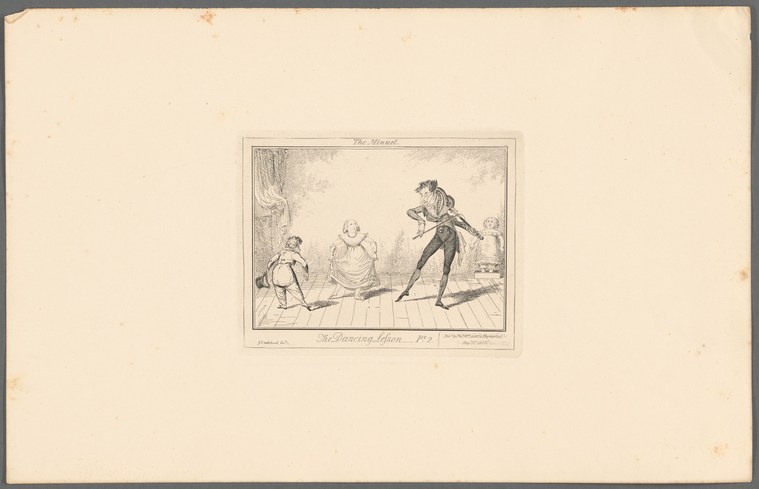
The dancing lesson, pt. 2: The minuet
Unknown artist
- Collection:
- Prints depicting dance
- Source:
- New York Public Library
- Rights:
- Public domain — free to use, share and adapt.
- Recorded as:
- Public Domain
This image documents the minuet at the point of instruction, not performance. For historians and dancers, it provides material evidence of how eighteenth-century dance technique was conveyed, the role of the dancing master, and the formal, attentive postures demanded by one of history's most influential social dances. The engraving's survival as a series suggests sustained interest in dance pedagogy as a subject worthy of visual documentation and circulation.
What you are looking at
An interior scene with wooden flooring depicts a dance lesson in progress. A portly dancing master in dark coat and breeches stands at center-right, gesturing with animated energy toward a student—a young man in light breeches and coat who mirrors his posture. A woman in a long dress with full skirt sits or stands at left, and another figure, possibly another pupil or musician, appears at the far right. The setting is spare, with minimal furnishing and a curtained doorway or alcove at upper left. The engraving uses fine crosshatching to model form and create spatial depth, with careful attention to light and shadow falling across the wooden floor.
The dancing
The dancing master's body is pitched forward in active instruction, one arm extended, weight shifted dynamically—he is demonstrating rather than simply observing. The young male pupil stands in an upright, formal posture opposite him, arms positioned as if beginning to execute steps. His frame is closed, vertical, and controlled. The seated woman watches from the side, her posture attentive. The spatial relationship between master and pupil is frontal and instructional, characteristic of one-to-one or small-group pedagogical demonstration.
The dance depicted
The title identifies this as part two of a dance lesson focused on the minuet. The minuet was the dominant social and theatrical dance of the eighteenth century, performed in court and aristocratic settings. The formal posture of the male pupil, the upright carriage, and the master's demonstrative gesture are consistent with minuet instruction as documented in period dance manuals. The scene captures the pedagogical moment—the transfer of courtly technique from master to student—rather than the performance itself. The minuet's characteristic formality and attention to precise positioning and flow are implied by the careful posture and the formal dress of the participants.
How it was made
This is an engraving, identifiable by the regular parallel lines (hatching and crosshatching) used to create tone, shadow, and texture. The technique allowed fine detail and was well-suited to reproductive circulation; multiple prints could be pulled from the plate. The composition is framed within a simple rectangular border and accompanied by a caption below, suggesting this is a page from a series or instructional manual. Engravings of this kind were produced in significant number in the eighteenth century and distributed to a relatively broad, educated audience interested in dance instruction, manners, and satire.
About this work
This is one plate from a multi-part series on dance instruction, specifically the minuet lesson. The series appears didactic in intent—a visual guide to how dance was taught and learned in the eighteenth century. The work belongs in a dance gallery because it documents not performance but pedagogy: the formal transmission of courtly technique through direct bodily demonstration. The minuet itself was the defining social dance of the period, and images showing how it was taught reveal the status it held and the care invested in mastering its form.
How to look at it
Note the stillness and formality of the pupil's stance—the minuet was not a vigorous dance but one of measured, controlled grace. Observe how the master's body leans forward in active demonstration, suggesting the kind of kinetic teaching common before video: the student learns by watching and mirroring the master's body. The wooden floor beneath them is significant: minuet instruction and performance required sprung flooring that allowed controlled sliding and precise footwork. The simplicity of the setting—no music, no ornament, no audience—emphasizes that this is a working lesson, not a performance.
The period
The minuet dominated European court and aristocratic dance from approximately the 1650s through the 1780s. By the eighteenth century, it had become the emblem of refinement and social status, taught to all children of the gentry and nobility. Parallel with this, a thriving market emerged for dance instruction books, often illustrated, that codified technique and etiquette. Engravings and satirical prints about dance and dancing masters circulated widely in the same period. The minuet's codified steps, positions, and arm placements made it an ideal subject for visual instruction.
Where it lives
Held in the NYPL's Prints Depicting Dance collection. This is a single engraved plate from a numbered series on dance instruction, suggesting it was part of a published work or portfolio on the teaching and practice of dance, likely produced and distributed in the eighteenth century.
Dance in this work
Questions about this work
What is a minuet and why was it important?
The minuet was the principal social and court dance of the seventeenth and eighteenth centuries across Europe. It was the mark of a gentleman or lady—essential to aristocratic education and identity. Unlike modern dances, it was slow, formal, and required precise control. Every step and gesture was codified. To dance a good minuet was to demonstrate refinement, rank, and training.
Why are there multiple parts to this dance lesson?
The series documents different stages or aspects of minuet instruction. Part 2 focuses specifically on the minuet itself; earlier and later parts likely addressed posture, preparation, or more advanced variations. Serialized instruction was common in published dance manuals and broadsheets of the period, allowing learners to progress methodically.
How can I tell this is an engraving and not a drawing or painting?
Engravings are made by incising lines into a metal plate. The printed image shows the characteristic regular parallel lines (hatching) used to create shading and tone. No brush marks or watercolor wash is possible with this technique. The crisp, uniform line work and the way tone is built through systematic cross-hatching are diagnostic of engraving.
What was the role of the dancing master?
The dancing master was a professional instructor and sometimes composer of dances. He held significant status in aristocratic society as a gatekeeper of courtly refinement. Masters not only taught steps but modeled posture, carriage, and the correct interpretation of music. They were often hired for the entire season and expected to teach entire families or court circles.
More dance artwork





