49 works in this view — arrow keys or swipe to move between them.
Dance in Art
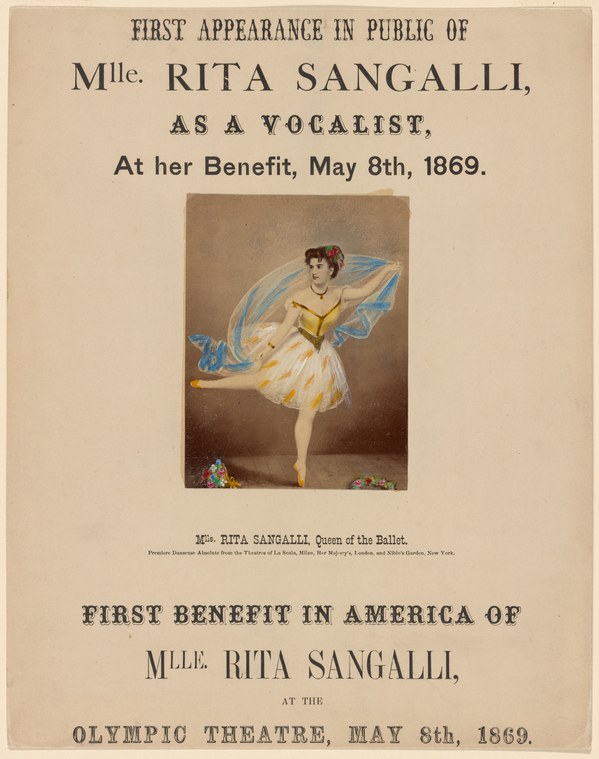
First appearance in public of Mlle. Rita Sangalli, as a vocalist, at her benefit, May 8th, 1869
Unknown artist
- Collection:
- Prints depicting dance
- Source:
- New York Public Library
- Rights:
- Public domain — free to use, share and adapt.
- Recorded as:
- Public Domain
Rita Sangalli was one of the most celebrated ballerinas of the Gilded Age, and this print is direct evidence of her status and the theatrical machinery that built it. The image shows how mid-19th-century New York theaters packaged and sold their star performers, and how balletic training and bearing translated into broader theatrical celebrity beyond dance itself.
What you are looking at
This is a printed benefit announcement for a vocalist's debut performance, illustrated with a hand-colored image of a young woman in pale yellow silk dress with a fitted bodice and full skirt. She stands in an elegant contrapposto pose, one arm raised gracefully above her head, the other at her side. A large blue silk scarf or shawl billows behind and around her body, caught mid-movement. The background is muted brown; at her feet are scattered jewels or ornaments rendered in gold and red. The overall composition presents her as a classical performer—refined, posed for display, and theatrically lit. The entire print functions as publicity material for Mlle. Rita Sangalli's first public appearance as a vocalist at her benefit performance on May 8th, 1869, at the Olympic Theatre, with a notation identifying her as "Queen of the Ballet."
The dancing
A single female figure is depicted in a standing pose rather than active dance movement. Her weight rests on her back leg, creating a slight curve to the torso; her raised arm and the flowing scarf suggest motion or lightness rather than a held step. The pose is classical and balletic in its elegance—the upright carriage, the elongation of the line, the controlled placement of limbs. There is no indication of footwork or weight transfer; this is a portrait pose inflected with dance-like grace rather than a moment of performed movement.
The dance depicted
The image presents a vocalis in a balletic pose, though the context is vocal performance rather than dance per se. However, the notation "Queen of the Ballet" on the print establishes that Sangalli was known primarily as a ballet dancer, and this image uses balletic vocabulary—the elongated line, the classical stance, the theatrical presentation—to frame her as a performer. The theatrical context and balletic grace suggest she was trained in Romantic or Classical ballet, standard training for principal dancers of her era. The image documents not a dance moment but the celebrity persona of a ballet dancer stepping into vocal performance.
How it was made
This is a lithographic print, hand-colored with watercolor or gouache, printed from a photographic or drawn original. The technique allowed for mass production of promotional materials—essential for theater publicity in 1869. The hand-coloring individualizes each print and elevates its presentation above simple black-and-white newsprint. The quality of the color work, particularly in the rendering of the yellow dress and blue scarf, suggests this was produced by a professional theatrical printer serving New York theaters, and the surviving example indicates the high production values of mid-19th-century theatrical promotion.
About this work
This is a printed theater benefit announcement from 1869, illustrating the vocalization debut of Rita Sangalli, a prominent New York ballet dancer of the Gilded Age. The image uses balletic iconography and classical pose to frame her as an elegant performer, whether dancing or singing. It documents the crossover aspirations common among 19th-century theatrical celebrities—dancers who sought to establish themselves as multi-talented performers—and the visual language theaters used to market debuts. The work belongs in a dance archive because it preserves evidence of a major ballet figure's career, her theatrical persona, and the conventions of how dancers were presented to paying audiences in 1860s New York.
How to look at it
Notice the pose: this is not a moment of active dancing but a calculated presentation of a dancer's body at rest. The raised arm, the floating scarf, and the scattered jewels create a sense of theatrical elegance and lightness, but the stance is stable and composed for the viewer's gaze. The hand-coloring—particularly the luminous yellow of the dress and the weightless blue of the scarf—emphasizes the otherworldly, ethereal quality associated with Romantic ballet. This is not a candid image but a flattering idealization, designed to sell tickets.
The artist
The print is unmarked; the artist is unknown. It was produced by a commercial theatrical printing firm in New York or possibly London, as indicated by the printers' mark at bottom (partially legible). Such publicity materials were factory products—designed, printed, and distributed by theater management or commercial publishers working in the entertainment industry.
The period
This announcement dates to the height of the Romantic ballet era in America, when European-trained dancers were the dominant form of theatrical entertainment in major cities. Sangalli was a leading figure in this ecosystem. The print represents the visual culture of theatrical promotion in the 1860s, when lithography had made color reproduction affordable and benefit performances were standard practice—allowing performers to profit directly from their celebrity. The notation of Sangalli as "Queen of the Ballet" reflects the prestige and drawing power of ballet dancers in this era, before other forms of theatrical entertainment fragmented the audience.
Where it lives
This is a printed promotional poster from the New York Public Library's collection of dance-related ephemera. It is one of a vast archive of 19th-century theater publicity materials documenting the celebrity system and commercial machinery of professional dance in America.
Dance in this work
Questions about this work
Was Rita Sangalli a ballerina or a singer?
Sangalli was primarily a ballet dancer, trained in the Classical/Romantic tradition, and one of the most celebrated ballerinas of her era in New York. This print announces her venture into vocal performance—a crossover attempt common among star performers of the period. The notation identifying her as "Queen of the Ballet" on the poster itself confirms her primary reputation was as a dancer.
What is a benefit performance?
A benefit was a theatrical performance organized for the financial benefit of a particular performer or artist. The performer retained a portion of ticket sales, making benefits lucrative and a sign of a performer's drawing power and prestige. In the 19th century, benefits were major events, often featuring the star performer in multiple roles or genres.
Why was this printed?
This was promotional material—a poster or broadside announcing Sangalli's debut vocal performance and directing potential audiences to the Olympic Theatre on the specified date. It would have been distributed to newspapers, displayed in theaters, and mailed or posted publicly to drive ticket sales.
What does the pose tell us about ballet training of this era?
The elongated vertical line, the controlled arm placement, the grace and lightness—all hallmarks of Classical and Romantic ballet—appear in this non-dance pose because they were so fundamental to a ballet dancer's training and public persona. Balletic carriage and movement quality were not confined to performance; they defined how elite dancers presented themselves socially and professionally.
More dance artwork





