49 works in this view — arrow keys or swipe to move between them.
Dance in Art
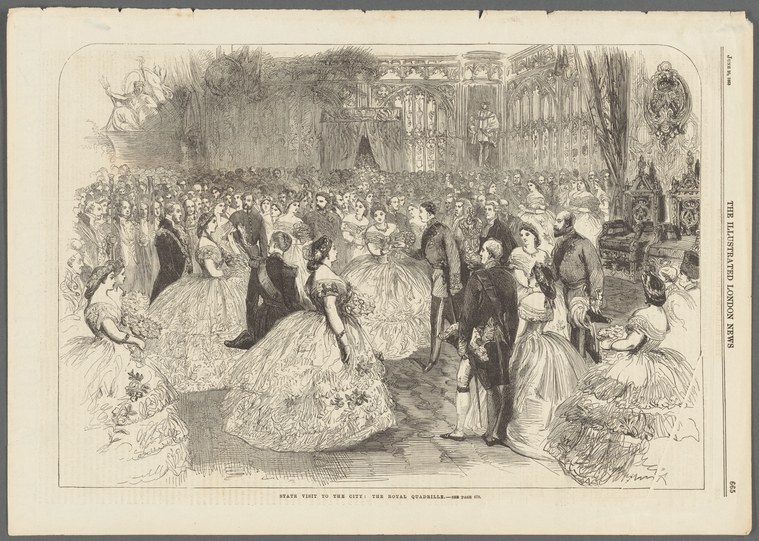
State visit to the City: the royal quadrille
Unknown artist
- Collection:
- Prints depicting dance
- Source:
- New York Public Library
- Rights:
- Public domain — free to use, share and adapt.
- Recorded as:
- Public Domain
The quadrille was the most prestigious ballroom dance of the nineteenth century, and this print documents its appearance at an official state function. For historians of ballroom dance and social dance, the image is invaluable: it shows the actual costume, spacing, and formal arrangement of a quadrille in real practice, and demonstrates how the dance was framed and celebrated by the visual culture of the period. For dancers today, it illustrates the geometric and processional character of quadrille choreography, distinct from the flowing rotational movement of the waltz that would eventually displace it.
What you are looking at
A grand ballroom scene rendered in fine pen-and-ink engraving, crowded with formally dressed figures in mid-nineteenth-century costume. The space is ornate, with draped curtains, decorative architectural elements, and elaborate chandeliers or light fixtures visible at the top of the composition. In the center and foreground, multiple couples are positioned in the formation of a quadrille: women in voluminous ball gowns with full skirts, men in dark tailcoats. The figures are arranged in facing lines and square formations characteristic of quadrille choreography. The perspective draws the eye toward the back of the room where more dancers and spectators fill the space, suggesting this is a formal society ball. The mood is one of controlled elegance and social ceremony; the artist has captured a moment of geometric precision in the dance formation rather than dramatic movement.
The dancing
The dancers are positioned in the closed holds and structured alignments required by quadrille choreography. Couples stand face to face or side by side in four-person squares, with partners' arms positioned for ballroom contact. The women's massive skirts dominate the visual composition, their bell-shaped silhouettes creating a strong vertical rhythm across the image. The men appear stationary or in the moment of forward movement typical of quadrille figures. There is no evidence of the flowing, turning motion that characterizes waltz or free ballroom forms; instead, the bodies are held in the more restrained, processional carriage of formal square-dance positions.
The dance depicted
This depicts a quadrille, the most fashionable and ceremonial ballroom dance of the mid-to-late nineteenth century. The quadrille was a set dance performed by two, three, or four couples arranged in a square formation, with a caller directing the figures. The image captures the social gravity of the ballroom quadrille: this was not improvised partner dancing but a highly codified, formal sequence that required knowledge of specific figures and precision from all participants. The presence of onlookers and the density of formally dressed spectators indicates this is a significant social event—a royal ball or major society function. The title's reference to a 'State visit to the City' and 'Royal Quadrille' confirms the ceremonial and official nature of the occasion.
How it was made
This is a steel or wood engraving, recognizable from the fine parallel hatching lines that create tone and shadow, and the precision of the line work throughout. The technique allowed for sharp detail and high contrast suitable for reproduction in periodicals or expensive gift prints. The density of figures and the complexity of the architectural setting required considerable skill to render without losing clarity. Engravings of this type circulated widely in the nineteenth century as illustrations in newspapers, magazines, and satirical publications, making them important documents of how ballroom dancing was understood and represented to a broad educated public. The fine detail suggests this was either a significant commission or a print designed for middle- to upper-class viewers.
About this work
This engraved scene documents the quadrille, the quintessential ballroom dance of Victorian and Second Empire society. The work captures not just the dance formation but the social ritual surrounding it: the formality of dress, the precision of arrangement, the presence of witnesses and officials, and the geometric clarity that made the quadrille the ideal dance for ceremonies and state occasions. For dancers and historians, it preserves how the quadrille appeared to its own era—not as a folk or vernacular form, but as the height of ballroom etiquette and court performance. The engraving format gave it circulation among educated audiences and placed it in the company of other important contemporary events, confirming the cultural weight the quadrille carried.
How to look at it
Attend first to the formation: notice how the couples are arranged in squares and lines, and how that geometry structures the entire composition. The artist has chosen a moment of static positioning rather than movement, which is appropriate to the quadrille, where much of the dance consists of processional walks and precise changes of place within the square. Look at the density and arrangement of the onlookers—their presence is not accidental but confirms this is a ceremonial occasion, not a private social dance. The elaborate architecture and furnishings, and the uniformity of dress (formal evening wear, no variation in costume), all reinforce that this is a state or court function. Notice how the artist uses the women's skirts to create visual rhythm and spatial clarity; the massive bell-shaped gowns of the 1860s-70s are as much part of the dance picture as the choreography itself.
The period
The quadrille dominated European and American ballrooms from the 1820s through the 1880s, reaching its peak of prestige during the mid-Victorian era and the reign of Napoleon III in France. It was considered the most 'civilized' and 'refined' of ballroom dances, requiring training and social standing to perform correctly. The dance was particularly favored for official and court functions because its geometric structure, set figures, and lack of improvisation made it suitable for large numbers of mixed-ability participants and for public ceremony. By the time this engraving was made, the waltz had become the preferred partner dance for romantic or social occasions, but the quadrille remained the dance of state occasions and formal protocol. The engraving itself reflects the mid-nineteenth-century appetite for documentary images of contemporary social life, particularly the life of the upper classes and court circles.
Where it lives
The work is held in the NYPL Prints collection and is catalogued as a dance-related print. It appears to have been a published engraving, likely from a newspaper or magazine of the period, rather than a unique work. The catalogue record provides the title and general subject but lacks artist attribution, precise date, and technical medium information.
Dance in this work
Questions about this work
What is a quadrille and how is it different from a waltz?
A quadrille is a set dance for two to four couples arranged in a square, with a caller directing specific figures and patterns. The waltz is an improvised partner dance in three-quarter time, emphasizing continuous turning and rotation. The quadrille was more formal, codified, and ceremonial; the waltz was more intimate and emotional. By the late nineteenth century, the waltz had become more popular for social dancing, but the quadrille remained the dance for state occasions and official protocol.
Why would a royal ball feature a quadrille?
The quadrille's geometric precision, set figures, and requirement for trained dancers made it the ideal dance for court ceremony and official functions. Unlike the improvised waltz, the quadrille could be performed correctly by large groups of mixed ability, and its formal structure suited state occasions. It announced rank, training, and social order through its very structure and execution.
How does the costume in this image affect how the dance looks?
The massive crinoline skirts of the 1860s-70s completely transform the visual appearance of ballroom dance. The skirts restrict movement and create a bell-shaped silhouette that moves as a unit rather than following the body's articulation. This favors the walking, processional figures of the quadrille over the continuous turning and close partnering of the waltz, and it affects how dancers could position their bodies and manage space on the floor.
Is there a caller or musician visible in this image?
The engraving does not clearly show a musician or caller, though the density of figures and the formal nature of the scene suggests they would have been present. Quadrilles required a caller to direct the figures and a band to provide music. The artist's focus is on the dancing couples and the social setting rather than the performance apparatus.
More dance artwork





