49 works in this view — arrow keys or swipe to move between them.
Dance in Art
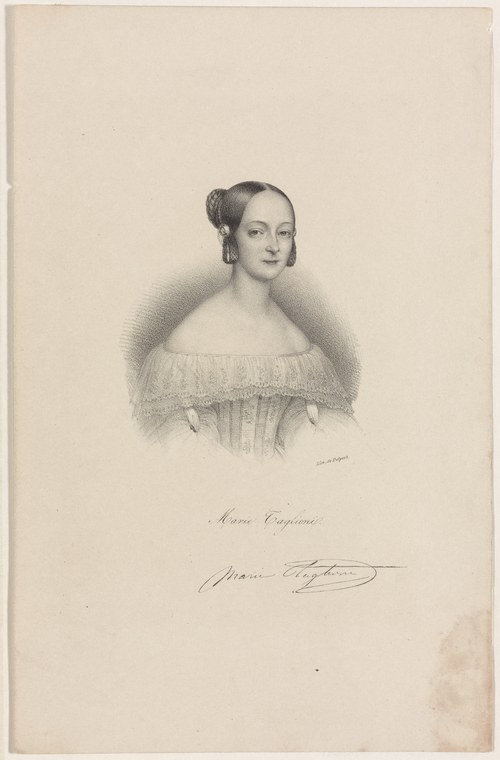
Marie Taglioni [followed by a facsimile signature]
Unknown artist
- Collection:
- Prints depicting dance
- Source:
- New York Public Library
- Rights:
- Public domain — free to use, share and adapt.
- Recorded as:
- Public Domain
Taglioni was the first great international ballet star and effectively invented the Romantic ballerina as an ideal of movement and appearance. This portrait captures not a moment of dance but the cultural mythology surrounding her—the ethereal beauty that audiences associated with her performances. It is essential evidence of how Romantic ballet was understood and marketed in its own time.
What you are looking at
A half-length portrait of a woman in the Romantic era, rendered as an engraving or lithograph. She is shown from approximately the waist up, facing three-quarter right, with her head turned slightly toward the viewer. Her dark hair is arranged in the fashion of the 1830s–1840s, drawn back smoothly and gathered into a knot at the back of the head, with a ringlet or loop of hair visible at the temple. She wears a off-shoulder dress with a deep neckline and a gathered, ruffled chemise or fichu of sheer fabric that drapes across her shoulders and chest, the fabric rendered with fine cross-hatching to suggest lightness and transparency. The background is neutral and fades to shadow around the figure. Below the portrait is the text "Marie Taglioni" followed by what appears to be a facsimile signature. The print employs stippled and hatched toning to create volume and a soft, luminous quality to the face and neck.
The dancing
The sitter's posture is upright and composed, the shoulders held back in an open position. Her expression is calm and turned inward, neither engaging the viewer nor performing for the camera—a portrait convention of the period. The arrangement of the sheer fabric across the shoulders is deliberately graceful, draping in soft folds that frame the figure. There is no visible indication of dance pose or movement; this is a portrait meant to convey elegance and refinement rather than a record of the body in motion.
The dance depicted
Marie Taglioni (1804–1884) was the most celebrated ballerina of the Romantic era and the principal dancer of *La Sylphide* (1832), the work that defined Romantic ballet. This is a portrait engraving, not a depiction of dance in performance, but rather a record of the dancer as a public figure and celebrity. The print documents her as she was known to audiences of the 1830s–1840s: elegant, ethereal, and defined by the balletic aesthetic—the soft drapery, the uplifted posture, the refined features. The image does not show her dancing, but it is inseparable from what her dancing meant.
How it was made
This is an engraving or fine-line lithograph, a reproductive print technique that allowed multiple copies to circulate widely and affordably. The fine cross-hatching and stipple work visible in the rendering of the face and fabric suggest skill in tonal modeling and suggest this was made from a portrait painting or drawing. The technique of the facsimile signature below—printed as if autographed—was common practice in celebrity portraiture of the period and reinforced the sitter's status as a public personality. As a print, this object was circulated to theaters, galleries, and private collectors, making Taglioni's image iconic and recognizable across Europe.
About this work
This is a formal portrait engraving of Marie Taglioni, the dominant figure in Romantic ballet and the creator and first dancer of *La Sylphide*. It dates to her period of greatest fame, likely the 1830s or 1840s, when her image was in high demand. The work is not a record of her dancing but rather of her celebrity status and the visual ideal she embodied—the Romantic ballerina as ethereal, refined, and graceful. It belongs in a gallery of dance in art because it documents how dancers of the era were presented to the public, and because Taglioni's influence on the visual and physical language of ballet cannot be separated from the way she was imagined and reproduced in portraiture.
How to look at it
Look at the way the sheer fabric is rendered—the artist has used delicate cross-hatching to suggest weightlessness and transparency, a visual parallel to the ethereal quality Taglioni brought to the stage. Notice the upright posture and the turned-inward gaze; this is a portrait convention that conveys dignity and refinement rather than theatrical performance. The smooth modeling of the face and the careful attention to hair and drapery reflect the technical skill required of reproductive printmaking and suggest that this portrait was valued enough to warrant careful execution. The facsimile signature positions this as an authorized celebrity image.
The period
The 1830s–1840s were the golden age of Romantic ballet in Europe. Marie Taglioni's debut in *La Sylphide* in 1832 revolutionized ballet by introducing the supernatural sylph—otherworldly, weightless, danced on pointe—as the central character. Her dominance was so complete that she defined the visual and aesthetic language of ballet for a generation. Celebrity portraiture of dancers flourished during this period as lithography and engraving made it possible to reproduce images cheaply and distribute them widely. Theater-goers could purchase prints of their favorite dancers; these images functioned as souvenirs, publicity, and cultural documents. Taglioni's portraits and engravings were among the most sought-after celebrity images of the era.
Where it lives
This print is held in the New York Public Library's collection of prints depicting dance. It is a reproductive engraving or lithograph, likely issued in the 1830s–1840s, when Taglioni's fame was at its height. It is one of many such prints in circulation during the Romantic era.
Dance in this work
Questions about this work
Was this made from a painting?
Very likely. The style and technique suggest it is a reproductive engraving or lithograph based on an earlier portrait painting or drawing. Prints of this kind were made from paintings by portrait artists and then circulated to the public. The original painting, if it survives, may be in a museum or private collection.
Is this Taglioni dancing?
No. This is a portrait, not a performance image. It shows her as a public figure, not in the act of dancing. However, the graceful drapery and refined posture are conventions borrowed from ballet aesthetics, and the image is inseparable from her identity as a dancer.
Why is her signature printed below?
This is a facsimile signature, printed as part of the engraving. It was a common practice in celebrity portraiture of the era to add an autograph-like signature to make the image feel like an authorized or personal gift from the famous person. It increased the portrait's appeal to fans and collectors.
When was this made?
The catalogue does not record a date, but based on the style of dress, hair, and Taglioni's period of greatest fame, it was almost certainly made in the 1830s or 1840s. It may have been issued multiple times or in multiple editions.
More dance artwork





