49 works in this view — arrow keys or swipe to move between them.
Dance in Art
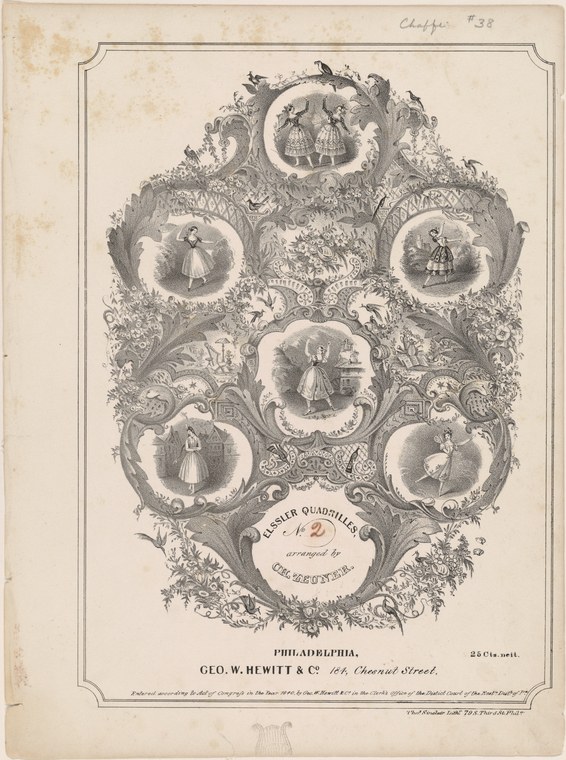
Elssler quadrilles, No. 2 arranged by Ch. Zeuner
Unknown artist
- Collection:
- Prints depicting dance
- Source:
- New York Public Library
- Rights:
- Public domain — free to use, share and adapt.
- Recorded as:
- Public Domain
This print is direct evidence of how a specific, named dance was performed and taught in early 19th-century America. It connects the celebrated international dancer Fanny Elssler to the ballroom culture of ordinary Americans, and it demonstrates how quadrilles—now rarely danced—were documented, packaged, and sold as a commercial commodity. For historians of dance pedagogy, ballroom culture, and women performers, this is a primary source.
What you are looking at
This is a decorative engraving organized as an ornate shield or escutcheon, with elaborate rococo framing composed of scrollwork, foliage, and cherubs. Six oval vignettes are inset within the ornamental border, each depicting a fashionably dressed woman in mid-dance. The central vignette at the top shows two figures; four corner vignettes show single dancers; a sixth vignette occupies the base. The women wear the full skirts, corseted waists, and refined dress of the early 19th century—high-waisted Empire silhouettes with long skirts, some with shawls or cloaks. Each figure is caught in a moment of controlled, elegant movement: some with arms raised, others in turning postures. The composition is symmetrical and hierarchical, suggesting this is a didactic or commemorative print rather than a scene from a stage performance. At the bottom, a cartouche reads "ELSSLER QUADRILLES No. 2 / arranged by / Ch. Zeuner." Below that, publication details identify the printer as "GEO. W. HEWITT & Co. 165 Chestnut Street, PHILADELPHIA."
The dancing
Each figure maintains an upright, ballroom-trained posture characteristic of Regency and early Victorian social dancing. The arms are held at varying heights—some extended gracefully outward, others raised overhead or held at the sides—suggesting the figure positions and arm patterns of quadrille choreography. The women's full skirts are animated by implied motion; several appear to be executing turns or traveling figures across the floor. The positioning of the feet and the overall carriage suggest trained dancers moving through prescribed, geometric patterns rather than improvisational or athletic motion. The figures are isolated in their ovals, each inhabiting their own moment of the dance, which is consistent with a dance suite or demonstration of separate figures.
The dance depicted
This is a print documenting or promoting a quadrille suite, specifically the Elssler Quadrilles No. 2, choreographed and arranged by Charles (Ch.) Zeuner. The quadrille was the dominant ballroom dance of the mid-19th century, performed by two or four couples in a square or rectangular formation, moving through a series of prescribed figures (usually five: *Première*, *Deuxième*, *Troisième*, *Quatrième*, and *Finale*). Fanny Elssler was one of the most celebrated ballet dancers of the 1830s–1840s, and naming a quadrille suite after her suggests either that she danced it or that the choreographer sought to capitalize on her fame. Zeuner's arrangement for this particular quadrille would have specified the music, figures, and steps for amateur dancers and dance masters, making this print a practical instructional object as well as a commercial advertisement.
How it was made
This is a wood or steel engraving, printed from a single plate. The fine lines, careful cross-hatching in the background and ornamental work, and the sharp detail throughout are characteristic of engraving technique, which allowed for mass production and wide circulation in the 19th century. The rococo ornamental frame—with its swirling acanthus leaves, cherubs, and symmetrical scrollwork—suggests a design tradition reaching back to the 18th century, even though the dress and the subject matter are contemporary to the 1830s–1840s. The print was produced in Philadelphia, indicating it was commercially distributed in the United States. Engravings of dance instruction or dance-related music were common during this period, reaching middle-class dance students and music teachers.
About this work
This Philadelphia engraving documents a quadrille choreography by Charles Zeuner, named after the celebrated dancer Fanny Elssler. Quadrilles were the essential social dance of the ballroom in the early 19th century, and prints of this kind—with didactic illustrations of key figures—were distributed to help dance masters, musicians, and ambitious amateurs learn and perform the latest choreographies. The ornate rococo frame elevates what is fundamentally an instructional diagram to the status of a decorative and collectible print, reflecting the cultural prestige of ballroom dancing and the consumer market for dance education in 19th-century America.
The work sits at the intersection of visual culture, dance history, and commercial publishing. It shows how choreography was transmitted, advertised, and consumed; how dancers' names were used to market dances; and how engraving as a technology made fashionable dance accessible to towns and cities far from major ballrooms.
How to look at it
Examine the arm positions and body carriage in each vignette: they show the ballroom deportment and specific positions of the quadrille figures. Notice how each oval isolates a different moment or pose, suggesting these are the key steps or formations a dancer or dance master would need to memorize. The ornamental frame, while decorative, is deliberately *grander* than the subject would strictly require, which was a marketing strategy—framing the quadrille as elegant and cultured. Look at the women's dress: the high-waisted empire silhouette and long skirts indicate the date and the social class of the intended users.
The artist
The engraver is not recorded. Charles (Ch.) Zeuner, credited as the arranger, was likely a composer and dance master working in the early-to-mid 19th century; he is known to have created several quadrille arrangements, though little biographical detail survives. The print was published by Geo. W. Hewitt & Co. in Philadelphia, a commercial printing house. The anonymity of the engraver was typical for commercial prints of the period; the visual and commercial credit belonged to the publisher and the celebrated name (in this case, Elssler) rather than to the craftsperson who executed the plate.
The period
The quadrille reached its peak of popularity in Europe and America between the 1820s and 1860s. Originally a French court dance, it became the dominant ballroom dance for educated and aspirational middle-class couples, displacing the cotillion and the country dance. The Regency and early Victorian periods saw an explosion of published dance instruction, including engravings, lithographs, and printed instruction manuals. Fanny Elssler was at the height of her international fame in the 1830s–1840s, performing primarily in theatrical ballet but also in theatrical versions of social dances; her name on a quadrille would have been a strong commercial draw. Engraving was the primary technology for mass-producing dance instruction during this period, and Philadelphia was an active center of printing and publishing in the early United States.
Where it lives
The print is held by the New York Public Library in its collection of prints depicting dance. It was produced and published in Philadelphia by Geo. W. Hewitt & Co., a commercial printing business, suggesting it was distributed for sale to music teachers, dance masters, and amateur dancers in the United States.
Dance in this work
Questions about this work
What is a quadrille, and why was it so important?
A quadrille is a ballroom dance for two or four couples, organized in a square formation, moving through five standard figures set to music. It was the dominant social dance of the ballroom from the 1820s through the 1860s—as essential to 19th-century social dancing as the waltz became later. Learning quadrilles was part of a young person's education in manners and social accomplishment.
Who was Fanny Elssler, and why is a quadrille named after her?
Fanny Elssler (1810–1884) was an Austrian-Italian ballet dancer and one of the most celebrated performers of the Romantic era, famous for her dramatic roles and her Spanish dances. Naming a quadrille after her was a commercial strategy: it capitalized on her international fame and prestige to market the dance to amateur performers and to lend authority to Zeuner's arrangement.
How would this print have been used?
Dance masters and musicians would have purchased prints like this to learn new choreographies and to teach their students. The sequential figures in the ovals showed the key poses and arm positions; the title and composer's name made the choreography identifiable and authoritative. It functioned as both advertisement and instructional manual.
What technique was used to make this print?
This is an engraving, made by incising lines into a steel or copper plate and then inking and printing the plate. Engraving allowed for fine detail, precise reproduction, and relatively easy mass production—making it the ideal technology for publishing and distributing dance instruction before photography.
More dance artwork





