49 works in this view — arrow keys or swipe to move between them.
Dance in Art
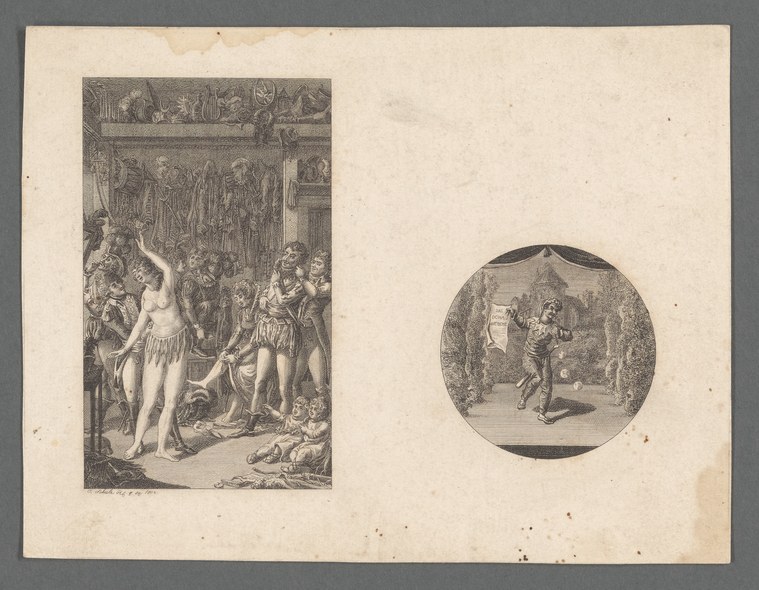
At left, actresses and their admirers in a dressing room; at right, Harlequin on stage
Unknown artist
- Collection:
- Prints depicting dance
- Source:
- New York Public Library
- Rights:
- Public domain — free to use, share and adapt.
- Recorded as:
- Public Domain
The print captures a historically crucial moment when European theater was divided between two competing models of the performer's body: the classical ideal inherited from antiquity and revived during the Renaissance, and the vernacular, physically inventive traditions of commedia dell'arte. For dance historians, the image documents how these physical ideologies were understood and represented, and how prints functioned as a medium for disseminating knowledge of performance styles. The work shows that even in the early modern period, theatrical 'types' were recognized and codified through visual representation.
What you are looking at
This print presents two distinct theatrical scenes on a single sheet. At left, a crowded interior depicts actresses or performers in a dressing room, surrounded by admirers, attendants, and supplicants. The space is richly detailed with architectural elements—columns, a coffered ceiling, doorways—and densely populated with figures in various states of interaction: some kneeling, some standing in attitudes of deference or conversation, others attending to the central female figure who stands nearly nude or in classical drapery. The composition is vertically organized, with the principal figure elevated and the crowd arranged in tiered groups around her. At right, in a circular vignette, Harlequin appears alone or with a single companion in a more austere setting, posed in the characteristic attitude of commedia dell'arte—a contrasting moment of solitary or intimate action against the theatrical bustle of the dressing room. The print's division into these two scenes suggests a narrative or thematic relationship between backstage reality and staged performance.
The dancing
The left scene centers on a standing female figure in classical or near-classical undress, her body upright and composed, arms gesturing with theatrical poise to the figures around her. Her pose suggests the formal bearing taught in neoclassical dance and pantomime. The surrounding figures are in various poses of obeisance, attention, or service—some bent, some kneeling, creating a pyramidal composition with the central figure as apex. On the right, Harlequin adopts the bent-knee, splayed-leg stance characteristic of commedia dell'arte physical comedy, a posture entirely opposed to the classical verticality of the actress. The contrast between the two figures' bodies encodes a distinction between theatrical genres.
The dance depicted
The left panel depicts a scene of theatrical dressing-room life rather than staged dance per se, but the central figure's pose and the formal arrangement of attendants around her recalls the conventions of neoclassical pantomime and the presentation of the actor-dancer as a sculptural or statuesque performer. The classical drapery and upright bearing suggest the influence of ancient statuary on Renaissance and early modern theatrical performance. Harlequin's appearance on the right represents the opposing tradition of comic, physically exuberant commedia dell'arte, in which the body was bent, contorted, and given to acrobatic or tumbling action rather than classical restraint. The print may be documenting or satirizing the contrast between these two theatrical modes.
How it was made
This is an engraving, recognizable by its fine hatched lines, sharp contrasts of light and dark, and the characteristic formal precision of the medium. Engravings circulated widely in Renaissance and early modern Europe as prints, reproduced from a single copper plate and distributed to collectors, scholars, and theater-goers. The technique allowed for fine detail and tonal nuance, supporting the elaborate architectural setting and the individual characterization of figures. The subject matter—theatrical life and commedia dell'arte—suggests this was created for an educated urban audience familiar with both classical theatrical revival and popular street performance.
About this work
This engraved print documents two modes of theatrical performance in Renaissance or early modern Europe. The dressing-room scene at left, crowded with admirers and servants attending a classically posed actress or performer, represents the world of refined, statuary-influenced neoclassical theater. The circular vignette of Harlequin at right represents the opposing tradition of commedia dell'arte, with its bent postures and comic physicality. Together, the two scenes stage a visual argument about the nature of theatrical bodies and performance: the actor as classical sculpture versus the actor as acrobatic buffoon. The print is part of a long tradition of theatrical satire and documentation that used prints to circulate knowledge of performance practices to a wider audience than any single performance could reach.
How to look at it
Attend to the posture and bearing of the two central figures: the vertical, dignified stance of the actress in the left scene, echoing classical sculpture and the ideals of neoclassical performance; and the bent, physically exuberant pose of Harlequin on the right. Notice how the dressing-room scene is crowded, architecturally complex, and filled with narrative incident, while the Harlequin vignette is stripped down and isolated. The print's division of the sheet into these two contrasting moments invites comparison: it asks you to think about what each figure's body communicates about theatrical value, skill, and legitimacy. The formal precision of the engraving technique itself—its fine lines and careful tonal gradations—mirrors the classical restraint of the actress, while the caricatural simplicity of Harlequin suggests the popular, vernacular nature of commedia dell'arte.
The period
This print dates to the sixteenth or seventeenth century, a period of intense theatrical innovation in Europe. The Renaissance revival of classical texts and aesthetics produced a theatrical tradition centered on formal gesture, symmetry, and the dignified body—visible in court spectacles, intermezzi, and early opera. Commedia dell'arte emerged in Italy and spread across Europe during the same period, offering a radically different physical vocabulary rooted in improvisation, acrobatics, and satirical comedy. Both traditions coexisted, often competed, and were sometimes combined. Prints were a crucial medium for documenting and debating these performance modes, circulating images of actors and actresses to readers who might never attend a live performance. The theatrical print became a genre of its own, serving as a visual record of performance practice and a tool for thinking about the nature of acting.
Where it lives
The print is held in the New York Public Library's collection of prints depicting dance. It is catalogued as depicting theatrical performance and commedia dell'arte, but lacks detailed information on its artist, date, or medium in the current record.
Dance in this work
Questions about this work
What is the relationship between the two scenes?
The print presents two contrasting modes of early modern European theater side by side. The left scene shows the world of neoclassical, court-influenced performance centered on formal beauty and classical ideals. The right scene shows commedia dell'arte, a popular tradition of improvised comic theater with a radically different physical vocabulary. Together, they document a historical moment when European theater was divided between elite and popular forms, each with its own ideals of the theatrical body.
Is this depicting an actual dance?
Not a specific dance in the modern sense, but rather theatrical performance and gesture in the broadest sense. The classical actress's pose represents the formalized, dance-like movement associated with neoclassical theater and early opera. Harlequin's bent posture represents the physical comedy of commedia dell'arte, which incorporated acrobatics and tumbling. For early modern performers, the distinction between 'dance,' 'acting,' and 'gesture' was not fixed, and all three were understood as skilled bodily practice.
What was commedia dell'arte?
Commedia dell'arte was a form of improvisational theater that emerged in Italy in the sixteenth century and spread across Europe. It featured stock characters like Harlequin, Arlecchino, Pantalone, and the lovers, each with recognizable costumes, masks, and physical vocabularies. Harlequin was typically a witty, acrobatic servant character whose body was bent, twisted, and given to rapid, comic movement—the physical opposite of the dignified classical performer. Commedia troupes performed in public spaces and at court, making them one of the most widely circulated and influential performance traditions of the early modern period.
How does this print show the difference between performance traditions?
The print uses posture and setting to visualize the ideological divide between classical and popular theater. The left figure stands upright, framed by architecture and surrounded by an orderly, if crowded, interior space; her body echoes classical sculpture. Harlequin is isolated, his body bent and contorted, his setting bare and simple. The engraving's formal precision in depicting the classical scene contrasts with the caricatural simplicity of Harlequin, suggesting different artistic values and audiences for each tradition.
More dance artwork





