49 works in this view — arrow keys or swipe to move between them.
Dance in Art
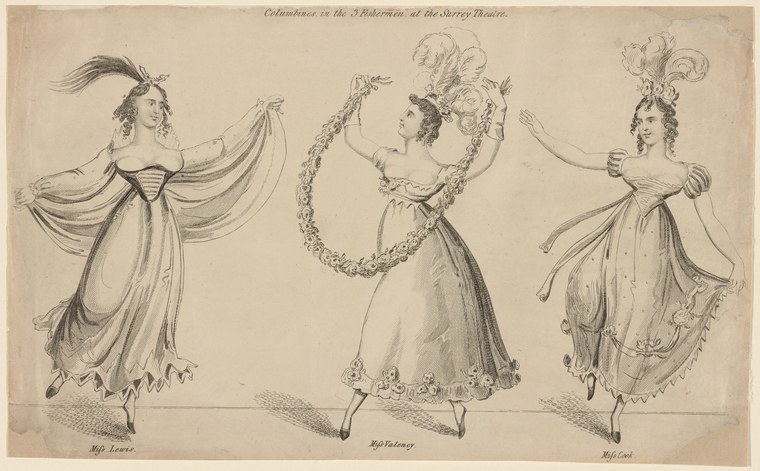
Columbines in the Three Fishermen at the Surrey Theatre
Unknown artist
- Collection:
- Prints depicting dance
- Source:
- New York Public Library
- Rights:
- Public domain — free to use, share and adapt.
- Recorded as:
- Public Domain
This is direct documentary evidence of English theatrical dance in the Regency era—showing not a composed or idealized image, but a record of actual performers, named, in an actual production. The image reveals how theatrical dance in this period was organized around costume and spectacle, and specifically how the female dancer was presented: as a decorated, posed figure in ensemble display rather than as a soloist demonstrating technical prowess.
What you are looking at
Three female figures in theatrical costume are arranged across the composition in a moment of exuberant gestural display. Each wears a Regency-era high-waisted muslin dress with short sleeves and a corseted bodice, the silhouettes fashionable around 1800–1820. All three sport elaborate feathered headdresses with tall ostrich plumes and ornamental curls. The leftmost figure (labeled "Miss Lemore") extends her arms outward in a broad, wings-like gesture, her drapery lifted behind her. The central figure (labeled "Miss Daloony") holds aloft an elaborate garland or wreath of flowers above her head with both hands, her body angled in a three-quarter pose. The rightmost figure (labeled "Miss Cook") stands in a similar stance to the left, with drapery floating around her legs and arm raised in a sweeping arc. The three are set on a simple ground line with no other setting indicated; the focus is entirely on their silhouettes and the fluid, floating quality of their garments. The engraving technique creates sharp, decisive lines that emphasize the swirl of skirts and the ornamental detail of dress and headdress.
The dancing
Each figure stands in a relatively upright, posed position rather than in active step-work. Their arms are extended and raised—one pair spread wide, one pair lifted vertically with an object, one pair sweeping. The weight appears grounded and stable, with no indication of springing or elevation. The gestural quality is balletic in its extension and line, with the long, straight arms and lifted port de bras. The emphasis is on the display of the draped skirts and the decorative elements of costume rather than on the footwork or dynamic transfer of weight.
The dance depicted
The inscription identifies this as depicting "Columbines in the Three Fishermen at the Surrey Theatre." The Columbine was a stock character in pantomime and theatrical spectacle of the early 19th century—a witty, agile female figure often partnered with Harlequin. The title suggests this is a scene from a specific theatrical production at the Surrey Theatre in London, a venue known for spectacular pantomimes and burlesque entertainments. The three figures are likely meant to represent a trio of Columbines in an ensemble display, emphasizing their decorative and theatrical presence rather than their narrative or acrobatic action. The dress and headdress, the posed gestures, and the theatrical context all point to English theatrical dance of the Regency era—not classical ballet technique, but the spectacular, costume-driven theatrical dance of pantomime and burlesque.
How it was made
This is a hand-colored or watercolor engraving, executed with fine cross-hatching and linear detail. The medium allowed for crisp definition of the drapery and ornamental detail, and the addition of color (visible in the shading and tonal variation) enriches the costume information. The small format and precision of the line suggest this was a print made for circulation among theatre-goers or collectors of theatrical imagery—the kind of souvenir or record that documented a specific performance or performer. The inclusion of the performers' names labels it as a portrait-document of an actual production.
About this work
This is a theatrical print documenting three performers in a specific pantomime production at a London theatre in the early 19th century. The work captures the spectacular, costume-driven aesthetic of Regency-era stage dance—emphasized through the display of fashionable dress, ornamental headdresses, and decorative gesture rather than through displayed technique or narrative action. It is an artifact of the theatrical culture in which pantomime and theatrical spectacle were dominant forms of dance performance in England, and in which the female dancer was defined as much by costume and ornamentation as by bodily virtuosity.
As a record of a specific performance moment by named dancers, it belongs to the documentary tradition of theatrical prints—a form that served both as publicity and as memory of live performance. The inscription ties the image to a particular venue and production, making it valuable evidence for theatre history and the social presence of dance in early 19th-century London.
How to look at it
Attend to the stillness and posed quality of the figures: this is not a moment of action or transition, but a tableau of display. Notice how the artist used line and shading to create the illusion of floating, billowing drapery—a Regency fashion detail that also served theatrical effect. The raised arms and extended gestures are graceful but do not suggest the springing or turnout of later ballet training. Look at how the three figures are nearly identical in pose and costume; they are presented as an ensemble spectacle, not as individuals with distinct roles.
The artist
The artist is not recorded. The style and technique suggest an established theatrical print-maker or engraver working in the London theatre world of the early 1800s, producing the kind of documentary and promotional imagery that circulated among playgoers and theatre collectors.
The period
The early 19th century saw the rise of theatrical spectacle and pantomime as dominant forms of entertainment in London. The Surrey Theatre, opened in 1782, was a major venue for these productions. This was the era immediately preceding the rise of Romantic ballet in the 1830s—a period in which theatrical dance in England was dominated by costume, ensemble display, and narrative pantomime rather than by pure technique or the pointe-work that would come to define ballet. The fashion evident in the dress dates the print to c. 1800–1820, placing it in the Regency period proper. Female performers in theatre were celebrated partly for their beauty, costume sense, and ornamentation, reflected here in the elaborate headdresses and the emphasis on the silhouette and drape of the skirt.
Where it lives
The work comes from the New York Public Library's collection of prints depicting dance. It is catalogued as a theatrical print documenting a specific production, but no further provenance information is recorded.
Dance in this work
Questions about this work
What was a Columbine?
Columbine was a stock character in pantomime, derived from the commedia dell'arte tradition. In English pantomime of the early 19th century, Columbines were witty, agile female characters often dressed in fashionable contemporary costume and ornamented with elaborate headdresses. They were frequently presented in ensemble numbers emphasizing spectacle and costume.
What was the Surrey Theatre?
The Surrey Theatre was a major London playhouse opened in 1782, located on the south bank of the Thames. It was known for producing elaborate pantomimes, burlesque entertainments, and spectacular theatrical productions. It was one of the primary venues for theatrical dance in the early 19th century.
How does this differ from ballet?
This is theatrical pantomime dance, not classical ballet. There is no evidence of turnout, pointe work, or the specific technical vocabulary of ballet training. Instead, the emphasis is on posed gesture, costume display, and narrative pantomime. Classical ballet technique was just beginning to develop in France and Italy during this period and had not yet become dominant in English theatre.
More dance artwork





