49 works in this view — arrow keys or swipe to move between them.
Dance in Art
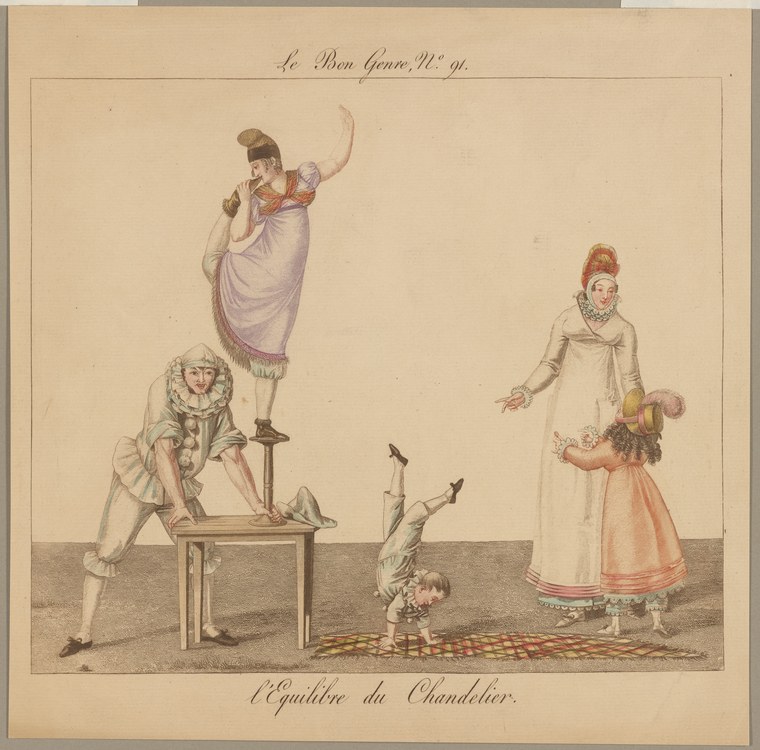
L'Equilibre du chandelier
Unknown artist
- Collection:
- Prints depicting dance
- Source:
- New York Public Library
- Rights:
- Public domain — free to use, share and adapt.
- Recorded as:
- Public Domain
This image documents a vanished form of theatrical acrobatics and the training methods that preceded modern dance. For historians of performance, it reveals the vocabulary of bodily spectacle available to 18th-century audiences and the technical demands placed on professional performers of the period. For acro-dancers and circus artists today, it offers evidence of historical precedent for their own practice of extreme flexibility and partnered balance.
What you are looking at
A hand-colored engraving shows a theatrical acrobatic performance titled "L'Equilibre du Chandelier" (The Chandelier Balance). At stage center, a male acrobat in a draped purple-pink garment performs an extreme inverted balance atop a wooden table, his body arched backward with legs extended vertically and one arm gesturing expressively. A second male performer, dressed in a pale tunic with fur collar, steadies the table from below, his body angled to provide support. To the right stands an elegantly dressed woman in a high-waisted white gown with coral-pink skirt, reddish hair styled high, and a decorative collar; she gestures toward the acrobat with an expression of wonder or encouragement. A small child in simple dress crouches or plays on the floor. The setting is minimal—a plain stage floor rendered in brown wash—which focuses all attention on the precarious human feat. The composition emphasizes the extreme flexibility and control demanded of the performer.
The dancing
The central acrobat demonstrates extreme dorsal flexibility, achieving a deep backbend with legs fully extended upward in a vertical line, requiring extraordinary core strength and spinal mobility. His arms are positioned expressively rather than for balance, suggesting this is a performance skill rather than gymnastics proper. The supporting performer maintains a grounded, wide-legged stance with bent knees, his role clearly to stabilize the apparatus. The elegantly dressed woman and child are witnesses or participants in the spectacle—their presence and her gestural response frame this as a social or theatrical event rather than a private feat.
The dance depicted
This is not a dance in the traditional sense but rather acrobatic theater of the late 18th or early 19th century—a form of spectacular bodily performance that shared venues and audiences with dance. The extreme flexibility required (particularly the dorsal arch) suggests training in contortionism or partner acrobatics (adagio). The theatrical context, elegant dress of the witnesses, and formal staging indicate this was a professional entertainment, likely performed at court, in a salon, or in a public theater. The title references the chandelier-like visual form created by the inverted body position.
How it was made
This is a hand-colored engraving, a reproductive print technique that allowed mass distribution of theatrical imagery. The fineness of the line work and the delicate hand coloring in pastels—particularly the subtle modeling of flesh tones and the layered gauze fabrics—indicate high-quality production aimed at an educated, moneyed audience. The technique allowed the composition to be widely circulated, making this a document of fashionable entertainment and theatrical innovation available beyond those who witnessed live performance. The NYPL catalogues this as a print in its dance collection, suggesting it was acquired and preserved as evidence of performance practice.
About this work
This engraving documents a moment of extraordinary bodily control presented as theatrical spectacle in the late 18th or early 19th century. The acrobatic 'chandelier balance' combines extreme flexibility, partnership, and staged presentation in a form that existed at the boundary between dance, acrobatics, and circus entertainment. It shows how the period's fascination with the body's physical limits found expression in public performance, and how such performances were preserved and circulated through the print market. The image is evidence of an entertainment form now largely displaced by modern acro-dance and circus arts, but it reveals continuities in how performers use extreme positions to astound and delight audiences.
How to look at it
Watch the line of the acrobat's body: the artist has captured the exact moment of maximum extension and vulnerability, with the torso fully inverted and supported only by the partner's grip and the table. Notice how the woman's gesture and the child's presence transform what could be a purely technical feat into a moment of social theater—this is not a strength display but an entertainment, shared and witnessed. The elegance of the supporting players' dress and their spatial distance from the acrobat frame this as a fashionable leisure activity, a performance for people of leisure and cultivation.
The period
The late 18th and early 19th centuries saw explosive growth in theatrical entertainment outside court ballet, including acrobatics, pantomime, and specialty acts. Public theaters competed for audiences by featuring ever more daring physical feats. The popularity of such spectacles reflected both Enlightenment fascination with the body's mechanical and physiological capacities and the emerging market for commercial entertainment. Hand-colored engravings of famous performers and celebrated acts were a primary form of theatrical publicity and souvenir, allowing audiences to commemorate remarkable performances and performers to establish their reputations beyond the cities in which they performed.
Where it lives
This print is held in the NYPL's collection of prints depicting dance, suggesting it was acquired as documentary evidence of performance practice rather than as fine art. The catalogue entry provides no artist, date, or publication information, indicating it entered the collection as an anonymous historical document.
Dance in this work
Questions about this work
Is this actually a dance?
Not in the modern sense, but in the 18th century the boundary between dance, acrobatics, and theatrical spectacle was fluid. This would have been performed in the same venues and by trained theatrical performers, often alongside dances. Modern acro-dance and partner acrobatics (adagio) are direct descendants of such entertainment.
How did they train for this?
The extreme flexibility required—particularly the dorsal arch—would have been developed through years of systematic training, likely in theatrical families or specialized schools. Such training often began in childhood and combined stretching, partner work, and rehearsal of specific 'attitudes' or positions that audiences had come to expect.
What does 'chandelier' mean here?
The inverted body position creates a silhouette resembling a hanging chandelier, with the legs extended upward like candles or arms. The title is purely visual and descriptive, naming the position by the domestic object it resembles.
Who performed this?
The print does not identify the performers, but such acts were typically professional entertainers—often members of traveling troupes or contracted performers in major theaters. The elegance of the setting and dress suggests this was a high-status entertainment, likely performed for aristocratic or upper-middle-class audiences.
More dance artwork





