49 works in this view — arrow keys or swipe to move between them.
Dance in Art
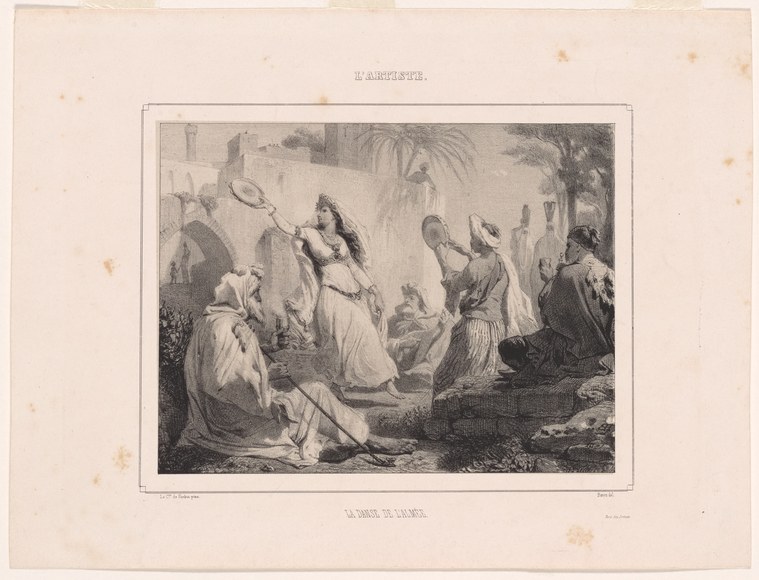
La danse de l'Almée
Unknown artist
- Collection:
- Prints depicting dance
- Source:
- New York Public Library
- Rights:
- Public domain — free to use, share and adapt.
- Recorded as:
- Public Domain
The almée became a stock figure of orientalist fantasy across European art, literature, and theater, shaping how generations understood—or misunderstood—Middle Eastern dance. This print reveals the machinery of that fantasy: how prints circulated exoticized imagery, how theatrical convention shaped perception, and how the female dancer's body became a canvas for European desire and imagination.
What you are looking at
A theatrical scene set in an orientalizing interior, likely North African or Middle Eastern based on the palm fronds and architectural details visible at right. A central female figure in white drapery performs an energetic dance, arms raised and body twisted, while seven other figures—some seated, some standing—watch or participate. The women wear flowing white garments and head coverings in period-romantic style rather than ethnographic accuracy. The lighting is theatrical, with strong contrasts that suggest gaslight or candlelight. The composition is crowded and dynamic, with the dancing figure dominating the center; the onlookers are arranged in a loose semicircle, some clapping or gesturing in encouragement. The mood is one of spectacle and entertainment, a European fantasy of exotic leisure rather than a documentary record.
The dancing
The central dancer stands with her body arched backward, arms raised high and slightly back, one leg extended or shifted, conveying rapid rotational or undulating movement. Her posture suggests hip-driven or torso-led motion rather than the rigid frame of ballet. The surrounding figures are mostly static; some sit cross-legged or reclined, others stand with arms raised in gestures of enthusiasm or applause. The relative stillness of the audience emphasizes the dancer's solo performance and the spectatorial nature of the occasion.
The dance depicted
The title *La danse de l'Almée* names the almée (or almah), a professional female dancer in Egypt and the Levant, typically performing for mixed audiences in public or private contexts. The romantic-era European imagination transformed this into a symbol of oriental sensuality and exoticism. The image shows a solo female performer in what was marketed to European audiences as an 'almée dance,' though the actual choreography and technique are not documented here—only a theatrical approximation. The costume and setting are romanticized rather than authentic; the pose suggests belly dance or similar torso-centered movement, but filtered through European theatrical conventions.
How it was made
This is an engraving or etching on paper, characterized by fine parallel lines and cross-hatching to create tone and shadow. The technique allows for precise detail in drapery and facial features while maintaining the fluid, atmospheric quality necessary for theatrical effect. The regular distribution of the image on the page and the formal border suggest publication in a periodical or portfolio. The medium's ease of reproduction and relatively low cost made such works accessible to a broad middle-class audience interested in travel, exoticism, and theatrical spectacle.
About this work
This is a nineteenth-century European engraving depicting the almée, a professional female dancer of the eastern Mediterranean, reimagined as an exotic theatrical performance. The work belongs to a substantial visual tradition of orientalist entertainment imagery that circulated widely through prints and illustrated journals. It captures not an actual dance practice but a European fantasy of oriental leisure and female performance—a spectacle designed for consumption by European audiences hungry for images of distant lands. The work is valuable not as ethnographic evidence but as a document of how nineteenth-century European culture imagined, exoticized, and packaged non-European dance for theatrical and commercial purposes.
How to look at it
Notice the contrast between the dynamic central figure and the static or gesture-only onlookers: the artist is not showing a participatory social dance but a solo performance designed for observation. Examine the costume carefully—the flowing white drapery and European-style headdressing are theatrical conventions, not documentary costume. The raised arms and arched torso suggest a moment of peak energy or ecstasy, the kind of dramatic climax European audiences expected from theatrical spectacle. The setting, with its palm fronds and architectural hints, is a painted or stage set rather than a location, emphasizing that this is a performed fantasy rather than a glimpse of actual practice.
The period
The nineteenth century saw an explosion of interest in oriental subjects across European visual culture, driven by colonial expansion, travel narratives, and the success of orientalist painting. The almée became fashionable in European entertainment around the 1830s-1850s, featured in popular theater, circus, and dance performances marketed as 'authentic' spectacles of the Orient. Simultaneously, the rise of illustrated journals and mass-produced engravings democratized access to such imagery, allowing middle-class audiences to consume exotic performance without leaving home. The romantic era's taste for dramatic gesture and emotional intensity shaped how European artists depicted non-European dance, emphasizing dynamic movement and sensuality over any ethnographic accuracy.
Where it lives
The work is held in the New York Public Library's collection of prints depicting dance. It is a mass-produced engraving, likely from a periodical, portfolio, or commercial print series circulated in the nineteenth century.
Dance in this work
Questions about this work
Was this how almées actually danced?
No. This is a European theatrical interpretation shaped by romantic-era conventions about female performance and oriental exoticism. Actual almée dances varied by region and context; they included both participatory social forms and professional solo performance. This image shows what European audiences wanted to see—drama, sensuality, exotic spectacle—rather than ethnographic documentation.
Why did Europeans become obsessed with the almée?
The almée fit perfectly into nineteenth-century orientalism: she was female, foreign, and associated with leisure and pleasure in an imagined 'East.' Travel narratives, paintings by orientalist artists, and theatrical productions all circulated and reinforced the image. Prints like this one made the fantasy accessible and affordable to the European middle class.
Is this belly dance?
The image shows movement that could be described as belly dance or a related torso-centered form, but mediated through European theatrical convention. The term 'belly dance' itself is a twentieth-century English label. Nineteenth-century Europeans would have called this an 'almée dance' or simply 'oriental dancing,' though it bore only loose relation to actual practice.
More dance artwork





