49 works in this view — arrow keys or swipe to move between them.
Dance in Art
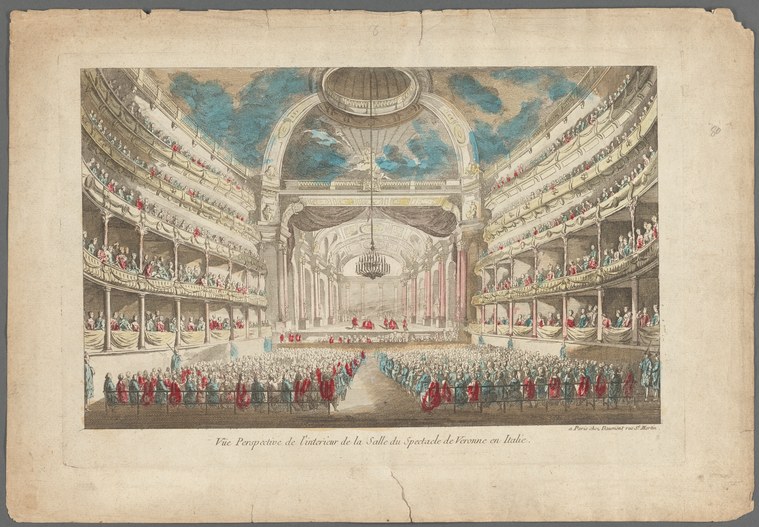
Vue perspective de l'interieur de la salle du spectacle de Veronne en Italie
Unknown artist
- Collection:
- Prints depicting dance
- Source:
- New York Public Library
- Rights:
- Public domain — free to use, share and adapt.
- Recorded as:
- Public Domain
The image is a primary document of 18th-century Italian theatrical practice, showing how court spectacles were staged, organized, and experienced in purpose-built auditoria. For historians of dance, it demonstrates that not all theatrical performance was narrative ballet; much consisted of processional, formal, and massed movement. The architectural record also shows the conditions under which dancers performed—the sightlines, the stage depth, the relationship between stage and audience—which shaped what kinds of movement were visible and effective.
What you are looking at
This is a perspectival view of an interior theater during a spectacle or performance, likely the Teatro Filarmonico or similar 18th-century Italian opera house. The vast elliptical auditorium is packed with spectators arranged in multiple tiers of gallery boxes that curve around the walls and rise toward an ornate domed ceiling with sky-painted vault. The stage at the far end is deep and austere, occupied by massed figures in red and white costumes arranged in formal blocks or processions. The architecture is classical: paired columns, arched openings, and elaborate decorative moldings in white stone frame every tier. Light from above emphasizes the shallow stage and illuminates the assembled crowd. The effect is one of enormous scale and organizational precision—every box filled, every figure placed—capturing a moment of civic or ceremonial performance before a full house.
The dancing
The figures on stage are arranged in two large corps-de-ballet-like groups, one in red costume and one in white, standing in formal procession or ranks rather than in active dance movement. They are upright, frontal, and static—not engaged in partnering, turns, or elevation. The spectators in the boxes are shown standing and watching, creating a frame-within-frame effect. The overall composition emphasizes pageantry and massed formation rather than individual dancer technique or partnering work. The scale of the auditorium dominates the human figures, making the spectacle itself the subject rather than the virtuosity of the dancers.
The dance depicted
This appears to document a court spectacle or state performance rather than narrative ballet or social dance. The formal arrangement of costumed figures, the architectural grandeur, and the assembled aristocratic audience suggest a ceremonial or allegorical entertainment of the sort common in 18th-century Italian theaters. The costume (red and white uniforms or livery) and the processional formation indicate this is likely a professional theatrical company or state performers rather than amateur courtiers. The work may depict a specific documented performance or a type of spectacle, but the printed source and inscribed French title suggest it was circulated as a record of an actual event or building, not a fictional scene. Without more specific historical context, the dance content cannot be confidely identified beyond 'formal court or state spectacle.'
How it was made
This is a hand-colored engraving or etching, recognizable from the fine line work, the perspective construction, and the pastel coloring applied by hand after printing. The technique allowed for exact architectural perspective, which is the work's primary visual achievement—the vanishing-point construction draws the eye deep into the theater space. Such prints were produced in series and sold to a broad audience of educated European collectors, nobles, and theater enthusiasts. The colored hand-coloring suggests this was a higher-quality, more expensive impression, likely owned by someone of means. The production demonstrates both technical mastery and commercial intent: it is a reproducible record of a real (or idealized) building and event, designed to circulate knowledge of Italian theatrical sophistication.
About this work
This is a perspectival engraving of the interior of an 18th-century Italian theater during a grand spectacle, showing the building's architecture and the arrangement of performers and audience in anatomical precision. The dance content—massed figures in formal ranks and procession—is secondary to the architectural and social spectacle. The work belongs in a dance gallery because it documents how dance and spectacle were integrated into civic space, how bodies were arranged and displayed in theatrical contexts, and how performance was understood as mass ceremony rather than individual virtuosity. It is also evidence of print culture's role in circulating knowledge of theatrical architecture and practice across Europe.
How to look at it
Study the perspectival construction first—the lines of the boxes, columns, and vault lead the eye toward the distant stage and create a powerful sense of depth and enclosure. Then examine the distribution of figures: how the massed performers are arranged in ranks, how the boxes are filled with spectators, how symmetry and repetition create order and grandeur. The artist chose a moment of stillness or stasis, not dynamic action, which reflects the nature of the spectacle—this is about assembly, ceremony, and collective presence rather than individual movement. The colored engraving also invites attention to the distinction between the red-costumed and white-costumed groups, suggesting allegorical or thematic significance in their arrangement.
The artist
The artist is not recorded. The work is inscribed in French ('Vue perspective de l'interieur de la salle du spectacle de Veronne en Italie'—'Perspective view of the interior of the theater building in Verona, Italy'), suggesting it was made by or for a French publisher or collector, but may have been engraved by an Italian or transalpine workshop. The style, perspective method, and finish are consistent with 18th-century Venetian or Northern Italian print production, a region that exported architectural and theatrical views throughout Europe.
The period
This dates to the 18th century, when purpose-built opera houses and theaters were a source of civic pride and artistic innovation in Italian cities. The Teatro Filarmonico in Verona, rebuilt in the 1730s after a fire, exemplified this wave of investment. Simultaneously, the rise of ballet d'action and ballet-pantomime in France and Italy was transforming dance from court spectacle to narrative and virtuosic art; this image may represent a transitional moment, or it may document the older court spectacle tradition still in use for state ceremonies. The print's circulation in French suggests the internationalization of theatrical knowledge and the cosmopolitan appetite for images of other nations' artistic achievements.
Where it lives
The work is held in the Prints collection of the New York Public Library, catalogued as depicting dance. It is part of the broader print tradition of architectural and theatrical views that circulated among collectors and antiquarians in the 18th and 19th centuries. No artist, date, or publisher is currently recorded, suggesting it may have been bound into an album or collection of similar views and its original context was lost or not documented.
Dance in this work
Questions about this work
Is this a painting or a print?
This is a hand-colored engraving or etching, meaning it was printed from an incised metal plate and then colored by hand. The fine lines and perspective construction are typical of engraving; the pastel coloring was added afterward. This made it reproducible and relatively affordable, allowing it to circulate widely among educated European collectors.
What is happening on stage?
Two groups of performers in red and white costumes are arranged in formal ranks or processions on stage, watched by a packed audience in the tiered boxes above. This appears to be a court spectacle or state ceremony rather than a narrative ballet. The performers are standing and processing rather than dancing in the sense of jumping, turning, or partnering.
Why is the audience more visible than the performers?
The architectural perspective and scale of the building dominate the composition because the theater building itself was the point of pride and interest. The spectacle was not just the performance but the collective experience of a large, wealthy, well-dressed audience assembled in a purpose-built, elaborately decorated space. This reflected the civic and social importance of theater in 18th-century Italian cities.
Which theater is this?
The inscription says 'Verona, Italy,' suggesting it may be the Teatro Filarmonico (rebuilt in the 1730s) or another contemporary Veronese theater, but without a publisher mark or date, the specific building cannot be confirmed with certainty. The architectural style is consistent with theaters of the 1730s–1760s.
More dance artwork





