49 works in this view — arrow keys or swipe to move between them.
Dance in Art
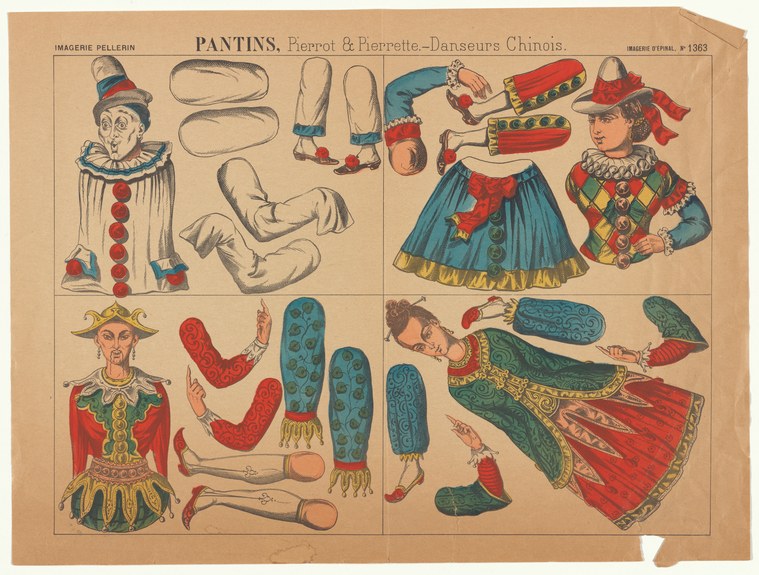
Pantins: Pierrot & Pierrette, Danseurs Chinois
Unknown artist
- Collection:
- Prints depicting dance
- Source:
- New York Public Library
- Rights:
- Public domain — free to use, share and adapt.
- Recorded as:
- Public Domain
Pantin figures are the direct ancestors of modern paper dolls and cut-out animation, but they are rarely recognized in dance history because their motion was mechanical rather than choreographed. Yet they reveal how ordinary people understood dance—as exaggeration, spectacle, and caricature—and they show the commedia dell'arte tradition persisting in mass culture and toy form long after it left the stage. This sheet is a document of how dance imagery was used to sell cheap entertainment to children, and of the aesthetic fantasies (here, orientalism) that circulated through popular toys.
What you are looking at
This is a page from a French paper toy or pantin sheet, a popular form of inexpensive folk entertainment from the 19th century. It depicts two figures identified as Pierrot and Pierrette—characters from the Italian commedia dell'arte tradition—dressed in Chinese-inspired costume. The sheet is divided into four quadrants showing the complete costume pieces for assembly: heads with distinctive makeup (Pierrot's white face with blue markings and pointed hat, Pierrette's jeweled headdress), loose robes in turquoise and red with gold and patterned trim, elongated shoes or slippers in coordinating colors, and articulated limbs—forearms and lower legs rendered as jointed wooden forms. The figures are rendered in hand-colored engraving or lithography typical of mid-19th-century Paris toy production. The layout is functional and modular: once assembled with string or pin joints at the shoulders, elbows, hips, and knees, these figures could be made to move in a dancing or gesturing motion by pulling a string from below—the defining feature of pantin toys.
The dancing
The assembled figures show exaggerated elongated proportions typical of pantin design—the limbs are disproportionately long to allow for visible motion when jointed. Pierrot displays the characteristic commedia mask with a white face, the ruff collar, and a costume combining French carnival tradition with orientalist fantasy. Pierrette mirrors his silhouette but with a jeweled, feminine headdress and skirt. The bodies are shown both in component form and as dressed figures, allowing assembly to be followed clearly. The articulation of limbs at joints created a stiff, jerking motion rather than fluid dance—the puppeteer pulled a single string to make both arms and legs move in exaggerated synchronized gestures, creating an illusion of dancing.
The dance depicted
These are not depictions of actual dance but of theatrical characters performing dance-like motion as novelty toys. The commedia dell'arte tradition (Pierrot and Pierrette roles) did include comic stylized movement and posturing, and pantin figures were marketed as 'danseurs'—dancers—even though their motion was mechanical and puppet-like. The 'Chinese' designation in the title appears to reflect 19th-century European fascination with Orientalism and exotic costume fantasy rather than any authentic representation of Chinese dance. The pantin format itself created a distinctly European form of kinetic entertainment: pulling a string produced jerking, inorganic motion that caricatured dance rather than represented it. This was mass-market theater for children and the urban poor—accessible, affordable, and produced in the tens of thousands.
How it was made
This is a hand-colored lithograph or engraving printed on paper, likely produced in Paris in the mid-19th century. The technique allowed for rapid, inexpensive mass production of toy designs; a single page could be printed, colored by hand in assembly-line fashion, and sold for a few centimes. The modular layout—showing separate components for the purchaser to assemble—was essential to the economics of pantin production. The hand-coloring visible here (particularly the bold turquoise robes and red details) indicates this was a commercial product of moderate quality, not a luxury item. Marks and foxing suggest age and circulation; the paper has darkened to tan, typical of 19th-century wood-pulp stock.
About this work
This is a pantin sheet—a printed paper toy designed for home assembly and animation—depicting Pierrot and Pierrette as 'Chinese dancers.' Pantins were one of the most widespread forms of moving-figure entertainment in 19th-century Europe, predating cinema and accessible to working-class children who could not afford marionettes or mechanical automatons. The characters derive from commedia dell'arte but are costumed in an Orientalist fantasy reflecting the period's fascination with distant cultures. The 'dance' these figures performed was mechanical and exaggerated: by pulling a string attached to a wooden bar beneath the assembled figure, both arms and legs would move in synchronized jerking motions, creating a caricature of dancing rather than a representation of it.
The sheet reveals the intersection of several 19th-century phenomena: the persistence of commedia dell'arte character types in popular culture; the explosive growth of toy manufacturing and mass printing; the vogue for chinoiserie and Orientalist aesthetics; and the emerging market for cheap, reproducible entertainment aimed at children and urban poor. Pantin sheets are rare survivors because they were meant to be used, cut, assembled, and eventually worn out—few were preserved. This example, held by the New York Public Library, documents a form of kinetic play and narrative performance that was ubiquitous but has left scant trace in museum collections.
How to look at it
Note the deliberate exaggeration of limb length and the clearly marked joint points (shoulders, elbows, hips, knees)—these are not anatomically proportioned bodies but mechanical systems designed to amplify motion. The costume detail (embroidery, jeweled headdress, ruffles) is rendered with precision even though the figure itself is crude and jointed, reflecting the makers' understanding that visual interest would hold a child's attention even as the motion was jerky and unnatural. Look at the heads separately: both faces are mask-like and expressive rather than realistic, in keeping with commedia tradition. The 'Chinese' elements—the pagoda-shaped hat, the turquoise robes, the gold patterning—appear arbitrary and Western fantasy rather than informed representation; this reveals how orientalism worked in popular culture. Finally, consider what motion this design would create: pulling the single string would lock the arms and legs into unison, producing a stiff, mechanical pantomime of dancing—caricature and spectacle rather than grace.
The artist
The sheet is credited to Imagerie Pellerin, a major French toy and print publisher based in Épinal. Pellerin's workshops (active from the early 19th century through the 20th) produced hundreds of thousands of pantin sheets, religious prints, and folk imagery. The company employed dozens of colorists and engravers and distributed through street vendors and small shops across France and Europe. Pellerin was not a 'fine artist' but an industrial producer; sheets were designed for speed and appeal rather than artistic ambition. Many Pellerin pantins are now in museum collections, and the company's mark is a sign of a mid-market, mass-produced toy of reasonable quality.
The period
Pantin toys flourished in France and Europe between roughly 1800 and 1920, with peak production in the 1860s–1890s. They emerged as lithography and color printing made cheap mass production viable. Commedia dell'arte characters remained popular in popular culture and pantomime well into the 19th century, even as 'serious' theater moved toward realism. The Orientalism visible here—the 'Chinese' costume fusion—reflects the period of European imperial expansion and the aesthetic exoticization of Asia in decorative arts, fashion, and entertainment. At the same moment pantin figures were being produced and sold to children, ballet theaters were staging spectacles like *La Bayadère* (1877) and *Coppélia* (1870), which also used exotic fantasy costume and mechanical or doll-like motion as sources of spectacle. The pantin brought that theatrical idiom into homes and streets.
Where it lives
This sheet is housed in the Prints collection of the New York Public Library, catalogued as a mid-to-late 19th-century French pantin sheet. The library's collection of prints depicting dance includes both fine-art engravings and popular ephemera like this; their presence together reflects the library's commitment to documenting how people moved and performed across all social registers.
Dance in this work
Questions about this work
What is a pantin?
A pantin is a jointed paper figure glued to cardboard or thin wood, with limbs articulated at the shoulders, elbows, hips, and knees by string or pin joints. A single string attached to a wooden bar beneath the assembled figure allowed the puppeteer (often a child) to make both arms and legs move in synchronized jerking motions by pulling the string up and down. Pantins were one of the cheapest forms of toy animation, produced in the hundreds of thousands in 19th-century France.
Why are Pierrot and Pierrette depicted as 'Chinese dancers'?
Commedia dell'arte characters like Pierrot remained popular in European entertainment throughout the 19th century, and they were frequently costumed in exotic or fantasy dress for novelty and visual appeal. The 'Chinese' costume here reflects European Orientalism—a fascination with the aesthetic of distant cultures that was more fantasy than documentation. Toymakers combined familiar character types with fashionable exotic imagery to increase sales.
How would someone have used this toy?
The purchaser would cut out the separate component pieces from the printed sheet, glue them to cardboard, and assemble them using string or metal pins at the marked joints. Once assembled, pulling a string attached to a wooden bar below would animate the figure, making both arms and legs move in exaggerated, synchronized jerking motions. Children could perform them for each other, mimic stage performances, or simply play with the motion.
Is this really a dance artwork?
Pantin figures are artifacts of how dance was understood and performed in popular culture—as spectacle, exaggeration, and entertainment. The motion they produced was mechanical rather than choreographed, but they show how ordinary people engaged with and reimagined dance imagery. They belong in a gallery about dance because they document the circulation of theatrical characters and movement aesthetics in everyday life and children's play.
More dance artwork





