49 works in this view — arrow keys or swipe to move between them.
Dance in Art
Le maitre de danse
Unknown artist
- Collection:
- Prints depicting dance
- Source:
- New York Public Library
- Rights:
- Public domain — free to use, share and adapt.
- Recorded as:
- Public Domain
For historians and dancers, this print is evidence of how courtly dance was actually taught and valued—not as entertainment, but as a rigorous discipline of bodily refinement and social propriety. The image shows the dancing master as a figure of authority and artistic knowledge, his role as central to aristocratic life as a music or language tutor, and reveals the gendered nature of dance training in this period.
What you are looking at
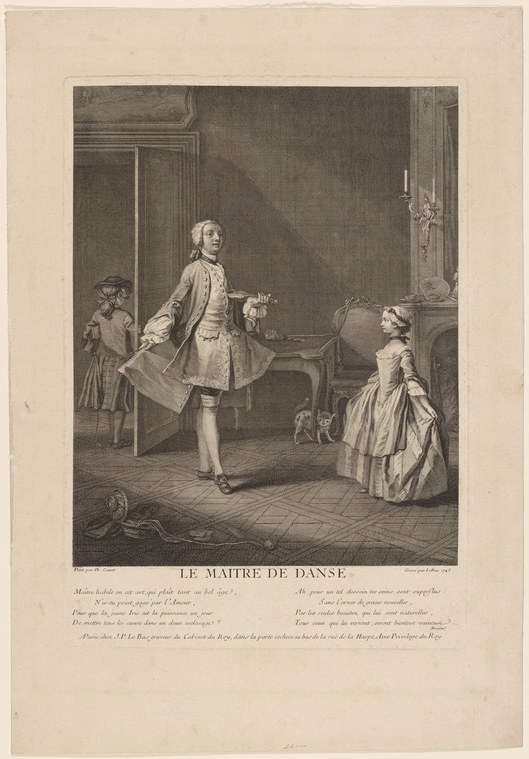
A dancing master instructs a young woman in an elegant interior, likely a nobleman's home or studio. The master, dressed in a long coat and breeches in the fashion of the mid-eighteenth century, stands in the center with one arm extended, gesturing to demonstrate proper deportment or arm position. The female student, in a white gown with panniers and a fitted bodice, stands to the right in an attentive pose. A young attendant or second student sits or crouches on the left near the doorway, watching the instruction. The room has paneled walls, a high ceiling with decorative molding, and a window on the right that admits cool light; the composition is staged with theatrical formality, the figures arranged as though frozen in a moment of polished instruction.
The dancing
The dancing master's posture is erect and commanding, his extended arm demonstrating an ideal line while his body remains composed and centered. The student's weight is distributed evenly, her arms positioned with formal precision; her gaze is directed toward her instructor. Both figures maintain the lifted spine and turned-out carriage characteristic of courtly dance training. The spatial relationship—master at center, student positioned to follow and mirror—is the fundamental pedagogical arrangement of eighteenth-century dance instruction.
The dance depicted
This print documents the practice of ballroom dance instruction as it was formalized in eighteenth-century France and across aristocratic Europe. The work appears to illustrate minuet technique or similar courtly social dance, the dominant teaching paradigm of the period. The dancing master (maître de danse) was a recognized professional who taught the nobility—particularly young women—the rules of posture, foot position, arm carriage, and the proper execution of country dances and minuets. The image shows the pedagogical method: demonstration by the master, observation and imitation by the student, with emphasis on refined deportment as much as footwork.
How it was made
This is an engraving on paper, likely a copperplate engraving executed in the eighteenth century. The technique—fine parallel lines and cross-hatching to create tone and shadow—is characteristic of French engraving of this period and would have allowed for multiple impressions to be printed and distributed. The presence of French text below the image and the style of the lettering confirm production in France. Such prints were common vehicles for disseminating models of correct behavior and technique among the educated classes; this image would have circulated among dancing masters, their patrons, and students as a visual reference and aspirational model.
About this work
Le Maitre de Danse is a teaching document rendered as fine art. It captures the formalized instruction in courtly dance that was central to aristocratic education in the eighteenth century, showing the dancing master in his professional role as arbiter of grace and correct deportment. The print preserves both the physical technique of the period and the social ritual of dance instruction—the master's authority, the student's attentive submission, the controlled elegance of the body as it was cultivated in elite circles. This work belongs in a gallery of dance art because it documents not a performance, but the machinery of dance pedagogy: how the body was taught to move, and how that teaching was represented and disseminated to shape practice across an entire culture.
How to look at it
Observe the position of the master's extended arm and the angle of his torso—he is showing, not performing; his body is the text from which the student learns. Notice the student's stillness and the direction of her attention: she is mid-absorption, not mid-motion. The composition freezes the moment of instruction rather than display, which is the work's subject. The formal architecture of the room—the symmetry of the panels, the receding depth—mirrors the discipline and order that the master is teaching the body to embody.
The period
In the eighteenth century, dancing masters held professional status and published treatises on dance technique. The formalization of minuet steps and the codification of ballroom etiquette created demand for instruction manuals in print and image form. By mid-century, engravings such as this one were common in France and circulated across Europe as visual instruction and as status markers—owning such prints signaled both wealth and cultural refinement. The dancing master's role was understood as akin to that of a rhetor or orator: to teach the body to express dignity, control, and grace in motion.
Where it lives
The New York Public Library holds this print in its collection of prints depicting dance. The inscription below the image is in French, and the engraving style and subject matter confirm eighteenth-century French origin, though neither the engraver nor the exact publication date is recorded in the catalogue.
Dance in this work
Questions about this work
What is a dancing master and why was this a prestigious profession?
A dancing master was a trained professional who taught courtly dances and deportment to the nobility and gentry. In the seventeenth and eighteenth centuries, the ability to move with grace and follow the rules of ballroom etiquette was considered essential to aristocratic identity and marriage prospects, especially for women. Dancing masters were therefore figures of cultural authority, sometimes traveling between courts and publishing instructional texts and images to spread their methods.
What dance is being taught here?
The print does not illustrate a specific dance step, but rather the general principles of courtly dance instruction. Given the period and dress, this is most likely instruction in minuet technique or in the fundamental positions and carriage required for ballroom dances. The focus is on posture, arm position, and the deportment that would apply across multiple dance forms.
Why is this image printed and distributed?
Engravings like this circulated as instructional aids and aspirational models. They allowed dancing masters to disseminate their methods beyond their own studios, and they allowed wealthy families to display refined taste and access to professional knowledge. Such prints were also used in the studios themselves as references for correct technique.
What does the dress tell us about the date and context?
The woman's panniers (side hoops), the man's long coat and breeches, and the style of the interior all indicate mid-to-late eighteenth century. The formality of the dress and the wealth implied by the interior setting show that dance instruction was an elite activity, confined to families of means.
More dance artwork





