49 works in this view — arrow keys or swipe to move between them.
Dance in Art
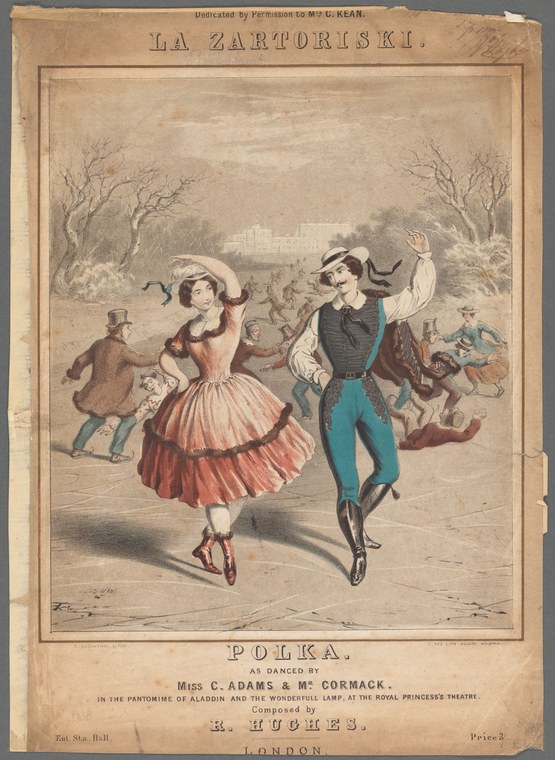
La zartoriski, polka, as danced by Miss C[aroline] Adams & Mr. [John] Cormack in the pantomime of Aladdin and the wonderfull [sic] lamp, at the Royal Princess's Theatre, composed by R. Hughes
Unknown artist
- Collection:
- Prints depicting dance
- Source:
- New York Public Library
- Rights:
- Public domain — free to use, share and adapt.
- Recorded as:
- Public Domain
This image preserves the only visual record most of us will ever have of how a specific popular dance was performed by named dancers in a specific theater on a specific occasion—a moment that would otherwise vanish. It shows the polka not as a diagram or a description but as a living, turning thing, captured mid-leap, with all the period costume and theatrical apparatus intact. For historians and dancers alike, it is an anchor to the actual past of 19th-century dance entertainment.
What you are looking at
A theatrical dance scene set in a garden or park landscape with bare trees framing the composition. In the foreground, a couple dominates the image: a woman in a voluminous red skirt with white trim and a red hat turns energetically to the right, her body caught mid-rotation; a man in dark jacket and bright turquoise/teal trousers partners her with his arm raised. Both dancers are in motion, their postures suggesting the quick, bouncing rhythm characteristic of the polka. Behind them, other figures in period dress—men in brown coats and women in colorful skirts—continue dancing or watching, creating a sense of social gaiety and ensemble movement. The scene is rendered in colored lithograph with soft brown tones in the landscape, creating atmospheric depth. A castle or grand building is visible in the misty background.
The dancing
The primary couple occupies the visual center in an open, energetic frame. The woman's torso twists sharply, her full skirt billowing outward, her hat brim visible against her profile. The man leans slightly forward in partnership, his raised arm extended, his posture alert and responsive. Both figures have their weight forward and appear to be on the balls of their feet. The dancers behind them are less distinct but echo similar postures of rotation and lift. The geometry between the lead couple suggests the kind of turning and hop-step interchange that defines polka partnership.
The dance depicted
This is a polka, as stated in the title: *La zartoriski, polka*. The work documents a specific theatrical performance—the pantomime *Aladdin and the Wonderful Lamp* at the Royal Princess's Theatre—danced by the performers Miss Caroline Adams and Mr. John Cormack. The polka was one of the defining social and theatrical dances of the mid-to-late 19th century, originating in Bohemia and spreading rapidly across Europe and America. This image preserves a moment of how the polka was staged in London theater: energetic, playful, performed in couples with high spirits and visible rotation. The choice of a garden setting and the inclusion of supporting dancers suggests the polka as a social dance adapted for theatrical spectacle.
How it was made
This is a hand-colored lithograph, as indicated by the characteristic soft color ranges and the tonal modeling visible in the landscape. The medium allowed for rapid publication and distribution of theatrical images, making this a commercial product tied to the performance itself—sheet music cover, souvenir, or theater advertisement. The composition shows the lithographer's skill in rendering motion: the swirl of fabric, the forward lean of the male dancer, the gathering of supporting figures are all conveyed through line and subtle tonal variation rather than heavy shadow. The hand-coloring adds specificity to costume (the vivid turquoise, the red dress, the brown coats) that monochrome printing would lose.
About this work
This is a theatrical souvenir documenting a specific performance of a polka in a mid-19th-century London pantomime. The work belongs to the tradition of dance imagery created for commercial circulation—not fine art, but working ephemera tied to an evening's entertainment. It records both the dance itself (the polka's characteristic turning, the partnership frame, the social joy) and the theatrical context (the named performers, the elaborate costume, the surrounding ensemble, the romantic garden setting). For dance history, it is invaluable precisely because it is humble: it shows how the polka actually looked when danced on stage in the 1860s or 1870s, with what energy, what dress, what accompaniment of supporting players. The inclusion of the composer's name (H. Hughes) and the dedication note add layers of theatrical documentation.
How to look at it
Notice the moment the lithographer chose: not a symmetrical pose but a moment of turning and thrust, with the woman's skirt caught in the act of swinging outward. This conveys the bounce and rotation essential to the polka far more effectively than a standing figure would. Observe how the supporting dancers are rendered less sharply, as atmosphere rather than focal point—a technique that throws the lead couple forward while maintaining the impression of a lively social gathering. The open arm position, the forward weight, the turned-out postures all signal a dance of joy and sociability, quite different from the formality of earlier social dances. The garden setting, with its romantic suggestion, places the dance in a theatrical fantasy rather than a real ballroom.
The artist
The artist is not recorded. The work is identified as a lithograph likely published in London in the 1860s–1870s, a period when theatrical souvenir prints were produced in quantity by music publishers and print sellers. The style is consistent with London theatrical lithography of the period: skillful in capturing movement and costume, attentive to the glamour of stage performance, but not signed or emphasized as individual artistic achievement. Such prints were often created by house artists in publishing firms and distributed alongside sheet music or as standalone theater souvenirs.
The period
The polka reached its peak of popularity in European and American society between the 1840s and 1870s, initially as a fashionable ballroom dance and increasingly as a staple of theatrical entertainment. By the time this image was made, the polka was established enough to warrant an elaborate theatrical staging (here embedded in a pantomime) and famous enough for performers' names to sell prints. The mid-Victorian period saw a boom in theatrical dance imagery as commercial lithography made such prints affordable to a mass audience. Pantomime was a major London theatrical form, often featuring spectacular dance scenes, and the polka fit naturally into its tradition of energetic, spectacular movement.
Where it lives
This work is held in the New York Public Library's collection of prints depicting dance. It is identified as sheet-music cover or theatrical souvenir. The dedication note at the top indicates permission for performance to M.S. & KEAR, suggesting it may have been published by a theater or music publisher in London.
Dance in this work
Questions about this work
Did real polka dancers move like this, or is this artistic exaggeration?
Both. The polka did involve rapid turning, hopping steps, and a forward, bouncy energy—all visible here. But the theatrical version was exaggerated and slowed for visibility: the skirt swirl and the upright posture are partly costume and stage convention. This image shows the theatrical polka, which was distinct from (though based on) the social ballroom version.
Who were Adams and Cormack?
They were performers in London theater in the mid-to-late 1800s, named here as dancers of this polka in a specific production of *Aladdin*. Beyond what this print tells us, their individual histories are not recorded. Such prints often preserve the only evidence we have that these performers existed.
What is a pantomime, and why would it include a polka?
English pantomime was a theatrical form combining story, comedy, music, and spectacular dance. By the Victorian era, polkas and other fashionable dances were regularly inserted as display numbers, allowing performers to showcase their skill and giving audiences a taste of current popular dance. The polka here is both character development and entertainment spectacle.
What does the dedication to 'M.S. & KEAR' mean?
This indicates that the composition was licensed or published with permission from M.S. and KEAR, likely the theater management or composer's representatives. It is a legal note, typical of published sheet music and theatrical prints of the period.
More dance artwork





