49 works in this view — arrow keys or swipe to move between them.
Dance in Art
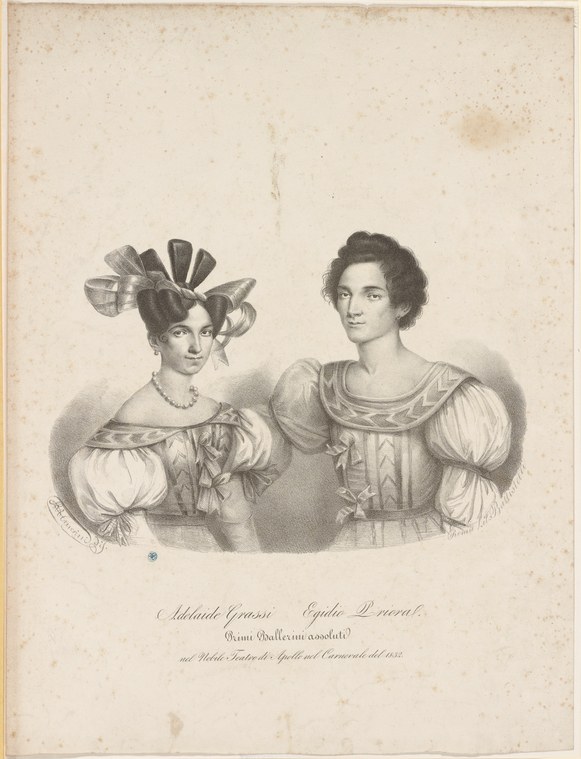
Adelaide Grassi, Egidio Priora, primi ballerini assoluti nel nobile Teatro di Apollo nel carnevale del 1832
Unknown artist
- Collection:
- Prints depicting dance
- Source:
- New York Public Library
- Rights:
- Public domain — free to use, share and adapt.
- Recorded as:
- Public Domain
This work documents the international profile of Italian dancers in the early Romantic era and shows how theatrical dancers were presented to the public as visual spectacles as much as moving bodies. The engraving's careful attention to costume over movement reveals the hierarchy of what mattered in early 19th-century ballet culture: the splendor of dress and the celebrity of the performer outweighed the choreography itself in promotional materials.
What you are looking at
Two women in theatrical dress occupy the frame in a bust-length portrait composition. The figure on the left wears an elaborate costume with a striking fan-shaped headdress composed of tall, stiff plumes that radiate upward; her bodice is heavily decorated with ornamental trim, and her sleeves are voluminous, gathered at the shoulder. The figure on the right, in simpler classical drapery with a softer arm position, gazes toward the viewer with a composed expression. Both women wear pearl necklaces and are rendered with careful attention to fabric texture and shadow—the engraving technique creates delicate gradations of light across the silk and muslin. The inscription below identifies them as "Adelaide Grassi" and "Egidio Priora, primi ballerini assoluti nel nobile Teatro di Apollo nel carnevale del 1832" (principal dancers at the noble Apollo Theatre during carnival 1832). The composition is symmetrical and formal, emphasizing the dancers' status and the splendor of their costumes rather than capturing them mid-movement.
The dancing
Both figures are shown from approximately the shoulders up, in a dignified, frontal pose rather than in active dance positions. The woman on the left has her arms raised in a stylized attitude, with hands positioned delicately; her posture is upright and somewhat formal. The woman on the right stands with a more relaxed arm position, one hand resting near the body. Neither figure displays the dynamic tension, weight shift, or footwork that would typically be visible in an action scene—instead, both are presented as portrait subjects, the better to display their costumes and status.
The dance depicted
This is a commemorative print of two principal dancers (primi ballerini assoluti) from the Apollo Theatre in Rome during the 1832 carnival season. The woman's lavish costume—particularly the elaborate fan headdress—suggests a theatrical dance, likely ballet or a mixed dramatic work combining dance with pantomime. The classical drapery and the formal portrait mode do not show the dance itself in action; instead, the print documents the dancers as celebrities and the spectacular costumes that were central to the theatrical experience. The headdress and ornamentation point toward the elaborate aesthetic of early 19th-century Italian opera-ballet, where visual spectacle was inseparable from the dance.
How it was made
This is a line engraving, rendered with fine crosshatching and careful modulation of tone to suggest volume and texture in the fabrics. The technique allows for precise detail in costume ornament and an almost portrait-like finish; the print was intended for circulation as a souvenir or promotional document, presenting the dancers to a wider public than could see them in the theatre. The quality of execution and the careful attention to dress suggest this was commissioned to celebrate notable performers, a common practice in 19th-century theatrical culture.
About this work
This is a commemorative engraving of two celebrated Italian ballet dancers—Adelaide Grassi and Egidio Priora—documented at a moment of professional prominence during the 1832 Rome carnival season. Rather than capturing a choreographic moment, the print functions as a celebrity portrait, documenting the dancers through the lens of costume and theatrical splendor. It belongs in a gallery of dance imagery because it records not the movement itself but the visual culture surrounding dance in the early 19th-century Italian theatre—the status of dancers, the design of performance, and the means by which theatrical celebrity was disseminated to the public.
How to look at it
Look first at the costume, not the pose: the elaborate headdress, the jeweled bodice trim, the voluminous sleeves, the quality of the materials rendered in the engraving—these are the subject. Notice how the artist has used shadow and crosshatching to convey fabric weight and sheen, making the costume the primary carrier of meaning. The faces and bodies are rendered with care, but they are secondary; this is a print designed to circulate the image of the costume and the dancers' celebrity, not to document choreography or technique. The formal, frontal presentation is characteristic of theatrical celebrity portraiture of the period.
The period
This print dates to 1832, a pivotal moment in European ballet history. Romantic ballet was emerging in Paris (La Sylphide premiered in 1832); Italy was a secondary but active centre for ballet and opera-ballet, with Rome's Apollo Theatre among the major venues. The carnival season was a time of maximum theatrical activity and spectacle. Italian dancers in this period were highly mobile, performing across European circuits; the elaborate costume and formal presentation here reflect the international standards of the period. This is not yet the ethereal, ghostly aesthetic of mature Romanticism, but rather the transitional moment when classical ballet aesthetics were still tied to spectacular costume and ornament.
Where it lives
This engraving is held in the New York Public Library's Prints collection, which preserves theatrical imagery documenting performance culture across centuries and geographies. It is one of many such commemorative prints produced during this period to celebrate notable performers and circulate their images through print culture.
Dance in this work
Questions about this work
Who were Adelaide Grassi and Egidio Priora?
They were prominent Italian dancers designated as "primi ballerini assoluti" (principal dancers of the absolute first rank) during the 1832 carnival season in Rome. The title reflects their elite status in the theatrical hierarchy. Beyond this print, individual biographical details about them are not widely documented, though their appearance here testifies to their professional significance.
What does the headdress tell us about the kind of dance they performed?
The elaborate fan-shaped headdress suggests a theatrical dance—likely ballet mixed with operatic pantomime—rather than pure classical ballet. The extreme ornamentation and the formal presentation mode are consistent with early 19th-century Italian theatre practice, where dancers performed in large-scale ensemble works combining music, spectacle, and narrative.
Why is this a portrait rather than an action scene?
This is a commemorative print designed to celebrate and promote the dancers through their costume and status, not to document choreography. Prints of this kind circulated as theatrical souvenirs and publicity; they functioned much like modern promotional photography. The formal portrait mode was standard practice for documenting theatrical celebrities of the period.
More dance artwork





