49 works in this view — arrow keys or swipe to move between them.
Dance in Art
Rappresentazione d'una mascherata
Unknown artist
- Collection:
- Prints depicting dance
- Source:
- New York Public Library
- Rights:
- Public domain — free to use, share and adapt.
- Recorded as:
- Public Domain
This work is crucial documentary evidence for understanding the social function and material conditions of courtly dance before the formalization of ballet. It shows the dress, the architectural setting, the mixing of genders, the presence of music and spectacle, and the integration of dance within a broader festive gathering—all essential context that choreographic notation alone cannot convey.
What you are looking at
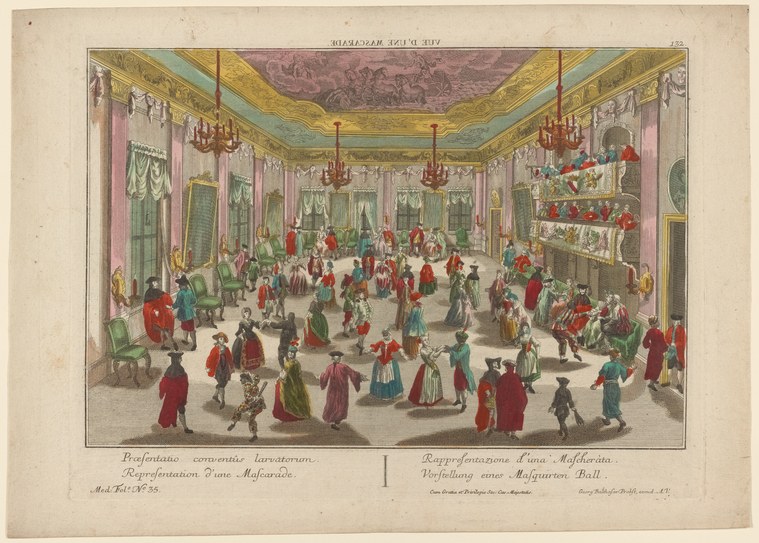
A grand interior hall with a high cove ceiling—painted in sky-blue with a central pink-mauve panel depicting clouds or a mythological scene—receives light from tall arched windows along the pink walls. Elaborate gilt architectural details frame the windows; gilt chandeliers hang at intervals. The floor is a pale stone or marble, crowded with figures in formal dress: men in long velvet robes in deep red and burgundy, women in long gowns of contrasting colors—greens, blues, reds—many with high jeweled headdresses. The crowd is distributed throughout the space in no single formation, some clustering in conversation, others standing in loose pairs, a few appearing to dance or move through the throng. The composition is dense and panoramic, the perspective suggesting a bird's-eye view of the entire function. A raised platform or gallery is visible at the right, possibly for musicians or observers. The overall atmosphere is one of formal social gathering—a masquerade or court festivity.
The dancing
The figures throughout are upright and formally postured, dressed in the rigid tailored garments of the 16th or early 17th century. No couples are captured in a recognizable ballroom hold; instead, bodies are scattered, some in apparent conversation, others walking or standing in observation. Where any bodily contact appears, it is minimal and social rather than choreographic—hands occasionally extended, bodies close but not in a dance frame. The heterogeneous distribution and posture of the crowd suggests social interaction rather than synchronized or paired dancing.
The dance depicted
This image depicts a masquerade (mascherata) or formal court gathering of the Renaissance or early Baroque period, the kind of aristocratic social function in which dance played a ceremonial role. No specific dance style is distinctly performed; rather, the work documents the social context in which dancing occurred—the setting, dress, and gathering of nobles. The title 'Rappresentazione d'una mascherata' suggests this is a theatrical or documentary representation of such an event rather than a capture of a specific dance form. Dancing may occur or be implied, but it is not the sole or dominant activity depicted.
How it was made
This is a hand-colored engraving or etching, characteristic of 16th or 17th century print culture. The fine line work, the pale tones, and the careful delineation of architectural detail and costume all suggest copper engraving, with watercolor or gouache hand-coloring applied afterward. This technique allowed for wide circulation of visual documentation—multiple impressions could be pulled and distributed—making such prints important vehicles for disseminating knowledge of courtly practice and fashion across Europe. The labor-intensive coloring suggests this was an expensive object intended for a patron of considerable means.
About this work
This is a bird's-eye view of a Renaissance or early Baroque masquerade, a formal aristocratic gathering documented in colored engraving. The work presents the social and sartorial context in which courtly dance took place—the setting, costume, and social roles—rather than depicting a specific choreography. The image is valuable not for its representation of dance technique but for its evidence of the scale, decorum, and social structure of noble entertainments in which dance was embedded.
How to look at it
Look first at the architecture and costume, which date the event precisely to the late Renaissance or early Baroque. Observe the absence of any formal choreographic formation or recognizable dance hold; bodies are scattered and social. Notice the raised platform at the right, likely for musicians or the organizers of the event. Attend to the precision with which the artist has rendered the elaborate costume—the jeweled headdresses, the rich fabrics, the elaborate sleeves—as evidence that the primary subject is not movement but the visual splendor of dress and setting. The engraver's careful attention to social positioning and proximity suggests an interest in documenting the social choreography of the event—who stands near whom, how bodies orient toward conversation—rather than the steps of any dance.
The period
In the 16th and early 17th centuries, the masquerade or masked ball was a fixture of aristocratic life across Europe, particularly in Italy, France, and the Low Countries. Such events combined music, dance, conversation, and theatrical spectacle, often lasting many hours and involving large numbers of nobles. Dance in this context was not a specialized performance art but a social practice integral to courtship, alliance-making, and the display of status and refinement. This engraving belongs to a rich tradition of prints documenting court life and fashion; similar works circulated among the educated elite to preserve and broadcast the visual splendor of such occasions.
Where it lives
The work is held in the New York Public Library's collection of prints depicting dance. The catalogue record is sparse; neither artist, date, nor publication information is recorded. The text at the foot appears to be Latin, and the style of lettering and the hand-coloring suggest a 16th or early 17th century origin.
Dance in this work
Questions about this work
Is this a depiction of a specific dance?
No. The image shows a masquerade or court gathering in which dance was a social practice, but no single choreography is depicted. The work documents the setting, costume, and social context of courtly festivity rather than a particular dance form or technique.
How do we know this is a masquerade?
The title states 'Rappresentazione d'una mascherata'—representation of a masquerade. The formal dress, the grand interior, the mixture of men and women in social groupings, and the apparent celebration all align with documented accounts of masked balls in Renaissance Italy and Venetian tradition.
What were masquerades used for?
Masquerades were elaborate entertainments for the nobility, combining music, dance, conversation, and spectacle. They served social functions—courtship, alliance-making, display of wealth and taste—and were sometimes used for theatrical or political purposes. The anonymity of masks allowed a degree of social role-play and freedom not otherwise permitted.
More dance artwork





