49 works in this view — arrow keys or swipe to move between them.
Dance in Art
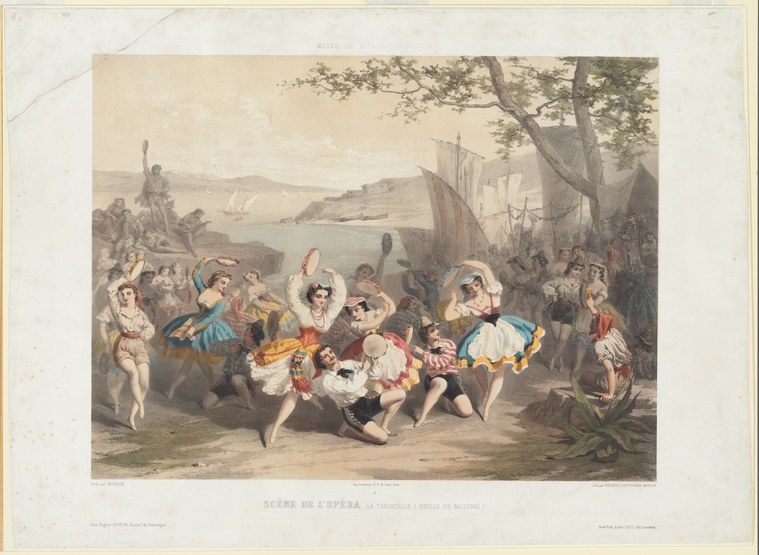
Scène de l'Opera, La tarentelle (Étoile de Messine)
Unknown artist
- Collection:
- Prints depicting dance
- Source:
- New York Public Library
- Rights:
- Public domain — free to use, share and adapt.
- Recorded as:
- Public Domain
This image documents a crucial moment in dance history: when folk and national dances entered the theatrical mainstream and were transformed into genres for elite consumption. The tarantella's presence in European opera and ballet houses made it a template for exoticism and passion that shaped Romantic aesthetics for a century. For any historian studying how folk movement enters and is altered by theatrical convention, or how prints circulated dance imagery before film, this work is a primary source.
What you are looking at
A seaside promenade erupts in choreographed revelry. In the foreground, a dozen or more figures in theatrical dress enact a tarantella, their bodies animated in characteristic rapid turning and leaping. The women wear voluminous skirts in pale blues, pinks, and whites, with enormous feathered hats; the men sport tight breeches and colorful jackets. The dancers occupy the center and left of the composition, their bodies caught mid-gesture—arms raised, torsos twisted, legs extended in the quick, energetic postures of southern Italian folk dance. The middle ground holds onlookers in period dress (early 19th century), some seated, others standing in rapt attention. At the water's edge behind them, sailing vessels with billowed canvas sit at anchor; the harbor recedes toward distant hills. A gnarled tree frames the right edge. The palette is warm and muted—ochres, pale blues, dusty greens—with strong white highlights on the dancers' skirts and hats. The engraving technique renders detail in fine parallel lines; the print appears hand-colored with watercolor or gouache.
The dancing
The central dancers display the rapid, nearly violent energy of the tarantella: legs bent and springing, torsos held upright but mobile, arms gesturing in arcs or held aloft with palms open. A woman in pale blue at the center performs a turn, her skirt flaring; nearby a man leaps or bounds. The figures are arranged not in strict formation but in a loose, ecstatic scatter—characteristic of folk celebration rather than courtly order. The onlookers form a frame, their static poses (seated, standing at rest) emphasizing the kinetic intensity of the dancers. No closed holds or ballroom frames are visible; these are solo or semi-coupled improvisations within a shared space.
The dance depicted
This is a tarantella, one of the most recognizable folk dances of southern Italy and Sicily. The title specifies "La tarentelle (Étoile de Messine)"—the Messina Star—likely referencing a celebrated dancer or a local variation. The tarantella was performed at festivals, weddings, and public celebrations throughout the 19th century; its rapid 6/8 rhythm and whirling figures made it a staple of European theatrical exotica. The image captures the dance in a theatrical frame—a scene from an opera or ballet, not a documentary of village practice. The elaborate costumes, the composed arrangement of onlookers, and the print's circulation as a gallery piece all indicate this is a stylized stage interpretation rather than street performance.
How it was made
This is an engraving or etching, hand-colored with watercolor or gouache applied after printing. The fine, closely-spaced parallel lines (hatching and cross-hatching) are characteristic of intaglio technique, which allowed for sharp detail and wide distribution; the hand-coloring was a common way to add commercial appeal to popular prints in the 19th century. The technique was economical and suited to theatrical imagery intended for sale to tourists and opera-goers. The quality of the line work and the sophistication of the composition suggest a professional workshop, likely producing such theatrical scenes in series.
About this work
This is a hand-colored engraving depicting a tarantella, the rapid, whirling folk dance of southern Italy, as performed (or as imagined) on stage in early 19th-century theater or ballet. The print belongs to a large category of 19th-century theatrical dance imagery—scenes extracted from operas, ballets, and pantomimes and sold as collectible prints. The tarantella in particular became a stock "local color" attraction in European theaters during the Romantic era, when audiences craved images of exotic, passionate, non-courtly dance. This work is valuable not for its accuracy to village practice, but for what it reveals about how metropolitan audiences saw, celebrated, and aestheticized folk movement. The combination of energetic body language, careful composition, and theatrical excess—the enormous hats, the saturated colors, the narrative frame of spectators—shows how the folk was packaged and sold.
How to look at it
Focus on the moment of maximum exertion: the artist has frozen the tarantella mid-whirl, not at rest. Notice how the pose is inherently unstable—the figure in the center appears to be caught in a turn, her weight distributed in a way that suggests motion rather than poise. The enormous, exaggerated hats and skirts are not accidental; they amplify the movement, making the bodies read as more energetic and more alien to courtly restraint. The composition—dancers scattered, onlookers arranged in tiers—mirrors the actual experience of watching folk celebration from the edge: the viewer is positioned as a fascinated outsider. Pay attention to what is *not* there: no musical instruments are visible, no clear indication of rhythm or ensemble structure. This is theater representing folk, not folk itself.
The artist
The artist is not recorded. The print was likely produced by a professional theatrical print publisher in Paris or London—the two centers of such production in the period. The French tradition of theatrical engravings (Engelmann, Aubert, and others) was highly organized and commercial; artists, engravers, and colorists worked in division of labor, and individual authorship was often not credited or recorded. The quality of the engraving suggests a skilled hand, but the work is characteristic of a large, anonymous industrial practice.
The period
This print dates from the early 19th century, the Romantic era in European dance and art. Romantic ballet (roughly 1830–1850) made intense use of "national" and "folk" dances as markers of character and locale: the Spanish cachucha, the Scottish reel, the Italian tarantella all appeared in major ballets. The tarantella was popularized in particular through operas like Rossini's *La donna del lago* (1819) and ballets performed across Europe. At the same time, theatrical prints—engravings and later lithographs, often hand-colored—had become a major industry in Paris, London, and Vienna. Customers could buy images of celebrated dancers, scenes from current productions, and exotic entertainments. The print market democratized access to theater, allowing the middle class to collect and display images of fashionable performance at home. This work sits at the intersection of Romantic aesthetic values (passion, nature, the non-European as marker of authenticity) and industrial print production.
Where it lives
The work is held in the NYPL's Prints Depicting Dance collection, which gathers theatrical, social, and folk dance imagery across media from the 16th century to the early 20th. As a hand-colored engraving with a theatrical subject and no authorship recorded, it exemplifies the kind of mass-produced, commercially distributed theatrical imagery that dominated the art market in the 19th century.
Dance in this work
Questions about this work
What is a tarantella?
The tarantella is a rapid, whirling folk dance from southern Italy and Sicily, danced in celebration and at weddings. Its origins are debated; folklore linked it to a cure for tarantula poisoning, though the connection is now considered metaphorical. By the 19th century it had entered European theater and opera as a stock image of Italian passion and folk authenticity.
Is this what the tarantella actually looked like?
Not exactly. This is a theatrical version, designed for a European stage audience. The costumes are exaggerated (the hats and skirts are theatrical, not village dress), the setting is composed, and the moment is frozen for viewing. It shows what European theater *thought* the tarantella should be—passionate, energetic, visibly foreign.
Who would have bought this print?
Middle- and upper-class people who attended or desired access to theater. Prints like this were sold in theaters themselves, in print shops, and through subscription. Collectors would frame them or bind them into albums. They were affordable enough for professionals and merchants, expensive enough to signal taste and cultural engagement.
Why are there no musicians visible?
The artist chose to omit them, likely to focus attention on the dancers' bodies. In theatrical performance, musicians would typically occupy a pit or stage left; here, the visual emphasis is on movement itself, on the dancers as spectacle rather than as part of an ensemble.
More dance artwork





