49 works in this view — arrow keys or swipe to move between them.
Dance in Art
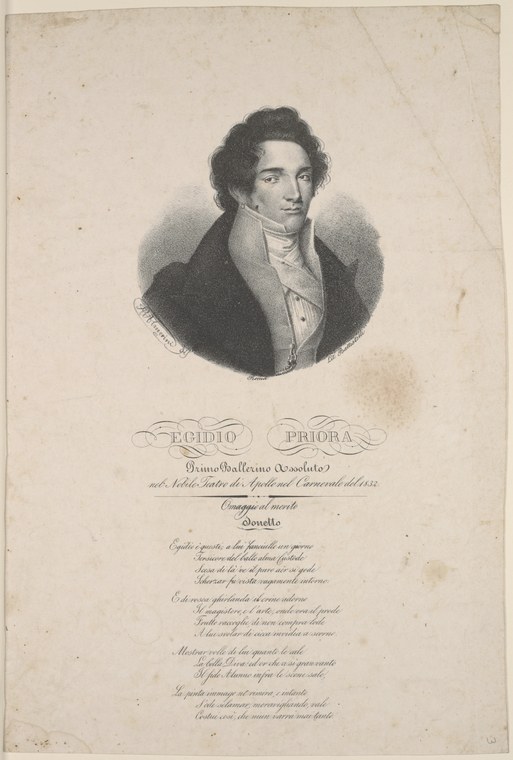
Egidio Priora, Primo ballerino assoluto, nel Nobile Teatro di Apollo nel Carnevale del 1832.
Unknown artist
- Collection:
- Prints depicting dance
- Source:
- New York Public Library
- Rights:
- Public domain — free to use, share and adapt.
- Recorded as:
- Public Domain
Egidio Priora represents the male principal dancer of Romantic-era Italian ballet—a period and region less documented than Paris or Milan. The print shows how individual dancers were celebritized and commemorated during this period, and provides a dated, named record of the professional ballet hierarchy (primo ballerino assoluto) in a specific theater at a specific moment.
What you are looking at
This is a portrait engraving of a male dancer presented as a bust-length figure against a plain background. The subject is identified by inscription as Egidio Priora, a primo ballerino assoluto (principal dancer) who performed at the Teatro Apollo in Rome during Carnival 1832. The man has dark, curled hair in the Romantic style and wears a high-collared white shirt with a dark coat or jacket with a large collar, typical of early 19th-century male formal dress. The engraving is rendered in stippled and lined tones that create soft modeling of the face and dramatic shadow around the shoulders. Below the portrait runs an ornamental cartouche containing the subject's name and credentials, followed by what appears to be a poem or dedication in Italian, printed in flowing script. The work is a formal, commemorative print celebrating a celebrated dancer of the period.
The dancing
The figure is presented in three-quarter view, the head slightly turned toward the viewer with a composed, dignified expression. There is no dance movement depicted—this is a portrait rather than a scene of performance. The pose is static and formal, with no visible body weight shift or limb extension that would indicate active dance. The clothing obscures the dancer's body below the shoulders, so no information about frame, technique, or physical training is visible in the figure itself.
The dance depicted
This is a commemorative portrait of a named historical dancer rather than a record of dance in action. Egidio Priora is identified as a primo ballerino assoluto—the highest rank in the male ballet hierarchy of the period—performing at a major Roman theater during Carnival 1832. The title tells us he was a star of Romantic-era ballet in Italy, but the engraving does not depict him dancing. The inscription and formal presentation indicate this was a celebrity portrait circulated to commemorate his status and achievements.
How it was made
This is an engraving, identifiable from the fine parallel lines and stippled tones used to model form and create tonal gradations. The technique allows for fine detail in the face and a formal, reproducible image suitable for wide distribution. The inscription is engraved in flowing copperplate script, and the whole composition—portrait, cartouche, and text—is integrated into a single plate. Such prints were a standard means of circulating portraits of celebrated performers and would have been sold to theater audiences and collectors as souvenirs and records of famous dancers.
About this work
This is a formal commemorative engraving of Egidio Priora, a celebrated male ballet dancer of the early 19th century, made to commemorate his performances at Rome's Teatro Apollo during Carnival 1832. It belongs to a tradition of celebrity portraiture in print that documented the star dancers of the Romantic ballet era. The work is valuable not as a record of dance movement or technique, but as historical evidence of who was considered a major performer, how dancers of rank were publicly presented, and how the ballet world circulated the image and reputation of its stars through print.
How to look at it
Attend to the formality of the presentation and the clothing: the high-collared shirt and dark coat place the subject firmly in Romantic-era male professional dress, not in performance costume or stage wear. The composed, dignified expression and three-quarter pose are conventions of portrait engraving, designed to convey status and respectability rather than to capture the dynamic movement of dance. The inscription below is essential to reading the work—it transforms a generic male portrait into a specific historical document by naming the subject and his achievement.
The artist
The artist is not recorded in the catalogue. The engraving is competently executed in the style of early 19th-century portrait prints, but without attribution marks or cartouche credits visible in the image, the engraver cannot be identified from the work alone.
The period
This print was made during the height of the Romantic ballet era (1830s), when male dancers were stars of the stage despite the gradual visual emphasis shifting toward female dancers in tutus. Italian ballet in this period maintained its own distinct tradition alongside the dominant Paris Opera school. The formal portrait engraving was the standard medium for circulating images of celebrated performers to the paying public, serving functions similar to modern theatrical publicity photography and fan imagery. The date (Carnival 1832) indicates this was likely commissioned and sold during or shortly after Priora's successful run at the theater.
Where it lives
This engraving is held in the New York Public Library's collection of prints depicting dance. It is part of a wider corpus of theatrical portraiture and commemorative prints circulated during the 19th century.
Dance in this work
Questions about this work
Is this image a record of how Egidio Priora danced?
No. This is a formal portrait, not a depiction of dance in action. It tells us he was a celebrated dancer and how he dressed in formal society, but not how he moved on stage or what technique he employed.
What does 'primo ballerino assoluto' mean?
It means 'principal dancer absolute'—the highest rank in the male ballet hierarchy. This was the equivalent of a modern principal dancer in a major company, reserved for the most celebrated male performers.
Why would a portrait like this be made?
Celebrated dancers of the Romantic era were public celebrities, and portrait prints were made to meet demand from theater audiences and collectors. These prints served as souvenirs, publicity, and records of who was considered a major star.
What can we learn from this about Italian ballet in 1832?
It shows that Rome had a major theater (Teatro Apollo) with a ranking system for dancers, that male dancers were still celebrated as stars, and that Italian ballet maintained a distinct performance tradition during the Romantic era.
More dance artwork





