49 works in this view — arrow keys or swipe to move between them.
Dance in Art
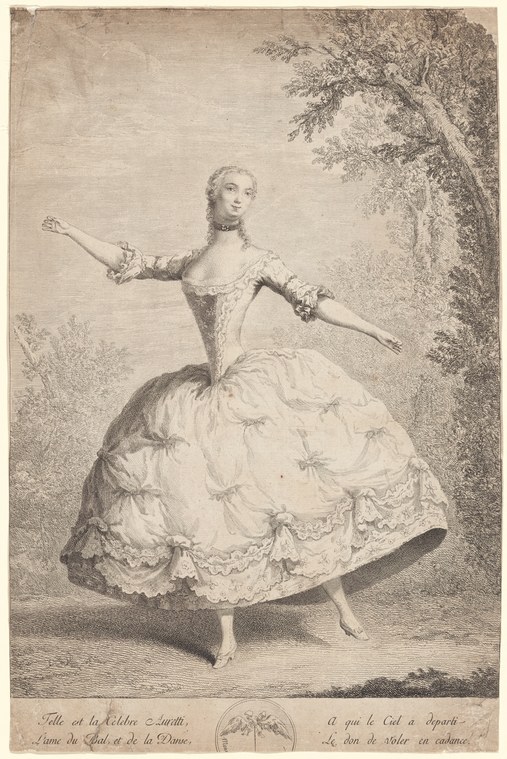
Anne (or possibly Janneton) Auretti.
Unknown artist
- Collection:
- Prints depicting dance
- Source:
- New York Public Library
- Rights:
- Public domain — free to use, share and adapt.
- Recorded as:
- Public Domain
This print is a primary source for understanding the aesthetic of eighteenth-century French court dance—the carriage, the arm frame, the relationship between costume and movement. It documents a professional or celebrated amateur dancer at the peak of Rococo culture and shows how dance was circulated and consumed as both a live practice and a reproducible image. It reveals that the formal, refined style we associate with Baroque and Rococo dance was not merely described in dance manuals but actively performed, seen, and recorded in real time.
What you are looking at
A young woman in an elaborate mid-eighteenth-century ball gown stands in an energetic pose against a landscape background with trees. She wears a fitted corset bodice with short sleeves and a massive skirt gathered and bunched at the hips, creating the silhouette typical of 1740s fashion. The skirt is caught mid-movement, billowing outward asymmetrically as though she has just spun or is about to. Her arms are extended in an open, welcoming gesture—the right arm raised and bent, the left extended to the side—and her body is turned in contrapposto, with her weight shifted and her head tilted upward in an expression of refined pleasure. She wears heeled shoes and stands on the balls of her feet. The print is rendered in fine line engraving with careful cross-hatching that creates depth and shadow, particularly in the foliage behind her and in the folds of the fabric.
The dancing
The dancer's frame is open and buoyant, with neither partner nor closed hold visible. Her raised right arm and extended left arm suggest the épaulement and arm carriage of formal eighteenth-century dance—elegant, symmetrical, and governed by strict codes of refinement. Her posture is upright but not rigid; her weight appears to rest on the ball of her right foot while the left trails. The slight twist of her torso and the cant of her head convey movement captured mid-phrase, not a static pose.
The dance depicted
This is almost certainly a depiction of French court dance of the Rococo period, most likely a minuet, contredanse, or allemande—the three dominant social dances of the 1740s ballroom. The open carriage, the upward tilt of the head, and the balletic arm frame all accord with the formal training required of aristocratic dancers. The print appears to document a specific celebrated dancer, possibly Auretti (as the title suggests), and shows how professional or semi-professional dancers of this era performed court dances for audiences and in paintings and engravings that circulated as both record and advertisement.
How it was made
This is a fine engraving, likely French, executed with great delicacy and precision. The technique allows for the rendering of fine detail in both the dancer's costume and the surrounding landscape, and the small size and portability of such prints made them ideal for circulation among collectors, dance masters, and court society. The careful modeling of light and shadow through line work, rather than wash or color, would have made the print reproducible and affordable, widening its audience beyond the aristocracy.
About this work
This engraving documents a moment in the history of European social dance at the height of the ancien régime. It captures not a moment of raw movement but rather the studied, codified elegance that characterized court dance in the 1740s—a moment when dance was inseparable from fashion, manners, and the display of status. The work sits at the intersection of dance portraiture and fashion print, preserving both the silhouette and the deportment of a specific era and possibly a specific celebrated performer. For historians and dancers, it is a precise record of how the body was trained, held, and displayed in the eighteenth-century ballroom.
How to look at it
Attend to the relationship between the dancer's costume and her body: her skirt is the largest visual element, yet it is her posture, arm frame, and the tilt of her head that convey the moment and the training. The artist has frozen her in an instant of transition, not at rest—the weight is on the ball of the foot, the arms are active, the body is twisted. Notice also the delicacy of the engraving line: the dancer's face is rendered with sensitivity, and the folds of the skirt are modeled through careful shading, not mere outline. This precision suggests the image was made from a live performance or a study by someone who understood how light and fabric behave in motion.
The artist
The artist is not identified in the catalogue record. However, the technique, style, and subject matter are consistent with French engravers of the mid-eighteenth century who specialized in fashion, theatrical, and portrait prints. Such works were often produced without attribution or under the name of the publisher rather than the engraver. The quality of line and the precision of the rendering suggest a skilled professional working within established French conventions of the period.
The period
In the 1740s, social dance in France was at an apex of codification and refinement. The minuet had become the dominant form of social display among the aristocracy, and the contredanse and alemande competed for favor. Dance masters like François Tomlinson and Kellom Tomlinson published detailed treatises with notated figures and prescribed arm positions. At the same time, the Rococo style in visual art emphasized elegance, grace, and the aestheticization of leisure—values that were perfectly embodied in the refined deportment of court dance. Engravings of dancers, particularly celebrated performers, were popular luxuries, functioning as both records of fashion and tokens of taste.
Where it lives
This print is held in the NYPL's collection of prints depicting dance. It is catalogued by subject rather than artist, and no publication information or date is recorded in the current record. The inscription at the base of the print, in French, may provide further information but is not transcribed in the available catalogue data.
Dance in this work
Questions about this work
What dance is this woman performing?
It is most likely a minuet, contredanse, or allemande—the three dominant social dances of the French court in the 1740s. The open arm frame, the upright carriage, and the refined deportment all match the codified style of these dances as taught by dance masters of the period. Without more context, it is difficult to specify further, but the visual evidence points to one of these three.
Who was Auretti or Janneton Auretti?
The catalogue record notes uncertainty about the name. If this is indeed a record of a performer named Auretti, she may have been a professional or celebrated amateur dancer performing at the French court or in the fashionable salons of Paris in the 1740s. Engravings of celebrated dancers were common at this time and functioned as a form of publicity and cultural record. Without additional sources, her biography cannot be reconstructed from this image alone.
Why is her skirt so large?
By the 1740s, women's skirts were gathered over wide panniers—hoops sewn into the fabric at the hips—which created the silhouette visible here. This was the height of fashion and an essential element of aristocratic dress. The size of the skirt was not merely decorative; it was a visible marker of status, leisure, and wealth. From a dancer's perspective, the wide skirt required specific techniques of balance and carriage to move gracefully, and the way it caught light and movement was part of the aesthetic appeal of the dance itself.
How do we know this is an engraving and not a painting or drawing?
The fine parallel lines (called cross-hatching) visible throughout the image, particularly in the sky and foliage, are characteristic of engraving technique. The artist used a burin (a pointed tool) to incise fine grooves into a copper plate, which were then inked and printed. This technique allows for great delicacy and precision but also requires a very different skill set from painting or drawing. The regularity and finesse of the line work throughout this print are distinctive markers of professional engraving.
More dance artwork





