49 works in this view — arrow keys or swipe to move between them.
Dance in Art
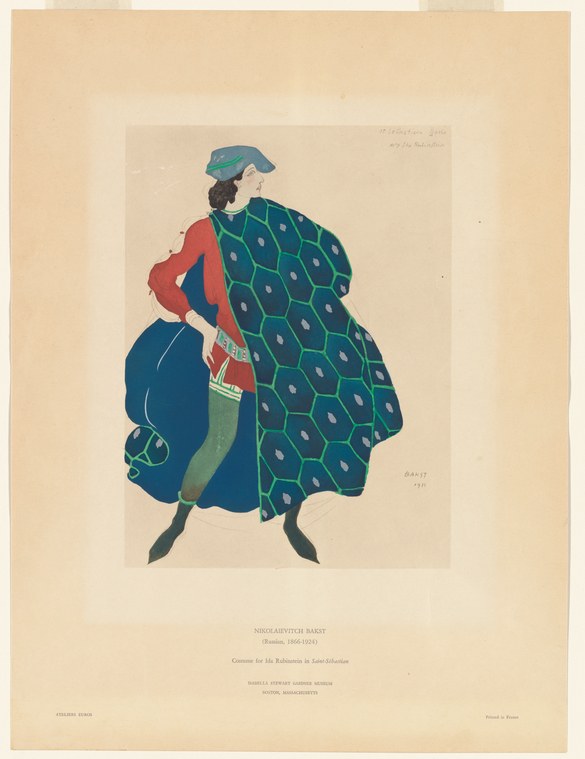
Costume for Ida Rubinstein in Saint-Sébastien
Unknown artist
- Collection:
- Prints depicting dance
- Source:
- New York Public Library
- Rights:
- Public domain — free to use, share and adapt.
- Recorded as:
- Public Domain
This work documents the costume design practice for one of the most important independent dancers of the Ballets Russes era, at a moment when theatrical dance was establishing itself as a total artwork combining dance, music, visual design, and narrative. Rubinstein's career and commissions like Saint-Sébastien shaped how dance was patronized, designed for, and understood as an art form worthy of collaboration with major contemporary composers and visual artists.
What you are looking at
A single figure stands in three-quarter view against a pale background, wearing an elaborate costume of deep forest green and rich red. The dominant garment is a spectacular cloak or cape of forest green with an allover pattern of pale blue diamonds or lozenges, lined and voluminous enough to sweep around the body. Beneath it, a fitted red jacket with gold trim is visible at the waist, paired with green tights. A blue cap or hat sits atop dark hair. The figure stands with weight shifted slightly, one leg forward in a pose that suggests either a moment of stillness or preparation for movement. The costume is rendered with careful attention to texture and pattern; the diamond pattern on the cloak is meticulous and rhythmic. A signature appears in the lower right corner. The composition is spare and formal, focusing entirely on the figure and the costume's sculptural presence.
The dancing
The single dancer is shown in a standing pose with gentle contrapposto weight distribution, neither fully frontal nor in profile but turned three-quarters toward the viewer's left. The posture is upright and dignified, with arms relaxed at the sides, suggesting a moment of presentation rather than active movement. The body is slender and the head held high. The stance conveys poise and readiness rather than dynamic motion, as if the performer is about to enter or has just exited the stage.
The dance depicted
This is a costume design for a theatrical dance production, most likely a classical ballet or dramatic ballet given the formal presentation and ornate costume. The work is identified in the catalogue as a costume for Ida Rubinstein in a work titled Saint-Sébastien (Saint Sebastian), a famous 1911 production. Rubinstein was a Russian-Jewish dancer and patron of the arts known for her commanding stage presence and role in avant-garde theatrical productions. The simplicity of the pose here—presentation rather than action—is typical of costume design drawings from this era, which prioritized showing the garment and its impact rather than capturing the complexity of movement.
How it was made
This is a color print or chromolithograph, recognizable by its flat color planes, the precision of the pattern work, and the character of the line. The medium allowed for reproduction and circulation of costume designs to dancers, designers, and the theatrical public. The technique demands careful registration of separate color layers—the green, red, blue, and cream—making the geometric pattern work possible. Such prints were often published in portfolios or journals documenting new theatrical productions, and this work bears the hallmarks of early 20th-century theatrical documentation practice.
About this work
This is a costume design document for one of the most significant avant-garde dance productions of the early 20th century. Ida Rubinstein's 1911 production of Saint-Sébastien, for which this costume was created, was a collaboration between the dancer, composer Claude Debussy, and artist Léon Bakst (or another designer of the Ballets Russes circle). The work demonstrates the elaborate visual thinking that surrounded theatrical dance in this period, when dancers like Rubinstein competed with the Ballets Russes for artistic prestige and innovative design. The costume itself—with its rich colors, geometric patterning, and suggestion of period or exotic dress—exemplifies the aesthetic principles of early 20th-century theatrical design: visual spectacle, chromatic intensity, and the use of costume as a primary means of characterization and atmosphere.
How to look at it
This is a costume in repose—a design drawing rather than a captured moment of performance. What to attend to is the costume's visual geometry and chromatic impact: the way the voluminous cloak creates a silhouette that frames and extends the body, the careful articulation of the blue-and-green diamond pattern that gives the garment structure and visual rhythm, and the way the red jacket and green tights create a coherent color scheme beneath. The figure's stillness is itself a choice: the artist is asking you to see the costume as a sculptural object, not as a dancer. The blue cap and the precise rendering of trims and seams suggest that this is a working design intended to be realized in fabric—a instruction to a costume maker as much as an artwork.
The artist
The artist is not recorded in the catalogue. However, the style and quality of execution suggest a designer associated with the Ballets Russes or the broader Paris theatrical world of 1911. The signature visible in the lower right may be legible in a higher-resolution source. Costume design in this era was often undertaken by visual artists (painters, graphic designers) rather than by dancers themselves, reflecting the collaborative model of early 20th-century theatrical production.
The period
This work was created in 1911, at the height of the Ballets Russes' influence on European art and design. The company, founded by Sergei Diaghilev, had launched three years earlier and revolutionized theatrical dance through radical collaborations between dancers, composers, painters, and designers. Ida Rubinstein, though not a Ballets Russes company member, moved in the same circles and commissioned work at comparable levels of artistic ambition. The visual aesthetic here—the bold color, the geometric pattern, the flattened perspective—reflects the influence of Cubism, Fauvism, and the decorative arts reform movements of the period. Costume design became a primary subject for serious visual artists, and reproductions of designs circulated widely through theatrical journals and portfolios, making this print a significant document of how dance was visualized and promoted.
Where it lives
This print is held in the New York Public Library's collection of prints depicting dance. It is catalogued as a reproduction or published design document associated with the Saint-Sébastien production; such items often circulated as portfolios or were published in theatrical journals of the period.
Dance in this work
Questions about this work
Who was Ida Rubinstein and why does she matter to dance history?
Ida Rubinstein (1883–1960) was a Russian-Jewish dancer and arts patron who operated as an independent theatrical producer outside the Ballets Russes, though she moved in overlapping circles. She was known for her striking presence, her commissioning of major contemporary artists and composers, and her role in creating ambitious multimedia theatrical productions. Saint-Sébastien, for which this costume was designed, featured music by Claude Debussy and was one of her signature productions. She demonstrated that a dancer with resources and vision could shape the direction of theatrical dance without company affiliation.
What was Saint-Sébastien and why was it important?
Saint-Sébastien was a 1911 theatrical production choreographed by and starring Ida Rubinstein, with music composed by Claude Debussy specifically for the work. It was staged at the Châtelet Theatre in Paris and was one of the most ambitious theatrical dance productions of its time, bringing together significant artists across disciplines. The work demonstrated the prestige that dance could command in the early 20th century and the commitment of major composers to collaborate on dance projects.
How do we know this is a costume design and not a portrait?
Several visual cues identify this as a costume design rather than a portrait of an actual person: the formality of the presentation, the focus on the garment's pattern and structure rather than facial features or personality, and the style of execution typical of theatrical costume design prints from this period. The figure serves as a mannequin to display the costume's visual impact. The catalogue identification as a costume design for a specific production confirms this reading.
What technique was used to make this print?
This appears to be a chromolithograph or color print, a technique that allowed multiple colored inks to be layered and printed together. The flat color planes, the precision of the geometric pattern, and the character of the outlines all suggest this technique. Chromolithography was ideal for theater design reproduction because it could faithfully render the color and patterning of actual fabrics, making it useful both as an artistic object and as a working document for costume makers.
More dance artwork





