49 works in this view — arrow keys or swipe to move between them.
Dance in Art
La fleur du village
Unknown artist
- Collection:
- Prints depicting dance
- Source:
- New York Public Library
- Rights:
- Public domain — free to use, share and adapt.
- Recorded as:
- Public Domain
For dance historians and practitioners, this image is evidence of how social dancing—particularly the waltz and other partner dances—was conceptualized and circulated in popular visual culture. It shows not the mechanics of the dance but its emotional and social meaning: the waltz as a site of individual expression, courtship, and the performance of idealized femininity. The title *La fleur du village* reminds us that dance was inseparable from the social construction of gender and desirability in this period.
What you are looking at
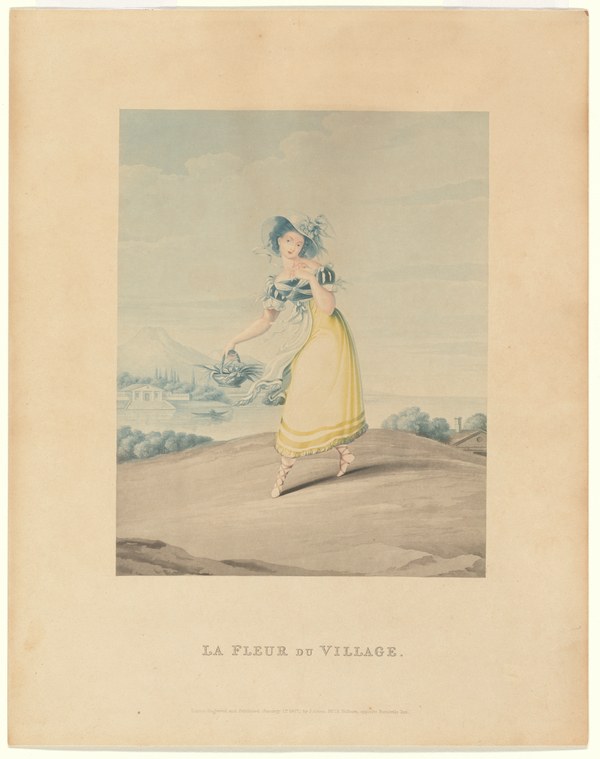
A young woman stands alone on an elevated, barren landscape, turning or posing with one arm extended gracefully outward. She wears a high-waisted, neoclassical dress in pale yellow with a darker striped or patterned bodice and short sleeves; her hair is styled up with what appears to be a decorative ornament or wreath. The figure is caught in a moment of elegant stillness or gentle movement, with her weight subtly shifted, suggesting either a pause within choreography or a moment of social dancing. Behind her, a distant landscape recedes—a valley or plain with trees, buildings, and architectural structures visible under a pale, clouded sky. The composition places the solitary figure prominently against this expansive natural setting, emphasizing her isolation and the delicacy of her pose. The work is a hand-colored engraving or aquatint, executed in soft tones of blue, yellow, and sepia, with careful attention to the fall of drapery and the modulation of light across the figure's body and the landscape.
The dancing
The dancer's posture is upright and composed, with the characteristic elongation of the neoclassical ideal. Her weight appears to rest primarily on one leg, while the other is subtly shifted, creating a gentle S-curve through the body. One arm is raised and extended, palm open and relaxed, while the other hangs naturally at her side. The pose suggests neither vigorous movement nor static display, but rather the arrested moment of a waltz, promenade, or similar social dance. Her gaze is directed outward, away from the viewer, contributing to a sense of reverie or contemplative grace rather than direct address.
The dance depicted
This work most likely depicts a waltz or a promenade from early 19th-century European social dance—possibly Regency-era courtship dancing. The neoclassical dress, the outdoor garden or country setting, and the solitary, introspective quality of the pose suggest the Romantic movement's interest in nature, individual feeling, and the idealized femininity of the period. The title *La fleur du village* ('The Village Flower') reinforces this reading: she is presented as a singular, delicate figure, a social ornament celebrated for grace rather than virtuosity. The image captures not a moment of technical display but the emotional register of social dancing—elegance, poise, and the presentation of the self in courtship.
How it was made
This is a hand-colored engraving or aquatint, a reproductive print technique that allowed wide circulation of fashionable imagery during the early 19th century. The soft coloring and careful modeling of form suggest professional hand-tinting applied after the printed line work. The technique was ideally suited to fashion plates, dance instruction imagery, and popular prints depicting contemporary social life. The print's presence in the New York Public Library's holdings of dance-related works indicates it was valued as documentation of period dance practice and fashion, part of the visual record of how women of the period moved, dressed, and were culturally imagined.
About this work
This is an early 19th-century French or English engraving depicting a young woman in an elegant neoclassical dress, posed in a moment of graceful stillness or gentle social dancing. The work belongs to the tradition of fashion and dance imagery that circulated widely during the Regency and early Romantic periods, capturing the aesthetic ideals of feminine movement and deportment valued in the ballroom and the drawing room. It is not a technical dance instruction image but rather a celebration of social dancing as an expression of refined feeling and natural grace—part of the broader cultural discourse about women, beauty, and movement that shaped European society in the early 19th century.
How to look at it
Attend to the arrested moment the artist has chosen: not the height of movement but a pause or glide, where the body is composed and the gaze is inward. Notice the careful attention to the fall of fabric, the positioning of the arms, and the subtle shift of weight—these are the signs of trained movement and refined carriage. The landscape setting is unusual for dance imagery of the period; it elevates the figure beyond the ballroom and associates her dancing with nature and feeling rather than social convention. The print's soft coloring and delicate line work create an effect of contemplative intimacy, inviting the viewer to admire both the figure's beauty and her emotional interiority.
The period
This work dates to the early 19th century, a period when the waltz was transforming European social dancing and generating considerable cultural anxiety and fascination. The Romantic movement's emphasis on nature, emotion, and the individual sensibility is evident in the composition: the solitary, contemplative figure set against an expansive landscape. Neoclassical dress and idealized bodily proportion remained the visual standard for depicting educated, refined femininity, even as Romantic aesthetics introduced new emphasis on sentiment and individualism. Dance imagery of this kind—fashion plates, prints, and illustrations—served both practical and aspirational functions: they taught correct deportment to young women while also circulating idealized images of beauty, grace, and social success through the emerging mass culture of the print market.
Where it lives
This work is held in the New York Public Library's collection of prints depicting dance. It is catalogued in the general holdings without recorded artist, date, or medium, but the style and subject matter place it confidently in the early 19th-century popular print tradition.
Dance in this work
Questions about this work
What dance is this woman doing?
The pose and setting suggest a waltz, promenade, or other early 19th-century social dance. The upright posture, raised arm, and shifted weight are consistent with Regency-era partner dancing, though the image captures a moment of stillness or gliding rather than vigorous motion. The solitary pose is unusual; in reality, these dances were performed with a partner in close proximity.
Why is she alone in a landscape?
The print is not a documentary record of dance practice but rather a romanticized vision of femininity and social grace. The natural landscape elevates the 'village flower' above the ballroom and associates her dancing with Romantic ideals of nature, emotion, and individual beauty. This was a common convention in early 19th-century popular prints.
What does her dress tell us about the period?
The high-waisted, neoclassical silhouette was the fashionable ideal for women of the educated middle and upper classes in the early 19th century. The pale color, delicate short sleeves, and minimal ornamentation reflect both Romantic aesthetics and the visual codes of refined, marriageable femininity. Such dresses were worn to social dances and appear frequently in period dance imagery.
More dance artwork





