49 works in this view — arrow keys or swipe to move between them.
Dance in Art
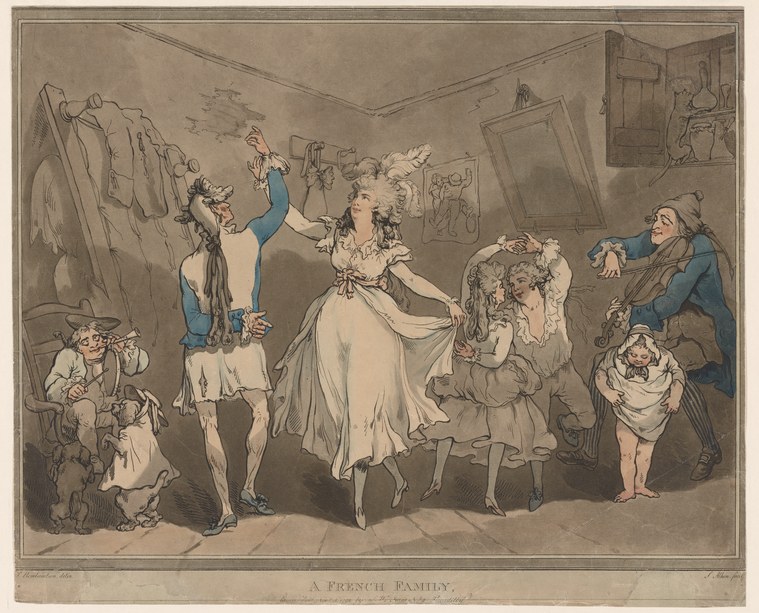
A French family.
Unknown artist
- Collection:
- Prints depicting dance
- Source:
- New York Public Library
- Rights:
- Public domain — free to use, share and adapt.
- Recorded as:
- Public Domain
This work documents dance as a domestic social practice rather than a formal institution, showing how dancing was integrated into family life and entertainment in the Regency period. It also preserves visual evidence of a now-obscure moment in dance history: the aesthetics, costumes, and conventions of parlor dancing in the early 19th century, when the high leg extension shown here was apparently a fashionable display of skill and flexibility.
What you are looking at
A fashionable family group occupies an interior space rendered in sepia tones with pen and wash technique. The scene captures a moment of social dancing and musical entertainment: a young man in blue breeches and white stockings performs a high leg extension or kick toward a standing woman in a flowing white Empire-waist dress, while musicians play in the background. Around them cluster family members—children, women in various states of dress or undress, and elderly figures—watching, participating, or attending to the spectacle. The setting appears to be a modest domestic interior with sketched furnishings and drapery. The composition is crowded and animated, with overlapping figures creating depth; the artist has emphasized the theatrical quality of the moment through exaggerated poses and the concentration of attention on the central dancing couple.
The dancing
The male dancer stands in a pronounced attitude, his right leg raised high in a vertical extension while his torso remains relatively upright, arms positioned to balance and display the movement. The female figure stands passively, watching, suggesting this is a display or demonstration rather than a partnered dance. The other figures adopt varied postures of observation: some seated, some standing, some leaning forward with evident interest. The artist renders the bodies with loose, confident draftsmanship that captures movement and personality through line rather than anatomical precision.
The dance depicted
This appears to be a scene of fashionable social dancing from the early 19th century, likely depicting a parlor or domestic dance entertainment. The high leg extension and the informality of the setting suggest this is not a ballroom dance in the strict sense, but rather an impromptu or domestic display of dancing skill—possibly a demonstration or performance for family amusement. The presence of musicians and the theatrical nature of the pose suggest this may depict a cotillion, quadrille, or other fashionable social dance of the Regency or early 19th-century period, performed in an informal domestic setting rather than a public ballroom.
How it was made
This is a hand-colored engraving or etching, worked primarily in sepia ink with watercolor or colored-ink wash applied selectively to accent clothing and create tonal effects. The technique allows fine linear detail in the background and furniture while the colored wash brings the central figures into prominence. This method of production—a printed engraved base with hand coloring—was typical of popular prints and satirical social commentary of the late 18th and early 19th centuries, indicating this work was intended for a broad literate public rather than a fine-art collector.
About this work
This hand-colored engraving presents a domestic scene of fashionable dancing and family entertainment, likely from the Regency era. The work captures the social function of dance in the home: not as a formal ballroom activity but as a participatory entertainment and display of skill and fashion. The artist observes the scene with affectionate humor, recording both the central dancer's evident pride and pleasure in his high extension, and the mixed reactions of family members—some delighted, some indifferent, some engaged in their own activities. The work belongs to a tradition of satirical and observational social prints that documented the manners and pleasures of the leisured classes.
How to look at it
Observe the central male dancer's pose: the high extension of his right leg is the focal point of the composition and the moment the artist chose to capture. Notice how the artist has exaggerated this pose to make it emphatic and slightly comic—the leg is extended almost impossibly high, and the dancer's posture emphasizes display rather than the balanced control required for formal ballroom dancing. Look at the reactions of the surrounding figures: they focus on the dancer with a mixture of amusement, admiration, and indifference that suggests this is a moment of domestic entertainment and showing off, not a formal social dance.
The period
This print dates to the early 19th century, a period when social dancing was undergoing rapid change. The fashions visible—the Empire-waist dresses, the informal domestic setting—place it in the Regency era (approximately 1811–1820). This was a period of intense interest in social dancing as both entertainment and courtship ritual, and prints documenting social life and manners were extremely popular. The ballroom dances of this period—the cotillion, the quadrille, the country dance—were the subject of numerous instructional books and satirical prints.
Where it lives
This work is held by the New York Public Library in its collection of prints depicting dance. The cataloguing as a 'French family' suggests the work may be satirizing French fashions or manners, or may depict the French dance culture that was highly influential in Britain during the Regency period.
Dance in this work
Questions about this work
Is this a ballroom dance?
No. While it depicts fashionable dancing of the ballroom-dance era, the setting is clearly a domestic interior, and the pose is too informal and display-oriented for formal ballroom dancing. This is domestic entertainment dancing—a social activity in the home rather than a public ballroom event.
What dance is being shown?
The specific dance is not identifiable from the pose alone. The high leg extension might suggest a cotillion or quadrille figure, or it might be an improvised display of skill. The early 19th-century setting and fashionable clothing support a Regency-era social dance, but the exact style cannot be determined.
Why is the artist satirical about this scene?
The exaggerated pose, the crowded composition with mixed reactions, and the title 'A French Family' suggest the artist is gently mocking fashionable pretension and the affectations of social dancing. The high leg extension and the theatrical self-display are presented with affectionate humor rather than cruel satire.
More dance artwork





