49 works in this view — arrow keys or swipe to move between them.
Dance in Art
La polkamanie
Unknown artist
- Collection:
- Prints depicting dance
- Source:
- New York Public Library
- Rights:
- Public domain — free to use, share and adapt.
- Recorded as:
- Public Domain
The print is rare evidence of how contemporaries experienced and satirized a major dance innovation. The polka was genuinely revolutionary—a fast, egalitarian, couple-centered social dance that challenged older ballroom hierarchies and decorum. Satirical prints like this show that the dance was not simply adopted; it was controversial, discussed, and debated in public. For dancers and choreographers, the image preserves the posture, frame, and moment of a dance form that remains taught and performed today.
What you are looking at
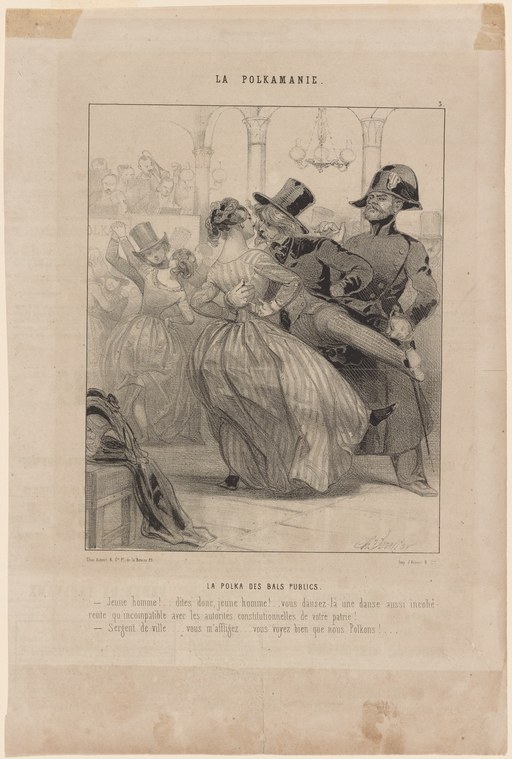
A crowded interior ballroom scene from the mid-nineteenth century, viewed from the side as though the viewer stands among the dancers. In the foreground, a couple mid-dance dominates the composition: the woman, in a full-skirted ball gown with visible striped or pleated fabric, leans back from the waist while her partner, a man in military dress uniform with a tall hat, supports her in a dynamic open position. Behind them, the ballroom recedes into shadow, filled with spectators in top hats and evening dress, their forms sketched lightly to suggest depth and crowd. Architectural details—classical columns and a vaulted ceiling with a chandelier—frame the scene in elegant perspective. The moment captured is one of energetic motion: the woman's skirts billow outward, her body arcs, and the man's posture shows effort and control. The print's title, "La Polkamanie," and a caption below make clear this is satire—social commentary on the polka craze that swept European ballrooms.
The dancing
The lead couple stand in an open-frame position with the woman's body supported and arched backward from the man's right side—a characteristic polka or quadrille figure. The man's left arm extends to hold her; his posture is upright and commanding. The woman's arms are not clearly detailed, but her spine curves and her skirts spread centrifugally, indicating rapid rotational movement. Their feet are small and lightly sketched, typical of period print conventions. Around them, dozens of onlookers stand or sit, many of them turned to watch the couple, confirming this as a public performance or demonstration within the ballroom rather than a casual social dance.
The dance depicted
This is a satirical image of polka dancing, the social craze that dominated European ballrooms from the 1840s onward. The polka was a fast, energetic couple dance in 2/4 time, often danced in a closed or semi-open frame with frequent turns and traveling steps. The print captures the moment of peak exertion—a turn or a traveling phrase—when the woman's full skirts would swing outward, creating the visual spectacle that made the polka both thrilling and, to conservative observers, scandalous. The title *La Polkamanie* signals that the artist is commenting on the dance's popularity as a mania or craze rather than celebrating it. The military man and fashionable woman represent the typical ballroom couple of the 1840s–50s.
How it was made
This is a lithographic print, likely a commercial illustration. The tonal range—deep blacks in the uniforms and shadows, lighter grays in the architectural background—and the fluid linework characteristic of lithography are evident throughout. The composition shows sophisticated use of perspective and atmospheric depth, with foreground figures rendered in full detail and background dancers sketched to suggest crowd without visual clutter. Lithography allowed rapid, affordable reproduction, making such satirical social commentary accessible to a broad urban audience in France and across Europe. This technique and subject matter suggest a publication in a satirical newspaper or album, likely aimed at middle-class readers amused or appalled by the dance fashion.
About this work
This is a mid-nineteenth-century satirical print documenting the social phenomenon of the polka craze that swept through European ballrooms. The artist captures not merely the dance itself—a couple in mid-turn, the woman's skirts billowing—but the ballroom crowd's fascination with it, hinting through the title *La Polkamanie* at attitudes of moral anxiety or simple mockery of the fad. The print is a lithograph, a medium that allowed quick distribution of topical commentary in newspapers and popular albums. It sits at the intersection of dance history and social satire, showing how a dance form became contested cultural territory in the nineteenth century. For dance historians, it documents the polka's technique and its role in ballroom etiquette; for art historians, it exemplifies the Parisian print culture of the 1840s–50s.
How to look at it
Notice the artist's choice to freeze the moment at maximum visual drama: the woman's skirts at full billlow, her body at an extreme arch, the man's supporting arm taut. This exaggerates the physical reality but makes the energy of the dance unmistakable. The crowd in the background is rendered deliberately less detailed, directing the eye to the couple and subtly reinforcing the satire—the bystanders are props to the performance. The military uniform and fashionable dress signal that this is not a folk or peasant dance but a ballroom novelty crossing social lines. Look also at the woman's posture: she is not passive but actively participating in the arch and turn, a detail that both illustrates the dance's energetic demands and, implicitly, challenges period conventions about female propriety.
The artist
The artist is not recorded. However, the print bears the mark of a professional lithographic shop—likely Parisian, given the French title and the sophisticated composition. The style is consistent with mid-nineteenth-century French satirical illustration, a thriving trade in Paris. Artists such as Honoré Daumier and Paul Gavarni created comparable social satire during the same decades. The image may derive from a newspaper like *La Caricature* or *Le Charivari*, or from a commercial album of fashionable types. The technical quality and subject matter suggest a shop with regular readers among the Parisian middle class.
The period
The polka arrived in European ballrooms in the mid-1840s, imported from Bohemia (then part of the Austrian Empire) through Paris and London. It was a radical departure from the formal, stationary figures of the quadrille or the sedately graceful waltz: faster, more physically exuberant, and executed by couples who could perform it nearly anywhere. By 1850, it was the dominant social dance, but not without resistance. Conservative moralists condemned it as too vigorous, too close-contact, and too democratic—a dance for anyone, not requiring aristocratic training. Satirical prints flooded the market in the 1840s–50s, many of them mocking the "polka mania." This image belongs to that moment of satire and anxiety. In fine art, the 1840s–50s saw the rise of commercial lithographic illustration and the expansion of print culture as a vehicle for social commentary.
Where it lives
The print is held in the New York Public Library's collection of prints depicting dance. It is catalogued as historical material but lacks detailed accession data. Prints of this type were widely distributed and often bound into albums or published serially, so the original publication context is not recorded here.
Dance in this work
Questions about this work
What is the polka, and why was it so controversial?
The polka was a fast, energetic couple dance in 2/4 time, originating in Bohemia and sweeping Europe in the 1840s. It was revolutionary because it was egalitarian (anyone could learn it), couple-centered, and physically vigorous—qualities that alarmed conservatives who saw it as undignified and morally questionable. Satirical prints like this one express the mix of fascination and disapproval with which educated Europeans greeted the craze.
Who made this print, and how was it distributed?
The artist is not recorded, but the technical quality and French title suggest a Parisian commercial lithographic shop, possibly one associated with a satirical newspaper or popular print album. Lithography allowed rapid, affordable reproduction, making such commentary accessible to middle-class readers. Prints were sold individually, bound into albums, or serialized in newspapers.
What does the woman's posture tell us about how the polka was danced?
Her arched back and extended position in an open frame show that the polka was not a closed, upright dance like the waltz, but one that allowed—or required—dramatic, dynamic body positions. The woman is actively engaged, not merely supported; her skirts swing outward because of rapid rotation and travel. This details contradicts later, more sedate versions of the polka and confirms contemporary accounts of its energetic character.
Why is the title 'La Polkamanie'?
The suffix "mania" signals satire: the artist is commenting on the polka not as a dance form but as a social craze or obsession. The print mocks the public's enthusiasm for the dance, a typical stance of satirical prints in 1840s–50s Paris. Similar titles like "Waltzmania" or "Quadrille-mania" appeared in contemporary prints, reflecting anxiety about fashion and mass behavior.
More dance artwork





