49 works in this view — arrow keys or swipe to move between them.
Dance in Art
Mascarade
Unknown artist
- Collection:
- Prints depicting dance
- Source:
- New York Public Library
- Rights:
- Public domain — free to use, share and adapt.
- Recorded as:
- Public Domain
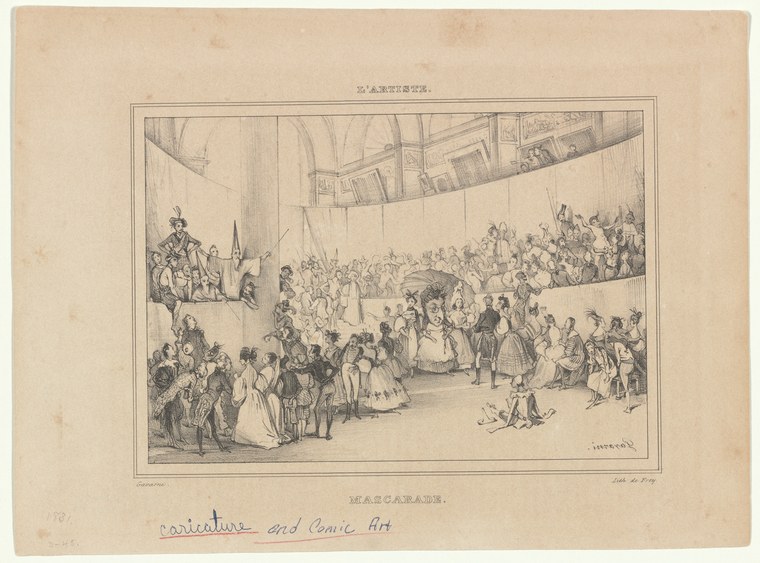
Masquerades were pivotal spaces where formal court dances migrated into public or semi-public social life, and where the boundary between dance and social performance dissolved. The image is rare evidence of how ballroom dancing was actually staged and observed in the 18th century—not in isolation, but within a charged atmosphere of disguise, speculation, and social display that fundamentally changed the meaning of the dance itself.
What you are looking at
A masquerade ball held indoors, likely in an 18th-century rococo interior with tall ceilings and architectural detail visible above. The artist employs a wide-angle perspective that compresses the space theatrically, showing multiple clusters of figures distributed across the floor and elevated viewing galleries. Elaborately dressed guests in formal wear—men in coats and tricorn hats, women in wide pannered gowns—move through the space in conversational groups and dance pairs. The density of figures suggests a public spectacle, and the viewing galleries packed with onlookers confirm this as a major social event. At center-left, a small group appears to be dancing while musicians (barely visible) provide accompaniment. The overall mood is one of theatrical artifice: the masquerade costumes, the formal architecture, the careful arrangement of figures across multiple planes, and the elevated vantage point from which we observe all combine to present the ball as a choreographed social performance rather than intimate gathering.
The dancing
The dancers visible at center-left show the closed-hold pairings typical of 18th-century ballroom dance, with men and women facing and moving in relation to one another. Posture is upright and formal; skirts are voluminous, constraining leg movement to small, controlled steps. The surrounding figures are chiefly in standing conversation or processional movement—social mingling rather than active dancing. The composition emphasizes the social geometry of the ballroom: pairs in partnership, groups in observation, and hierarchical spatial arrangement from floor to galleries.
The dance depicted
This is a masquerade or masked ball, a fashionable 18th-century social event in which formal ballroom dancing—most likely minuets, gavottesand other baroque-era court dances—took place within an atmosphere of theatrical disguise and social play. The image captures the event type itself rather than a specific dance form: the masquerade was the container, and the dances inside it were the genteel courtly repertoire. The presence of multiple couples and the formal dress indicate participation by the elite; the artist has chosen to show the event as spectacle—a moment of social display and observation—rather than isolating a single dance moment.
How it was made
This is a line engraving or etching printed on laid paper, executed with careful crosshatching and fine linework to render fabric, architecture, and crowd. The technique is characteristic of 18th-century reproductive print-making, which allowed such scenes to circulate widely among an educated audience interested in social customs and fashionable life. The formal composition and high finish suggest this was made for commercial distribution—a documented record of a notable social event or a type-scene representing masquerade culture. The artist's control of perspective and spatial recession is skilled, allowing the viewer to read the crowd and the architectural setting with clarity despite the density of figures.
About this work
A line engraving documenting an 18th-century masquerade ball in progress, capturing both the choreography of formal ballroom dancing and the social architecture of the event as public spectacle. The work is a valuable record of ballroom culture during the rococo period, showing how dances of the baroque repertoire—minuets, gavottes, and their companions—were integrated into masked social performance. The artist's choice to show the event from a bird's-eye or elevated vantage, with galleries full of observers, emphasizes that masquerade was as much about being seen and observed as about dancing itself. This is a document of social custom rendered as theatrical scene.
How to look at it
Observe how the artist has positioned the viewer as an external observer in a gallery or balcony, looking down at the crowded floor below: we are watching watchers. Notice the careful distribution of figures—some dancing in pairs at center, others standing in clusters, others merely observing from above—which captures the masquerade as a social system of movement and stillness, participation and observation. The formal dress and masks visible in the crowd confirm this as an event of controlled artifice; the architectural grandeur frames the dancers as participants in a stage-like setting. The artist has chosen to show the moment not of a single dance's peak, but of the ongoing spectacle—the masquerade as a complete social performance.
The period
The masquerade was at the height of fashion in 18th-century Europe, particularly in Venice and London, reaching its peak in the 1730s–1770s. It represented a temporary suspension of social hierarchy: masks allowed anonymity, and the theatrical atmosphere encouraged both playfulness and social transgression. Formally, ballroom dances of the period—the minuet, gavotte, cotillion, and later the quadrille—were highly codified steps requiring training; the masquerade allowed them to be performed in an atmosphere of costume and disguise that foregrounded the spectacle over the technical precision. Prints like this one documented the phenomenon for a European audience curious about fashionable life and social novelty.
Where it lives
The work is held in the New York Public Library's collection of prints depicting dance and is catalogued as a historical document of 18th-century social custom. It is a commercial print, likely published to meet demand among European elites for images of fashionable entertainments.
Dance in this work
Questions about this work
What dances would actually have taken place at a masquerade like this?
The formal ballroom dances of the 18th-century baroque and rococo repertoire: the minuet (the highest-status choice), the gavotte, the bourrée, and from mid-century onward, the cotillion and quadrille. These were all partner dances requiring training and performed in closed holds or in set formations. The masquerade didn't change the dances themselves, but the atmosphere of costume and anonymity did change how they were experienced and observed.
Were masquerades only for the very wealthy?
Masquerades ranged from exclusive private balls held by aristocrats to semi-public events in public rooms that charged admission. Venice's public ridottos were among the most famous, mixing social classes in ways that shocked contemporary observers. This print likely depicts a grand private or semi-public event of the fashionable elite, but masquerades as a phenomenon crossed class lines.
Why does the artist show the scene from above and include all those spectators?
The elevated vantage and the packed galleries are essential to understanding the masquerade as a social event. Being seen and watching others were as important as the dancing itself. The artist has documented the social system of the masquerade—who dances, who watches, how the space is organized—rather than focusing on the dance technique. This is a scene of social performance, not dance instruction.
More dance artwork





