49 works in this view — arrow keys or swipe to move between them.
Dance in Art
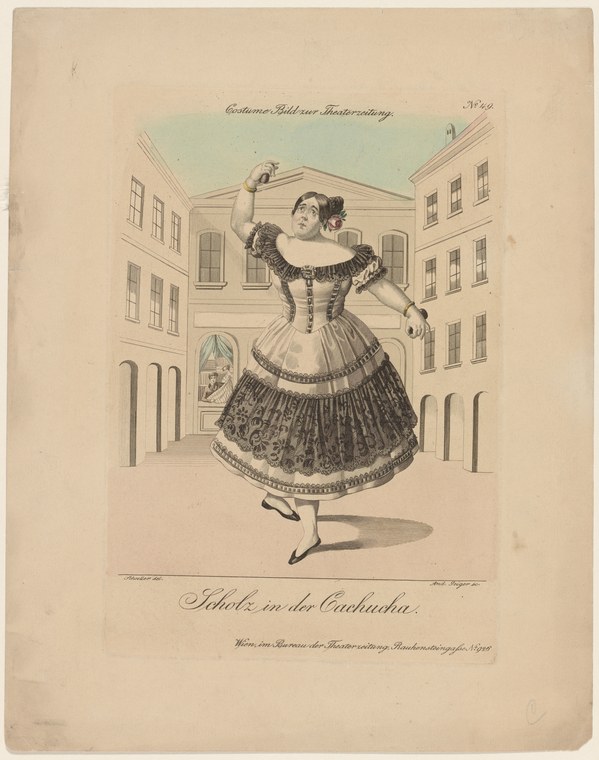
Scholz in der Cachucha
Unknown artist
- Collection:
- Prints depicting dance
- Source:
- New York Public Library
- Rights:
- Public domain — free to use, share and adapt.
- Recorded as:
- Public Domain
The cachucha was one of the most widely documented dances of the nineteenth century, and this print provides specific evidence of how the dance looked in performance and how individual dancers shaped it. For historians of Spanish dance in the theater and of the cultural circulation of dance across national boundaries, this image of Scholz is a concrete reference point—not a generic representation but apparently a record of a particular artist's interpretation of a role that women performers made famous.
What you are looking at
A woman in mid-nineteenth-century dress performs the cachucha in an urban plaza, her body captured in an energetic moment. She wears a dark, elaborately decorated dress with a deep neckline, puffed sleeves, and a voluminous skirt featuring intricate patterns and trim. The skirt is caught in motion, lifted to show her legs and feet. Her torso is arched back, one arm raised overhead in an expressive gesture, the other extended to the side, her face turned upward in exuberance. The setting is a neoclassical courtyard or plaza, with three-story buildings featuring large windows and regular fenestration forming an austere backdrop. The sky is rendered in pale blue, and a sharp shadow is cast on the ground, emphasizing the sculptural quality of the figure and the intensity of her movement. The entire composition—figure, dress, and setting—is rendered in hand-colored engraving, with the title "Scholz in der Cachucha" printed below and a German attribution line suggesting this is a theatrical or performance print.
The dancing
The dancer's body is in a pronounced backbend or arch, with weight seemingly on one leg while the other is raised. Her raised arm extends upward with considerable extension, and her lowered arm gestures outward in a sweeping motion. The exaggerated spinal extension and the high, energetic arm placement are characteristic of Spanish dance of the period. Her feet and lower legs are visible, showing what appears to be a pointed or extended position. The isolation of a single figure, the emphasis on the torso and upper body movement, and the dramatic uprightness of her posture distinguish this from the paired, closed-hold dances of ballroom convention.
The dance depicted
This is a cachucha, a Spanish dance that became a popular theatrical piece across Europe in the nineteenth century, particularly celebrated in ballet and stage performance. The cachucha was associated with Spanish national identity and was often performed by soloists or in featured theatrical moments. The figure identified as "Scholz" was likely a professional dancer of the era; the name and German publishing context suggest this may document a particular performer's signature role. The image captures the dance's characteristic qualities: the upright, arched torso, the expressive arm work, the exposed footwork, and the sense of passionate, individual display rather than couple work or geometric formation.
How it was made
This is a hand-colored engraving or aquatint, a reproductive print technique that allowed for mass distribution of performance images to a theater-going public. The hand coloring—visible in the pale blue sky, the flesh tones, and the decorative detail of the dress—was applied after printing, making each impression unique in its exactness of color. The technique allowed fine rendering of the dress fabric and the architectural setting while capturing dynamic human movement in a way suited to theatrical promotion. The presence of a German language caption and publisher's mark indicates this circulated among German-speaking audiences in the nineteenth century, likely as a souvenir or promotional image for a touring dancer or theater production.
About this work
This is a theatrical performance document of the nineteenth century, recording the cachucha as performed by a dancer identified as Scholz. The cachucha was one of the defining popular dances of the era—Spanish in origin but absorbed into European theater and ballet as a vehicle for virtuosity and national exoticism. This print captures not only the choreography but the way the dance was understood: as a display of individual brilliance, architectural body control, and passionate energy, set against the rational geometry of the urban European landscape. The image belongs in a dance archive both as a historical record of how this dance was performed and as evidence of the way nineteenth-century theater made dance legible and portable through visual reproduction.
How to look at it
Look first at the body: the arch of the spine and the position of the raised arm are the signature of Spanish dance in this era, distinct from the upright carriage of classical ballet. Notice the footwork—the raised and pointed foot—and how the dancer's weight appears to be carried on a single supporting leg, which is consistent with the cachucha's stepping patterns. Observe how the dress is being moved by the dancer's motion; the lifted skirt was part of the performance vocabulary and allowed the audience to see the footwork and leg position. Finally, attend to the moment chosen: the artist has frozen a peak moment of extension and display, not a transitional step, emphasizing the theatrical virtuosity and the exuberance of the movement.
The artist
The artist is not recorded. The print was published in Germany and appears to be a professional theatrical or souvenir print of the type produced by multiple European publishers in the nineteenth century to capitalize on the popularity of touring dancers and stage productions. The hand-coloring and the quality of the engraving suggest a print house of some capability, likely based in a major German city.
The period
The cachucha became a craze in European theaters in the 1830s and 1840s, imported from Spain and adopted into ballet as a solo or featured dance. In the same period, theatrical prints in color became a standard form of fan merchandise and performance publicity, allowing theater-goers to own images of celebrated dancers and roles. The romanticization of Spanish and other "exotic" national identities was central to the aesthetics of this era, and the cachucha was marketed as an expression of Spanish passion and vivacity. This print dates from that mid-nineteenth-century moment when the dance was at the height of its European popularity, though the exact date of performance and publication remains uncertain.
Where it lives
This is a hand-colored engraving or similar reproductive print in the NYPL collection of prints depicting dance. It is one of hundreds of similar theatrical souvenir prints produced in Germany and other European centers in the nineteenth century, and it was likely available for purchase at theaters or through print sellers of the period.
Dance in this work
Questions about this work
What is the cachucha and why was it so popular?
The cachucha is a Spanish folk or national dance that became a sensation in European theaters in the 1830s and 1840s. It was adopted into ballet and stage performance as a vehicle for displaying virtuosity, national exoticism, and individual artistry—particularly by women dancers. The dance's characteristic features include a lifted, expressive upper body, rapid footwork, and use of the arms and head to convey emotion and energy. It fit perfectly with the Romantic-era taste for passion, folk authenticity, and non-classical body movement.
Who was Scholz and why was she important enough to be documented in print?
Scholz was a professional dancer of the nineteenth century, and the fact that her image was published suggests she was well-known enough to attract a market for her portrait. Professional dancers of the era became celebrities, and prints of them—often in their signature roles—were sold as souvenirs to theater audiences. Without more context, it is difficult to say more about her individual reputation, but the existence of this print is evidence that she was notable enough to warrant commercial reproduction.
How does this print tell us about how people learned dance in this period?
Prints like this were one of the primary ways that dance imagery circulated beyond the theater. A dancer in another city could own this image and use it as a reference for how the cachucha was performed by a celebrated artist. Combined with written descriptions and the memory of live performance, these prints helped to standardize and spread particular versions of dances across Europe. They also served as advertisements, encouraging people to attend performances and helping to build the celebrity of individual dancers.
Why is the dress so important to this image?
The dress is integral to the cachucha performance—the lifted skirt reveals the footwork and leg position, which are essential to understanding how the dance was executed. The embellishment and structure of the dress, with its fitted bodice and voluminous skirt, also define the silhouette and allow the torso and arm movement to read clearly. The richness and detail of the dress in this print also emphasize the glamour and status of the performer and the production, suggesting this was a significant theatrical event.
More dance artwork





