49 works in this view — arrow keys or swipe to move between them.
Dance in Art
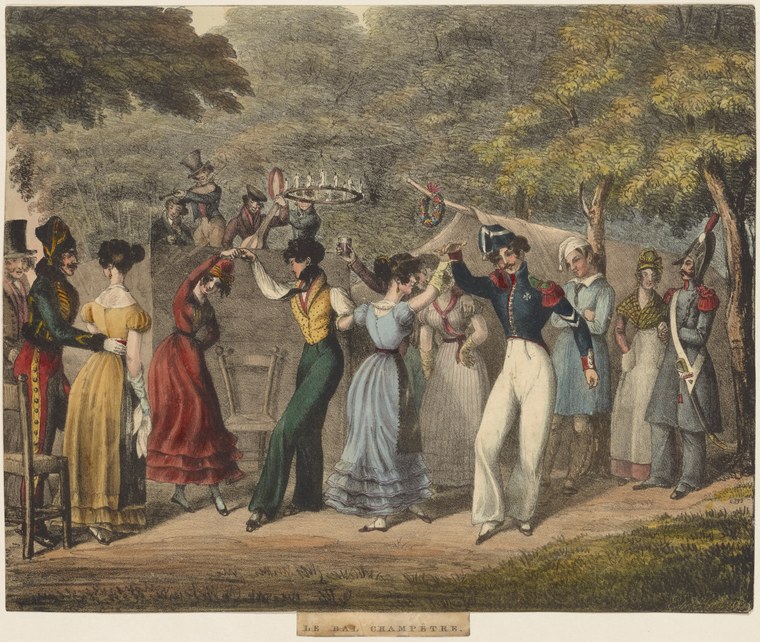
Le bal champêtre
Unknown artist
- Collection:
- Prints depicting dance
- Source:
- New York Public Library
- Rights:
- Public domain — free to use, share and adapt.
- Recorded as:
- Public Domain
This image is one of the primary visual records of how country dancing was actually performed in the early 19th century—the frame, the spacing, the scale of movement. The title and the French provenance (if confirmed) would make it a valuable record of how this dance was practiced outside Britain. For historians of courtship and gender, it documents the physical protocols of acceptable male-female contact during this period.
What you are looking at
A fashionable outdoor dance in a wooded park or garden, rendered in hand-colored engraving. The scene captures a moment of social dancing among what appears to be the leisure class of early 19th-century Europe. The composition centers on several couples engaged in dance, with the nearest pair—a woman in a pale, high-waisted gown with short puffed sleeves and a man in dark coat and pale breeches—in an engaged position. Surrounding them are spectators in period dress: women in Empire-waist gowns of yellow, red, and pale blue, and men in military-style dress coats with gold braiding. The setting is densely wooded, with tall trees creating a canopy overhead and soft, dappled light. In the middle distance, musicians can be seen, suggesting this is an organized social gathering rather than spontaneous dancing. The overall mood is one of refined leisure and courtship, typical of Romantic-era outdoor amusements.
The dancing
The dancers adopt the closed, upright frame characteristic of early 19th-century social dance: the man's left hand holds the woman's right at shoulder height, his right hand positioned at her waist, while her left arm extends toward his shoulder. Their bodies maintain formal vertical alignment with minimal hip movement. Several other couples are positioned throughout the scene in similar holds, suggesting the simultaneous dancing of multiple pairs rather than a line formation. The women's high-waisted empire silhouettes and the men's formal tailcoats are consistent with the period and the elegance of the occasion.
The dance depicted
This is a country dance or cotillion of the early 19th century, most likely French given the inscription 'Le bal champêtre' (the country ball). The scene depicts the kind of outdoor social dancing that occupied the rural leisure class during summer months. The formal dress, the presence of musicians, and the careful composition of multiple pairs suggest this is a formal country dance—a choreographed set dance with established figures—rather than improvised movement. The inclusion of spectators indicates this was a semi-public performance or demonstration of social accomplishment, as dancing skill and etiquette were central to courtship and social standing.
How it was made
This is a hand-colored engraving, identifiable by the fine parallel line-work defining form and shadow, the clear outlines, and the selective hand application of watercolor or gouache to create the pale tonalities of the fabrics and the soft greens of the foliage. The technique allowed for multiple impressions and thus wide distribution of this image as a record of fashionable conduct. The hand-coloring suggests this was a premium print, likely aimed at the educated and affluent audience who actually participated in such gatherings. The delicate execution and the romantic subject matter are characteristic of early 19th-century French and British fashion and social scene prints.
About this work
This is a document of courtship ritual and social dance in the Regency era, preserved in the form that made such images accessible to the aspiring middle and upper classes. The engraving records not just a dance, but an entire code of conduct: the posture, the dress, the gendered proximity, the presence of witnesses, and the woodland setting as a place of respectable leisure. It belongs in a dance collection because it captures the moment when dance moved outdoors and became a tool of romantic display, and because it shows us exactly how the body was held and how couples related in a form of dance—country dancing—that was foundational to both European and American social culture for centuries. The precision of the engraving means we can read the mechanics of the dance from the bodies themselves.
How to look at it
Notice the positioning of the hands and the distance between the partners—this is the social dance frame of its era, and it differs markedly from earlier and later styles. The artist has chosen to freeze a moment of movement but not an extreme moment: the dancers are upright and composed rather than captured mid-leap or turn. Look at the spectators to understand the social function: this is not private dancing but a semi-public display. The woodland setting, unusual for dance images, is itself the subject—this is a celebration of dancing in nature, a Romantic ideal.
The period
The early 19th century saw the country dance and the cotillion at the height of their cultural importance. The outdoor 'country ball' or rural fête was a Romantic-era invention, combining the formality of the ballroom with the naturalness and freedom of the garden or parkland. This was the era of Jane Austen (whose novels are saturated with the social significance of dancing), and the image reflects exactly that world: the high-waisted Regency gown, the military dress coat, the careful courtship through paired dancing. Simultaneously, this was a period of explosion in the production of fashion and social conduct prints, particularly in France and England, which circulated images of correct behavior to a reading and purchasing public.
Where it lives
The work is held in the NYPL Prints collection and is catalogued as a print depicting dance. No artist attribution is recorded.
Dance in this work
Questions about this work
What dance is this?
This is a country dance or cotillion, the most popular social dances of the early 19th century. These were set dances with established figures, usually performed by multiple couples in formation. The French title 'Le bal champêtre' (country ball) emphasizes the outdoor, rural setting.
How do I know this is early 19th century?
The women's Empire-waist gowns with high waistlines, short puffed sleeves, and the men's tailcoats are characteristic of Regency fashion (roughly 1800–1820). The engraving technique and hand-coloring are also consistent with the print culture of that period.
Why are there spectators?
Social dancing in this era was as much a display of refinement and courtship as it was recreation. The presence of witnesses—other fashionable people watching—indicates that dancing skill and deportment were public measures of social standing.
Is this a real event or an idealized scene?
It is likely a type scene—an image of the kind of gathering that occurred, rather than a record of a specific event. Fashion and conduct prints of this era worked as educational and aspirational documents for their audiences.
More dance artwork





