49 works in this view — arrow keys or swipe to move between them.
Dance in Art
Sposalizio del gobbo nan
Unknown artist
- Collection:
- Prints depicting dance
- Source:
- New York Public Library
- Rights:
- Public domain — free to use, share and adapt.
- Recorded as:
- Public Domain
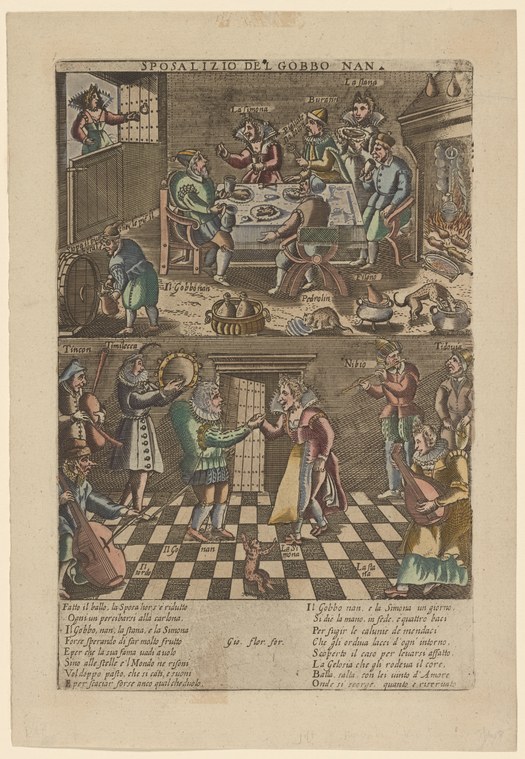
This engraving is one of the few surviving visual documents of how Renaissance social dances were actually performed in their original festive context, showing the informality and sociability of the event rather than the formal positions found in dance instruction manuals. It demonstrates that Renaissance dancing was not merely an elite technical practice but a ubiquitous social activity that merged with eating, drinking, music, and courtship in a single evening's entertainment.
What you are looking at
This is a two-register engraving depicting a wedding feast and celebration. The upper register shows an indoor banquet scene with figures seated and standing around a laden table; musicians play in the background, and attendants serve food and drink. The lower register depicts an outdoor or covered space with a checkered floor, where couples and groups of figures engage in social dance and celebration. The title references a hunchbacked dwarf (gobbo nano), likely a court entertainer or fool figure whose presence would have been typical in Renaissance festive gatherings. The composition captures the full social spectacle of a wedding celebration—feasting, music, and dancing—with numerous figures in period dress distributed across both scenes. The engraving employs crosshatching and fine line work to create depth and texture, and includes Latin inscriptions below describing the festivities.
The dancing
In the lower register, couples and groups move in loose formations across the checkered floor. Figures adopt varied postures: some stand in upright social positions, others lean toward partners, and a few appear mid-step. The dancers wear long gowns and doublets typical of Renaissance dress. Arm positions are mostly at the sides or extended in social gesture rather than in closed ballroom holds. The groupings suggest simultaneous informal dances and social interactions rather than a single coordinated figure, typical of Renaissance courtly entertainment where multiple activities occur in parallel.
The dance depicted
This depicts Renaissance-era social dancing at a wedding feast, most likely Italian given the title and style. The dances shown are informal social dances—likely variations of basse danse, galliard, or other court dances of the 16th century that would have been performed during celebrations of this type. The lower register shows the casual, interactive quality of such occasions: dancers move in and out of partnerships, converse, and circulate through the space rather than executing a formal sequence. The presence of musicians (visible in the upper register) confirms that instrumental music accompanied the dancing. The work documents not the technical execution of a specific dance form but the social function of dancing within courtly entertainment.
How it was made
This is a hand-colored engraving, as evidenced by the fine parallel line work (crosshatching) that builds form and shadow, combined with areas of watercolor or oil wash in reds, greens, and flesh tones. The technique of engraving allowed for precise detail and narrative complexity—multiple figures and settings can be rendered clearly—and the coloring by hand suggests this was a prestige object, likely produced in limited quantity for a educated courtly or merchant audience. The two-register composition and the inclusion of Latin inscriptions indicate this was created as an edifying or commemorative print meant for viewing and study, not casual consumption.
About this work
This is a Renaissance engraving documenting the festive culture of a 16th-century Italian wedding, with particular attention to the role of dancing and music in courtly celebration. The work captures both the formal feast and the informal social dances that followed, showing how dancing functioned as a central entertainment and expression of courtship and sociability. It belongs in a gallery about dance because it documents not merely the technique of a specific dance form but the cultural context in which Renaissance social dances were performed—their place in courtship, celebration, and the mingling of different social ranks (including the presence of a court dwarf or fool, a figure whose role in Renaissance entertainment was tied to comic performance and sometimes dance).
How to look at it
Attend to the contrast between the ordered formality of the feasting scene above and the looser, more interactive quality of the dancing below. Notice how the dancers are distributed across the space in multiple small groups rather than in a single coordinated line or set—this reflects the actual social practice of Renaissance dancing, which allowed simultaneous participation by many couples and groups. The checkered floor in the lower register is not merely decorative; it grounds the dance in a specific space and may reference actual Renaissance dance floors or pavements. Look also at the dress: the full skirts and long sleeves of the women and the doublets and hose of the men are not stylized fantasy but the actual garments in which these dances were performed, constraining and enabling movement in particular ways.
The period
This work dates to the 16th century, when printed engravings were becoming an important means of documenting and circulating images of courtly life and entertainment throughout Europe. Renaissance wedding feasts were elaborate theatrical events that served political and social functions—they displayed wealth, cemented alliances, and allowed for the performance of status through dress, music, and dance. Dancing at such events was guided by courtesy manuals and dance instruction books (such as those by Arbeau and others), but the actual practice was far more fluid and social than the formal positions in those texts suggest. The inclusion of a dwarf or fool figure reflects the common practice of employing such entertainers to provide comic relief at courtly celebrations.
Where it lives
This engraving is held in the New York Public Library's print collection devoted to dance imagery, which gathers visual documents of dance practice and performance from multiple periods and cultures. The work is catalogued by subject (dance) rather than by artist or date, suggesting it entered the collection as a historical document of dance practice rather than as a work by a known master.
Dance in this work
Questions about this work
What is a 'gobbo nano' and why is this a wedding for one?
A gobbo nano (hunchbacked dwarf) was a court entertainer or fool employed by Renaissance nobility to provide comic relief and entertainment at celebrations. Such figures were common at courtly events, and their presence at a wedding feast—likely as the host or a central entertainment—would have been a mark of the patron's wealth and status. Whether this engraving documents an actual historical wedding or is a generic scene of wedding celebration is unclear from the image alone.
What dances are actually being shown here?
The print does not show a single identifiable dance form but rather the social dancing that occurred during a wedding celebration. Based on the period and context, dancers would have performed variations of basse danse, galliard, pavan, or other court dances known from 16th-century manuals. The loose, informal groupings and the variety of gestures suggest that multiple dances or a continuous mixing of social movement took place rather than a formal, unified figure.
Why are there two separate scenes?
The two-register composition (banquet above, dancing below) was a common way of showing the full arc of a courtly celebration: the formal feast followed by the social dancing and entertainment that concluded the evening. This structure allowed the artist to document both the abundance of the feast and the sociability and courtship rituals enacted through dance, presenting a complete picture of courtly festivity.
More dance artwork





