49 works in this view — arrow keys or swipe to move between them.
Dance in Art
Le quadrille du Prince Impérial
Unknown artist
- Collection:
- Prints depicting dance
- Source:
- New York Public Library
- Rights:
- Public domain — free to use, share and adapt.
- Recorded as:
- Public Domain
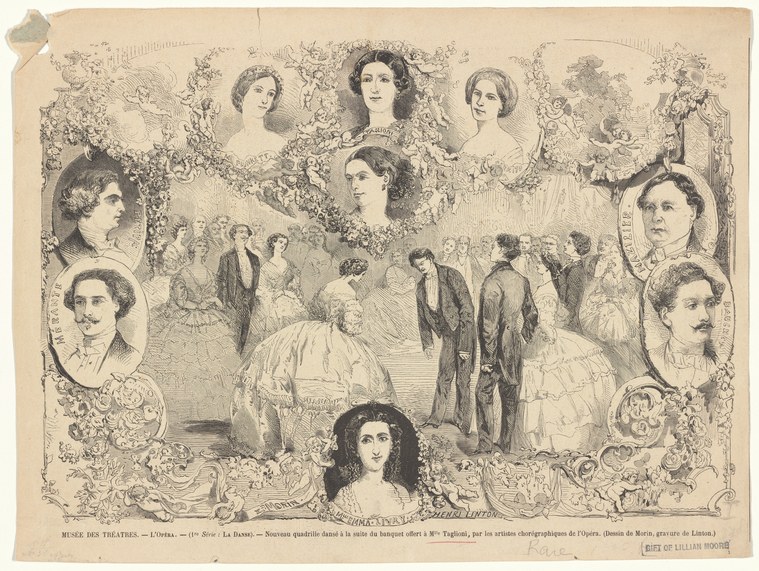
This image documents the quadrille at the height of its prestige in the French Imperial court, preserving both the formal structure of the dance and the aesthetic ideals of mid-19th-century ballroom culture. For dance historians, it is crucial evidence of how the quadrille was actually composed and performed, how it related to other social displays, and how it was celebrated in visual culture—not as folk practice but as high art and state ceremony.
What you are looking at
This is a composite engraving celebrating the Imperial ballet world, likely from the Second Empire in France (1850s–1870s). The composition arranges multiple portrait medallions of dancers and performers around a central scene of a formal ball or quadrille in progress. The central vignette shows elegantly dressed figures in a ballroom setting—men in dark formal dress coats and women in full crinoline skirts with bare shoulders and décolletage, the women's hair dressed high and adorned. Some couples stand at conversational ease; others are positioned as if mid-dance or about to join the quadrille. The overall design is ornamental, with scrollwork and floral garlands framing each portrait and the central scene, rendered in the delicate, labor-intensive technique of steel engraving. The portraits around the border appear to be of celebrated dancers and performers of the era, presented as celebrities of the moment. The whole forms a kind of social document of the fashionable dance world.
The dancing
The central dancers are in formal ballroom posture: upright carriage, women with arms either held at their sides or positioned for partner contact, men in the closed or promenade holds typical of the period. The women's voluminous skirts dominate the silhouette, extending to the ankles and requiring considerable floor space and careful footwork; the men are stationary or stepping with controlled precision. The portraits show individual dancers or performers in bust form, some in profile, suggesting they were well-known names. The spacing and grouping suggest both observation of actual court etiquette and idealization—the figures are graceful and composed rather than caught in vigorous action.
The dance depicted
The image documents the quadrille, the dominant ballroom dance of the mid-19th century French Imperial court and aristocracy. The title references the Imperial Prince, and the composition celebrates this as a prestigious social and artistic event. The quadrille was danced by sets of four couples in a square formation, with figured movements progressing through distinct phases; what we see here is likely the preparatory or promenade phase, with couples positioned for the dance rather than executing the most complex figures. This was the dance of state occasions and elite social life, distinct from the waltz which was simultaneously gaining ground. The engraving serves as a visual record of who danced and with whom, and of the spectacle of the Imperial ballet world.
How it was made
This is a steel engraving, a printmaking technique that allowed for fine detail and long print runs, making it far more durable and economical than copper. Steel engraving was the dominant medium for popular prints, fashion plates, and social documentation in the 19th century. The technique required hand-engraving each line into the steel plate, allowing the artist to render minute detail—the pleats in the skirts, the texture of the men's coats, the individual curls in the hair, the ornamental scrollwork. The composite structure—multiple portraits integrated into a single scene—was typical of commemorative prints celebrating important events or institutions. This object would have circulated widely as a print to be framed and displayed in homes or studios, making it a means of disseminating both fashion and social aspiration.
About this work
This engraving is a mid-19th-century French celebration of the Imperial court's quadrille culture, presenting the quadrille not as a mere dance but as an institution of state and high society. The quadrille was the ballroom dance that defined respectability and rank in the Second Empire; to be depicted dancing the quadrille at an Imperial ball was to be marked as part of the elite. The engraving's composite format—individual portraits of celebrated dancers framing a ballroom scene—treats the quadrille as both a social performance and a spectacle, in which the dancers were as much on display to each other as the print itself displays them to viewers. The work captures a moment when ballroom dancing was central to political and artistic identity, and when that world could be commodified and celebrated in print.
How to look at it
Attend to the rigid formality of posture and spacing: this is not spontaneous movement but choreographed, where every position and angle is prescribed by the rules of the quadrille. Notice the women's skirts—they are so voluminous that the dancer's legs are invisible, and footwork is inferred rather than seen; the dance was as much about the management of fabric and space as about the steps. The engraving's ornamental frame of portraits signals that the dance is not the primary subject; rather, the dancers' identities and status are. The central scene is idealized rather than naturalistic—the artist has arranged the figures to show the quadrille's formal structure, not to capture a single moment of action.
The artist
The artist is not recorded in the catalogue. However, the style is consistent with the commercial print trade of mid-19th-century Paris, which produced thousands of such commemorative and fashion-related engravings. The competent, high-finish technique and the design's integration of portraiture with narrative scene suggests a professional shop engaged in social documentation and court patronage work.
The period
The quadrille dominated European ballroom culture from the 1820s through the 1880s, reaching peak prestige during the Second Empire (1852–1870). It was the dance of Empire and aristocracy, requiring instruction, etiquette, and social standing to dance correctly. Simultaneously, the waltz was becoming more acceptable in high society after decades of controversy over its closeness and sensuality. The mid-19th century saw intense visual documentation of ballroom life—fashion plates, lithographs, engravings—as print technology made such imagery economical to produce and circulate. The quadrille was seen as the apex of refinement and national French culture; Imperial balls were state events, and the dancers were public figures whose participation was newsworthy.
Where it lives
This object is held in the New York Public Library's collection of prints depicting dance. It is catalogued as 'Le quadrille du Prince Impérial' with no artist attribution recorded.
Dance in this work
Questions about this work
What is a quadrille?
A quadrille is a ballroom dance for four couples arranged in a square formation, popular from the 1820s through the late 19th century. It consists of five or six distinct figures, each with prescribed steps and patterns, and requires instruction and coordination. It was the dominant dance of formal social life in Europe and was considered the height of refinement and respectability.
Why is the Prince Imperial mentioned in the title?
The Imperial Prince (Napoléon Eugène Louis Bonaparte, 1856–1879) was the only child of Napoleon III and Empress Eugénie, and the heir to the French throne during the Second Empire. A ball featuring the Imperial family would have been a major state occasion and a subject of intense public interest; his presence at the quadrille elevated it from a social dance to a ceremonial performance.
How do I tell this is an engraving and not a painting?
An engraving is made by hand-cutting lines into a metal plate (in this case steel), which is then inked and printed. You can see the characteristic parallel and crossed lines (hatching and cross-hatching) used to create shading and tone; the edges are crisp and precise, and there is no variation in texture like brushwork. The print would have been circulated as a reproduction, not as a unique artwork.
Why are there portraits around the edge?
The portraits are likely of celebrated dancers and performers of the Imperial court. The composite format allowed the print to function as both a record of a specific event and a celebrity roster, making it a collectible item for fans of dance and high society. It was a common format for commemorative prints in the 19th century.
More dance artwork





