49 works in this view — arrow keys or swipe to move between them.
Dance in Art
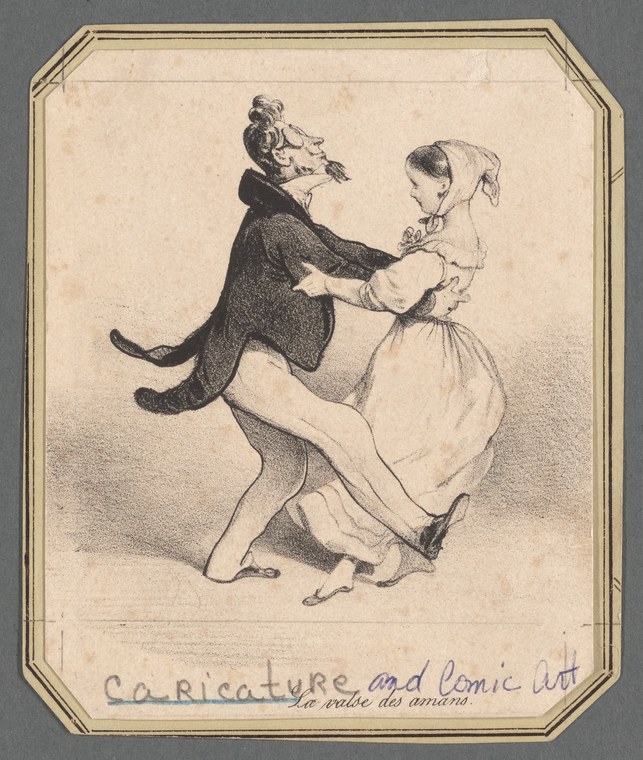
La valse des amans
Unknown artist
- Collection:
- Prints depicting dance
- Source:
- New York Public Library
- Rights:
- Public domain — free to use, share and adapt.
- Recorded as:
- Public Domain
This print documents the waltz at a moment when it was not simply a ballroom step but a symbol of modern courtship, physical daring, and theatrical display. For dance historians, it captures how 19th-century audiences understood the waltz as a form that allowed for intimate partnership and acrobatic display in a way earlier courtly dances did not. The comic exaggeration signals that the waltz was a live cultural debate—moralists saw it as dangerously intimate, while its advocates saw it as the embodiment of modern romance.
What you are looking at
A man in dark formal dress—coat, waistcoat, and trousers—lifts a woman in a light-colored gown high into the air, her body arched backward in exuberant mid-lift. The woman's skirts billow and spread as she is suspended, one leg extended, her arms around the man's neck and shoulders. The man lunges forward dynamically, his body angled to support her weight, his face turned toward her in close engagement. The composition is set against a plain background with a decorative border frame, rendered in what appears to be lithographic line work with fine stippled shading. The moment captures the climax of a theatrical or social dance—a moment of intimate partnership, physical display, and playful abandon. The inscription at the base reads "La valse des amans" (The Lovers' Waltz) and below that "la rube des amans" (possibly a variant or subtitle).
The dancing
The man is the active base, lunging forward with straight legs and torso bent to support the woman's weight across his shoulder and arm. The woman is lifted, her body forming a long diagonal line from head to feet, her weight entirely transferred to her partner. Her legs are extended, one higher than the other, and her upper body arches backward, creating the characteristic hyperextension of a theatrical lift. Both figures are facing each other in close proximity, their heads nearly touching, suggesting both physical intimacy and mutual trust in the acrobatic moment. The positioning and energy suggest a partnered dance that includes dramatic elevation as a key element.
The dance depicted
This is the Waltz, specifically a theatrical or comic rendering of waltz partnering at an extreme moment. The title "La valse des amans" (The Lovers' Waltz) and the inscription confirm the dance form. The lift shown here is not part of standard ballroom waltz technique but rather represents either the exaggeration common in comic and theatrical prints of the period, or a moment from theatrical waltz performance that pushes the form into acrobatic display. The image captures the Romantic-era fascination with waltz as an emblem of modern courtship and intimate partnership—here rendered with theatrical abandon rather than ballroom restraint.
How it was made
This is a lithographic print, identified by the characteristic fine line work and stippled tonal modeling visible throughout. The composition shows the refined draftsmanship typical of French caricature and satirical prints from the 19th century. Lithography allowed for rapid circulation of such comic and topical imagery, making it an ideal medium for satirizing fashionable dance crazes and social behavior. The decorative border and careful composition suggest this was published as a standalone print, likely part of a series on dance or social life, accessible to a broad middle-class audience.
About this work
This is a lithographic print depicting the climactic moment of a waltz lift, with a man raising his female partner high into the air in a dramatic arc. The image satirizes or celebrates the theatrical potential of waltz dancing in the early-to-mid 19th century, a period when the waltz was both scandalous and irresistibly fashionable. The artist has chosen a moment of maximum visual drama—the suspension and hyperextension of the lift—to convey the combination of physical skill, intimacy, and theatrical spectacle that made waltz both socially controversial and artistically compelling. The print belongs to a rich tradition of dance caricature and social satire that used lithography to comment on contemporary fashions and courtship rituals.
How to look at it
The viewer should attend to the moment of suspension—the artist has frozen the dance at the instant of maximum lift and extension, not at a step or transition. This choice emphasizes the acrobatic and theatrical nature of the moment rather than the technical sophistication of the dance itself. Notice how the woman's body forms a long, graceful arc from head to foot, creating a visual line that is more sculptural than functional for dance. The man's lunge and the woman's extended leg both point forward, creating a sense of forward momentum even in suspension. The close proximity of their faces and the intimacy of the embrace, combined with the comic exaggeration of the lift, suggest that the artist is playing with the tension between the waltz's reputation for respectability and its undeniable invitation to physical closeness.
The period
This print dates from the early-to-mid 19th century, when the waltz was at the height of its cultural controversy and popularity in Western Europe. The waltz had emerged as a ballroom dance in Vienna and Bavaria in the late 18th century, but it only became a widespread social phenomenon in the 1820s–1840s. The close hold required for waltz partnering—with the man's arm around the woman's waist and the couple moving as a unit—shocked conservative moralists who saw it as an invitation to impropriety. At the same time, it captivated artists, writers, and musicians, who celebrated it as the emblem of modern, romantic partnership. Lithographic satirical prints like this one capitalized on the waltz's cultural visibility, exaggerating its theatrical potential and its association with pleasure, flirtation, and physical abandon. The medium and style are consistent with the output of French caricature workshops in Paris, where such prints were mass-produced for popular consumption.
Where it lives
This print is held in the New York Public Library's collection of prints depicting dance. It is catalogued under the general classification of dance but lacks specific medium, date, or artist attribution in the current record.
Dance in this work
Questions about this work
Is this waltz technique actually used in ballroom dancing?
No. The dramatic lift shown here is theatrical or comic exaggeration, not standard ballroom waltz. In ballroom waltz, both partners remain in close contact and move around the floor in a closed hold. The lift may represent theatrical waltz from stage performances, or it may be a satirical exaggeration designed to poke fun at the waltz's reputation for intimate partnership. The print is more interested in the cultural meaning of the waltz—as an emblem of flirtation and modern courtship—than in accurate technical representation.
Why do so many 19th-century prints make fun of the waltz?
The waltz was controversial. Its close hold—with the man's arm around the woman's waist—scandalized conservative critics who saw it as inappropriately intimate in public. At the same time, it was wildly fashionable. Satirical prints capitalized on this tension between moral concern and social enthusiasm, using comic exaggeration to both celebrate and gently mock the waltz and the courtship rituals it enabled. The prints made the waltz visible and memorable, turning it into a topic of conversation and debate.
Who made this print and why?
The artist is not currently identified in the record. Based on the style, technique, and subject matter, this is likely a French lithographic print from a Parisian caricature workshop, created for popular circulation. Such prints were inexpensive, widely distributed, and designed to appeal to a middle-class audience interested in fashion, social satire, and contemporary dance crazes. The print served both as entertainment and as a form of social commentary.
What does 'la rube des amans' mean in the inscription?
The second line of the inscription is difficult to read and may be a variant title, a printing notation, or a caption in dialect or slang. It does not appear in standard French, and it may reflect a printing error, a regional expression, or a playful alteration of the main title. Without access to the original object or additional documentation, the meaning remains uncertain.
More dance artwork





