49 works in this view — arrow keys or swipe to move between them.
Dance in Art
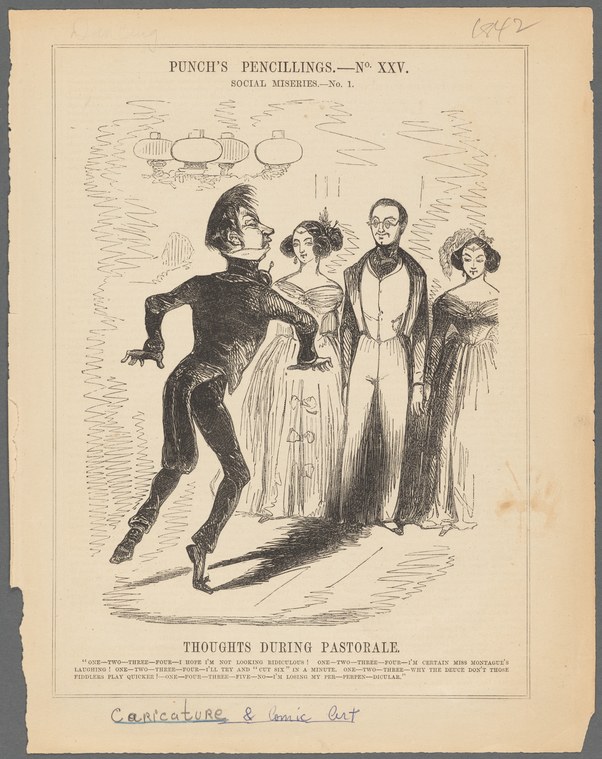
Thoughts during pastorale [a figure of the quadrille]; Punch's pencillings, no. XXV; Social miseries, no. 1
Unknown artist
- Collection:
- Prints depicting dance
- Source:
- New York Public Library
- Rights:
- Public domain — free to use, share and adapt.
- Recorded as:
- Public Domain
The work documents a crucial moment when dance—especially ballroom dance—became an object of middle-class anxiety and mockery in print culture. It shows how bodily performance and social status were inseparably linked in the nineteenth century, and how visual satire could be weaponized to police class behavior. For dance historians, it reveals how contemporary observers understood the relationship between authentic movement and theatrical affectation.
What you are looking at
A satirical engraving depicting four fashionably dressed figures in what appears to be a drawing room or ballroom setting. The central figure, a man in a tightly fitted black coat with exaggerated posture, leans dramatically backward with one leg extended in a theatrical pose, his body arched in an unnatural curve. To his right stand three onlookers—a woman in a pale empire-waist gown, a bald man in formal dress, and another woman in a dark gown—observing his performance with apparent bemusement. Above them float two thought bubbles containing indistinct scribbled text, suggesting the internal thoughts or gossip of the observers. The background is rendered in light wash with minimal detail, focusing attention on the figures and their interaction. The overall composition conveys mockery of affected mannerism and social pretension.
The dancing
The central male figure displays a grotesquely arched frame, with his torso bent backward at an extreme angle and his leg thrust forward in a balletic or affected gesture. His posture is deliberately contorted, suggesting caricature rather than actual dance technique. The three observers maintain an upright, formal stance in social proximity to the performer, their bodies relatively static and aligned vertically, creating a sharp contrast with his exaggerated curvature. Their facial expressions and body language register surprise or judgment rather than participation.
The dance depicted
The image appears to satirize the quadrille, a fashionable social dance of the nineteenth century, or possibly the exaggerated movement style adopted by certain dancers or socialites of the period. The title 'Thoughts during pastorale' and subtitle referencing quadrille suggest the work mocks the pretensions of ballroom dancing in fashionable society. The central figure's extreme posture parodies the elegance and refinement supposedly displayed by dancers of the upper classes, suggesting the image critiques both the dance itself and those who performed it with affected drama.
How it was made
This is a wood engraving or steel engraving, identifiable by the fine parallel hatching lines that create tone and shadow, the crisp black line work, and the characteristic pale paper stock. The technique allowed for mass reproduction in periodicals, making this accessible to a broad middle-class audience. The inscription 'Punch's pencillings' confirms this as part of a serial satirical publication, where such engravings served as social commentary on contemporary manners and fashions. The tightly controlled line and minimal use of wash testify to the skill required to convey character and mockery through engraving alone.
About this work
This is a social satire from the mid-nineteenth century, part of Punch magazine's series on contemporary social foibles. It uses exaggerated bodily distortion and formal composition to ridicule the affectations of fashionable ballroom culture, specifically the quadrille and the theatrical posturing adopted by those who danced it. The image targets not the dance itself but the pretense and social anxiety surrounding its performance in polite society. As a mass-produced engraving in a popular periodical, it reflects the magazine's role as arbiter and critic of middle and upper-class manners, using dance as a vehicle for broader satire on artificiality and social climbing.
How to look at it
Attend to the deliberate contrast between the central figure's grotesque, impossible posture and the formal reserve of the three onlookers. The engraver has frozen a moment of social performance and observation—the dance itself is reduced to a parody of movement, and the real subject is the judgment being silently leveled. The thought bubbles above the observers' heads, though their text is too fine to read in most reproductions, signify gossip or mockery. Note how the artist uses the extreme curvature of the male figure's body to signal both artificiality and loss of control—the body as a betrayer of pretension.
The artist
This work is attributed only as a 'Punch pencilling,' meaning it was created by one of the magazine's stable of artists and engravers, likely including John Leech or Richard Doyle, though attribution is not recorded in the catalogue. Punch employed a collective of talented illustrators to produce weekly social commentary through visual wit, and the unsigned status was standard practice. The style and satirical bite are consistent with the magazine's mid-nineteenth-century output.
The period
The quadrille dominated ballroom culture from the 1820s through the 1880s, and by mid-century it had become the subject of considerable anxiety about propriety, skill, and class distinction. Punch, founded in 1841, seized on such social tensions as material for satire. The mid-Victorian period saw growing unease about the theatricality of ballroom dancing—the tension between its status as a respectable social accomplishment and its association with performance, bodily display, and potential impropriety. Satirical visual commentary on dance was a regular feature of the magazine, targeting both the dancers and the social pretensions that surrounded them.
Where it lives
This engraving comes from Punch magazine's serialized 'Pencillings' series. It is catalogued as part of a broader collection of prints depicting dance held by the New York Public Library, reflecting the library's curatorial interest in visual documentation of social and theatrical movement.
Dance in this work
Questions about this work
What is a quadrille and why was Punch mocking it?
The quadrille was the dominant ballroom dance of the nineteenth century, performed by four couples in a square formation with a complex sequence of figures. By mid-century it had become a marker of middle-class respectability, and also a source of anxiety about whether one could perform it correctly and with sufficient elegance. Punch seized on this anxiety, using exaggerated bodily distortion to suggest that the dancers' attempts at refinement were actually ridiculous and transparent.
Why are the observer figures so important to the composition?
The three onlookers are the real subject of the satire. Their formal, upright postures and expressions of bemusement frame the performer's grotesqueness. The thought bubbles above their heads indicate that the image is concerned with social judgment—what people think about such performances, not the performance itself. The satire targets not just the dancer but the observers' own pretensions and gossip.
What do the scribbled thought bubbles say?
The text is too fine to read in most reproductions, and the catalogue record does not transcribe it. The bubbles are a visual device signifying internal commentary or gossip rather than conveying specific readable content. This was typical of Punch's technique—the image itself carries the satire, and the bubble text reinforced the idea that fashionable society was consumed with social judgment.
How does this fit into Punch's broader coverage of dance?
Punch regularly mocked ballroom dancing as a site of social anxiety, pretension, and bodily vulnerability. The magazine was aimed at the very middle-class readers who attended balls and danced quadrilles, so such satire functioned as social regulation—a form of policing that told readers how to think about their own participation in ballroom culture.
More dance artwork





