49 works in this view — arrow keys or swipe to move between them.
Dance in Art
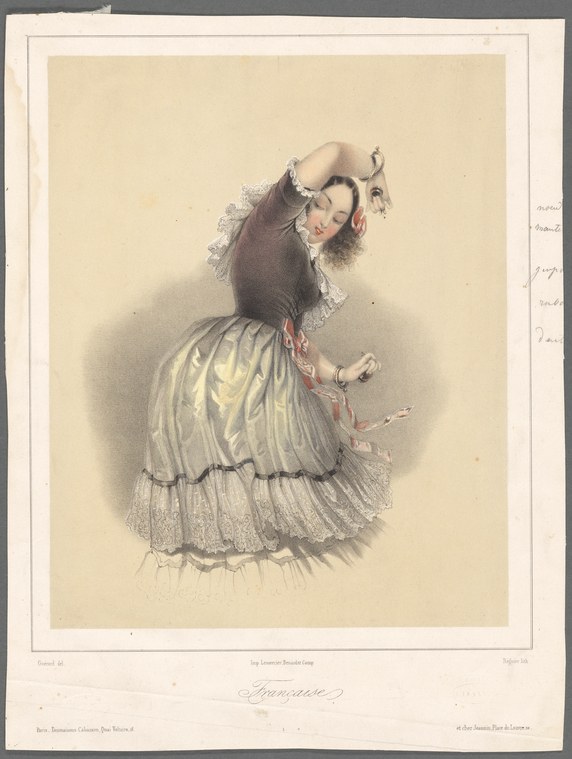
Française
Unknown artist
- Collection:
- Prints depicting dance
- Source:
- New York Public Library
- Rights:
- Public domain — free to use, share and adapt.
- Recorded as:
- Public Domain
This work preserves a fleeting gesture from a dance tradition that left almost no other trace—the social dances of the ballroom were not notated, and few descriptions survive. The print captures what the body did, how costume moved with it, and what mood and manner the period valued in a dancing woman. For historians of dance, fashion, and social history, such prints are primary evidence of embodied practice.
What you are looking at
A single female dancer is depicted in three-quarter view, her body tilted dramatically backward in a pose of theatrical abandon. She wears a dark jacket or spencer over a voluminous skirt with deep horizontal pleats or flounces, rendered in pale gray with delicate shading to suggest the weight and movement of the fabric. The skirt is gathered at the waist with what appears to be a red or pink ribbon detail. Her dark hair is long and loosely arranged, falling away from her face as her head tips back. The pose suggests a moment of playful exuberance or coquetry—the kind of spirited, flirtatious gesture characteristic of early 19th-century social dance. The composition is spare: the figure floats against a plain cream background with minimal shading, and the artist has used subtle grays and blacks to model the form. This is a portrait of a dancer captured mid-gesture rather than a narrative scene.
The dancing
The dancer stands in a contrapposto stance with her weight shifted, her torso arched backward and her head thrown back in a gesture of pleasure or release. Her right arm is raised and bent, the hand near her face in a gesturing pose. Her left arm hangs more naturally. The backward tilt of the torso and the extension of the line from hip through head suggest training in the ballroom or social dance of the period—this is not a rigid, corseted posture but a fluid, controlled arch that implies both strength and grace. The rendering emphasizes the silhouette and the play of the pleated skirt, which would move and ripple with such a movement.
The dance depicted
This appears to document a moment from early 19th-century social dance, most likely a figure or flourish from the quadrille, cotillion, or a similar fashionable ballroom form of the 1820s–1840s. The title 'Française' suggests it may depict a dance of French origin—possibly a specific named figure or step sequence. The pose is too mannered and too deliberately theatrical to be a naturalistic gesture; it is a staged moment, perhaps from a dance instruction manual or a satirical or celebratory print of the period's social dances. The coquettish, exuberant quality of the gesture aligns with the spirit of Romantic-era social dancing, which valued expression and lightness alongside formal technique.
How it was made
This is a hand-colored lithograph or possibly a stippled engraving, rendered with considerable delicacy. The artist has used soft tonal washes in gray and warm cream tones to model the figure, creating a luminous, ethereal effect. The pleated skirt is defined with fine parallel lines and subtle cross-hatching; the dark jacket contrasts sharply with the pale skirt, drawing the eye to the line of the body. The technique suggests this was a commercial print intended for broad distribution—likely a fashion or dance plate from a period journal or a series of such prints. The careful attention to costume detail and the refined execution indicate an audience of educated, fashionable viewers interested in both social dance and current fashion.
About this work
This is a stylish dance portrait from the early 19th century, capturing a single moment of social grace and exuberance in a woman's gesture during fashionable ballroom dancing. The work preserves not only the silhouette of the period—the high waist, the voluminous skirt, the trim jacket—but also the lived physical language of Romantic social dance: the playful arch of the back, the raised arm, the sense of pleasure in movement. It belongs in a gallery of dance art because it documents the aesthetic values of the period through the body: what was beautiful, what was desirable, what counted as skillful social presence. The image is neither a narrative tableau nor a technical instruction, but something between—a celebration of a specific moment and style of movement that was central to courtship, entertainment, and social identity in its time.
How to look at it
Notice the precise moment the artist chose: not the beginning or end of a phrase, but the apex of the arch—the moment of maximum extension and pleasure. The backward tilt of the head is exaggerated just enough to suggest joy without loss of control; the raised arm frames the face and extends the line of the body. Look at how the pleated skirt responds to the pose: the folds are not random, but follow the logic of the tilted stance and the gathered waist. The artist understood the relationship between posture and fabric, and used both to convey a sense of movement and feeling, not just form.
The period
The early 19th century saw an explosion of commercial dance and fashion prints, driven by the rise of lithography and the growth of an educated middle class eager to participate in or observe fashionable social life. The quadrille, cotillion, and other ballroom dances of this period were codified, published in instruction manuals, and celebrated in satirical and celebratory prints. The Romantic movement in art and literature elevated the expression of feeling and the beauty of the individual body; social dance, especially for women, became a vehicle for displaying grace, sensibility, and refined pleasure. Prints like this one were often issued in series and collected as records of fashionable dress and deportment.
Where it lives
This work is held in the New York Public Library's collection of prints depicting dance. It is a commercial print of the early 19th century, likely from a series or a fashion/dance journal.
Dance in this work
Questions about this work
What dance is this?
The title suggests it is a figure or moment from a French dance—possibly the Française, a ballroom form of the 1820s–40s. The pose is characteristic of the quadrille or cotillion, the most fashionable social dances of the period. Without more context, it is difficult to be certain, but the print was clearly meant to capture and celebrate a specific, named movement or style.
Is this a real dancer or a generic figure?
There is no way to know from the image alone. Early 19th-century dance and fashion prints often depicted idealized types rather than specific individuals, though some did record famous dancers of the day. The style and quality of this print suggest it was made for a broad audience, not as a portrait of a particular person.
Why is the pose so theatrical and exaggerated?
Social dancing of this period was highly theatrical and expressive, especially in the figure and cotillion. The backward arch and the thrown-back head were not ordinary gestures but deliberate, trained movements meant to convey pleasure, confidence, and grace. The pose also serves the purposes of the print itself: it displays the line of the body and the beauty of the costume in a single, memorable image.
More dance artwork





