49 works in this view — arrow keys or swipe to move between them.
Dance in Art
Allemande
Unknown artist
- Collection:
- Prints depicting dance
- Source:
- New York Public Library
- Rights:
- Public domain — free to use, share and adapt.
- Recorded as:
- Public Domain
The Allemande was foundational to Renaissance and early Baroque social dance culture, and this image is a rare surviving record of how a Renaissance dancer was meant to stand, gesture, and bear herself—not during active movement but in the composed, decorative stillness that frame such moments. For historians of courtly performance and dress, the image documents the precise fit, embroidery, and ornament of a 16th-century dancing costume and reveals the centrality of gesture and posture to the dance's aesthetic. For dancers, it offers a window into an era when dance was inseparable from nobility of bearing and visual elegance rather than technical virtuosity.
What you are looking at
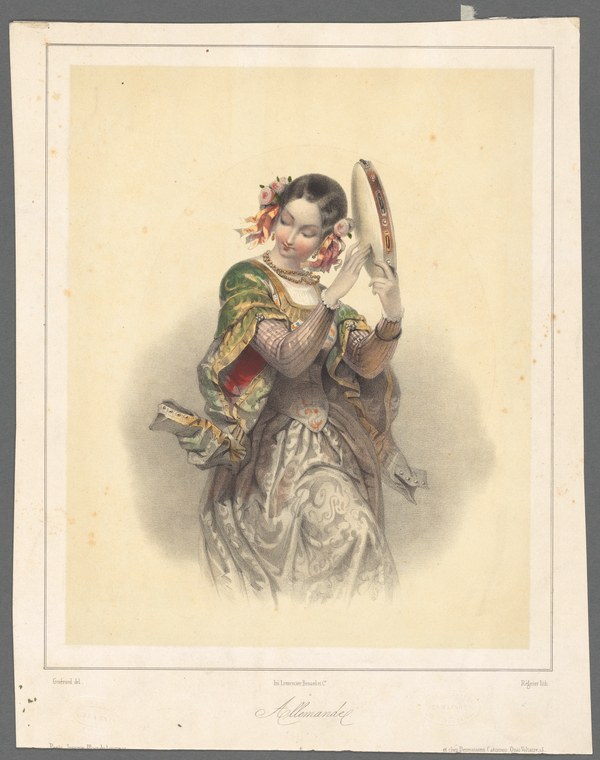
A single female figure dominates the composition, shown from roughly the waist up against a plain cream background. She wears an ornate Renaissance or early 16th-century costume: a fitted bodice with elaborate embroidered or brocaded sleeves in gold and green tones, and a high white collar or ruff at the neck. Her dark hair is crowned with a decorative wreath or garland of flowers and ribbons in red and gold. She holds a fan or feather accessory in one raised hand and gazes downward in a pose of modest, introspective grace. The figure is rendered in a soft mezzotint or engraving technique with delicate shading that gives her form volume and dimension against the flat ground. The title inscription at the base reads "Allemande," indicating this is a portrait of a dancer or a allegorical representation of the Allemande dance itself.
The dancing
The single figure is posed in a standing position with a vertical axis and minimal active gesture. One arm is raised and extended to the side at approximately shoulder height, holding a fan; the other arm falls naturally. The pose suggests a moment of repose rather than active dance movement—the weight appears balanced and centered, the body upright but not in motion. The downward gaze and gentle bearing convey refinement and courtly dignity rather than kinetic energy. There is no partner visible, and no footwork is legible from the composition.
The dance depicted
The Allemande was a processional or couple dance of the Renaissance and early Baroque periods, popular in German-speaking courts and throughout Europe in the 16th and 17th centuries. It was characterized by smooth, measured steps and an emphasis on graceful arm movement and posture rather than complex footwork. This image appears to be a character or costume study rather than a depiction of active dancing—a common format for dance instruction and court documentation of the period. The formal dress, the emphasis on bearing and gesture, and the contemplative pose all align with how the Allemande was understood: as an elegant, decorous social dance for aristocratic performers.
How it was made
This is a hand-colored engraving or possibly a mezzotint, executed with fine lines and delicate cross-hatching to create tonal depth in the figure while leaving the background spare. The coloring—particularly the rich greens, golds, and reds of the costume—was applied by hand after the print was struck, a labor-intensive practice that indicates this was a valuable, circulated image. The technique was well suited to fashion and court documentation, allowing fine detail in embroidery and jewelry while maintaining clarity of line. Works in this style were typically sold as individual prints, collected in sets, or bound as books of instruction or court dress.
About this work
This is a hand-colored engraving of a noblewoman or dancer posed as the allegorical or representative figure of the Allemande, a Renaissance-Baroque court dance. The work combines the conventions of fashion portraiture, dance instruction, and courtly virtue: the sitter is shown in full regalia with careful attention to costume detail, while her pose—modest, graceful, introspective—embodies the idealized bearing that the dance demanded. The image belongs to a long tradition of European court dance documentation, in which a single figure posed in formal dress served as a teaching tool, a mark of status, and a record of how dancing bodies should move and present themselves in elite social space.
How to look at it
This is a portrait of stillness and bearing rather than movement. The artist has chosen a moment of composed repose to demonstrate the carriage and ornament essential to the dance. Pay attention to the straightness of the spine, the angle of the head, and the precise placement of the raised arm—these are the elements of courtly deportment that the Allemande required. The costume itself is as much the subject as the body within it; the elaborate sleeve, the jewelry, the flower wreath all signal the status and refinement of the performer. In this tradition, the beauty of the dance lay partly in its slowness and grace, and this still image captures that quality better than motion ever could.
The period
The Allemande emerged in German courts in the late 15th century and spread throughout Renaissance Europe as a marker of sophistication and courtly refinement. By the 16th century when this print was likely made, it was standard in the repertoire of any noble dancer and was documented extensively in dance manuals, court records, and visual media. The fashion for hand-colored engravings of dancers and court costumes was particularly strong in Northern Europe in the 16th and early 17th centuries, serving both as fashion documentation and as moral instruction—the elegant bearing of the dance was often read as a mark of virtue. The rise of printed dance instruction and costume prints reflects a broader humanist interest in recording and teaching refined behavior through visual and textual means.
Where it lives
The work is held in the New York Public Library's collection of prints depicting dance. It is catalogued as source material for the study of Renaissance and early modern court culture, costume, and dance history.
Dance in this work
Questions about this work
What is an Allemande?
The Allemande was a processional couple dance that originated in German courts in the late 15th century and became a cornerstone of European noble dancing through the 17th century. It was danced to a slow, measured tempo and emphasized graceful, smooth steps and elegant arm movement rather than complex footwork. It was often one of the first dances taught to young nobles as a mark of courtly accomplishment.
Why does she look so still if this is a dance image?
This is not a snapshot of active dancing but rather a costume and bearing study—a common format for documenting court dances of the Renaissance. The pose shows how a dancer was meant to stand and carry herself: upright, dignified, composed. The Allemande itself was a relatively slow and decorous dance, and this image captures the stillness and grace that characterized it.
Who made this print and when?
The artist is not recorded in the catalogue, and the date is unknown. The style and technique suggest a Northern European origin (possibly German or Flemish) in the 16th or early 17th century, but this cannot be confirmed without further research or inscription on the plate itself.
What does the fan or feather in her hand represent?
The fan (likely a feather fan, popular in Renaissance courts) was both a fashion accessory and a prop used in courtly dances and social performance. It could be held, gestured with, or manipulated as part of the dance's arm work, and it was a visible marker of the dancer's status and refinement.
More dance artwork





