49 works in this view — arrow keys or swipe to move between them.
Dance in Art
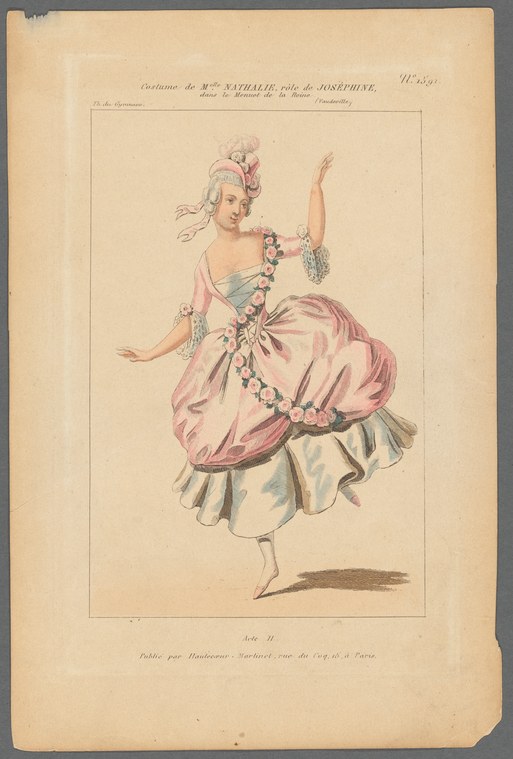
1591. Costume de Melle. Nathalie, rôle de Joséphine, dans Le menuet de la reine, Acte II, Th[éâtre] du Gymnase, vaudeville.
Unknown artist
- Collection:
- Prints depicting dance
- Source:
- New York Public Library
- Rights:
- Public domain — free to use, share and adapt.
- Recorded as:
- Public Domain
This is a primary historical document of how a named performer embodied a theatrical role in the early 1800s, showing not only the costume but the artist's interpretation of the body position and gesture within that role. It demonstrates that formal minuet-based entertainments remained part of theatrical performance well into the Romantic era, coexisting alongside the emerging classical ballet vocabulary. The print preserves evidence of how female performers at a commercial theater (vaudeville house) were visualized, marketed, and remembered.
What you are looking at
A single female dancer in theatrical costume occupies the center of the composition, posed in a moment of graceful animation against a plain background. She wears a pink silk dress with voluminous skirts gathered and lifted to reveal white underskirts, the bodice fitted and decorated with a garland of flowers or foliage that drapes diagonally across her torso. Her blonde hair is styled up and adorned with a pink plume or feathered ornament. She holds a small bouquet or floral cluster in her raised right hand while her left arm extends outward in a gesture of elegant deportment. Her left leg is extended in an attitude suggesting movement or balance, while her body displays the composed grace of a trained performer. The figure is rendered in hand-colored engraving or lithographic technique, with soft washes of pink, flesh tones, and gray establishing volume and shadow. The artist has captured her at a moment of stylized, choreographed motion rather than naturalistic movement.
The dancing
A single dancer in an upright, controlled posture with an extended left leg suggesting a pas or arabesque-like position. Her right arm is raised holding a floral prop; her left arm extends to the side in a second-position port de bras. The weight appears centered over her supporting right leg, and the overall frame suggests a formal, composed technique with emphasis on verticality and grace. Her bodily carriage shows the symmetrical deportment and turned-out alignment expected of trained stage dancers of the period.
The dance depicted
The title identifies this as a costume design for Mlle. Nathalie performing the role of Joséphine in *Le menuet de la reine* (The Queen's Minuet), Act II, performed at the Théâtre du Gymnase as a vaudeville entertainment. The pose and costume indicate a formal social dance of the Romantic era, most likely a minuet or a stylized theatrical interpretation thereof. The light, graceful deportment, the floral decorations, and the delicate femininity of the costume all point to the aesthetic values of Romantic theatrical dance as distinct from the developing classical ballet vocabulary of the period. The image documents a specific performer and role rather than codifying technique.
How it was made
This is a hand-colored engraving or possibly a lithograph, characteristic of 19th-century theatrical costume documentation. The medium allowed for rapid reproduction and distribution to a theater-going public, making such prints a familiar form of celebrity and promotional material. The hand coloring (visible in the pink dress, flesh tones, and subtle grays) adds specificity to the costume design while keeping production costs lower than a fully chromolithographic process. The technique implies this was a documented role from an actual production, circulated among theater professionals and enthusiasts.
About this work
This is a theatrical costume design print documenting a specific performer and role in early 19th-century French vaudeville. It records Mlle. Nathalie in the role of Joséphine in *Le menuet de la reine*, preserving both the costume and a stylized image of how the role was physically performed. Such prints served as a form of theatrical documentation, publicity, and archival record before photography; they were issued by theater printers and circulated to audiences, critics, and fellow performers as a way of recording celebrated performances and roles. The work belongs to a larger tradition of costume and character prints that tracked the development of theatrical dance and female stage performers across the 19th century.
How to look at it
Observe the careful balance of the pose: the artist has chosen a moment of poised suspension rather than dynamic action, capturing the theatrical rather than ballistic quality of the minuet. The extended leg and raised arm create an elegant diagonal line across the frame, emphasizing the verticality and controlled deportment that defined stage femininity of the period. Notice how the floral ornaments and pale coloring invest the figure with delicacy and romantic sensibility; this is not a document of athletic technique but of visual beauty and courtly refinement. The hand-coloring adds an intimacy and specificity that suggests this was meant to evoke an actual, seen performance.
The artist
The artist is not recorded in the catalogue. The print bears a publication line indicating it was made for theatrical distribution and sold by publishers and print sellers associated with Parisian theaters. Such costume prints were a standard commercial product of 19th-century Paris, produced by specialized engravers and lithographers who worked from sketches or observations of actual performances. The style and technique are consistent with mid-19th-century French theatrical print production.
The period
This work dates from the era when theatrical costume prints were a major form of celebrity documentation and theatrical record-keeping. In the 1830s–1850s, the Romantic ballet was in ascendancy in Paris, but theatrical entertainment remained diverse: vaudeville houses like the Théâtre du Gymnase offered comic operas, farces, and stylized social dances alongside more ambitious choreographic works. Female performers were celebrated as personalities and their roles in specific plays became part of their public image. The minuet, though an older form, retained theatrical currency as a marker of elegance, courtly refinement, and feminine grace.
Where it lives
The print is held in the New York Public Library's collection of prints depicting dance, indicating it was acquired as a document of theatrical history and performance. The publication line and printing technique confirm it is a commercial theatrical print, part of the standard output of Parisian theater publishers in the 19th century.
Dance in this work
Questions about this work
What was the Théâtre du Gymnase?
A Parisian commercial theater house known for vaudeville, comic opera, and light theatrical entertainments. It was distinct from the grand opera houses and ballet academies, serving a broad popular audience. Such theaters regularly commissioned costume prints to promote their productions and performers.
Was the minuet still danced in the 19th century?
The minuet as a ballroom social dance had declined, but it retained theatrical life as a symbol of courtly elegance and historical grace. It appeared in operas, vaudevilles, and historical comedies as a stylized performance piece rather than a functional social form, as seen here in *Le menuet de la reine*.
How do we know this is Mlle. Nathalie?
The title cartouche at the top of the print clearly states 'Costume de Mlle. Nathalie, rôle de Joséphine, dans Le menuet de la reine, Acte II, Th[éâtre] du Gymnase, vaudeville.' Such prints were issued as promotional and documentary records and sold to the public after the performance.
What does the pose tell us about how the minuet was performed on stage?
The upright carriage, extended leg, and graceful arm placement suggest a stylized, balletic interpretation rather than an historical recreation. The focus is on visual elegance and feminine poise rather than the complex footwork of the historical minuet, typical of how older dances were adapted for 19th-century theatrical audiences.
More dance artwork





