49 works in this view — arrow keys or swipe to move between them.
Dance in Art
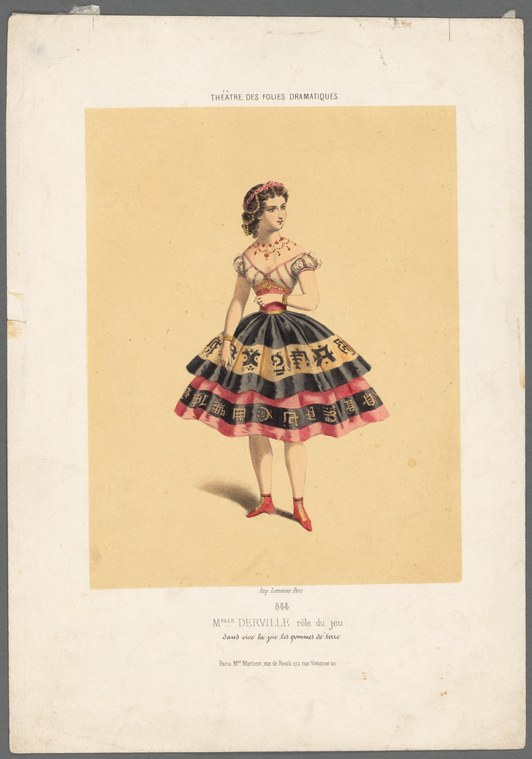
844. Melle. Derville, rôle du jeu, dans Vive la joie [et] les pommes de terre, Théâtre des Folies Dramatiques
Unknown artist
- Collection:
- Prints depicting dance
- Source:
- New York Public Library
- Rights:
- Public domain — free to use, share and adapt.
- Recorded as:
- Public Domain
For dance historians, this print documents the blurred boundary between theatrical dance and popular comedy in the 1890s, and the prominence of costume design in attracting audiences. For costume and textile historians, it is a precise record of a specific garment's construction and appearance. For researchers of theatrical culture, it exemplifies the archival practice of preserving and circulating images of stage performance through commercial prints.
What you are looking at
A young woman stands alone against a pale yellow ground, posed in a three-quarter view facing left. She wears a short-sleeved blouse with a patterned bodice in coral or peachy tones, fitted at the waist with a narrow ribbon or belt. Her skirt is the dominant feature—a full, tiered construction in dark navy or black silk with horizontal bands of contrasting fabric: the upper sections feature decorative patterning or text (possibly sheet music notation), while lower tiers are edged in vivid pink or coral silk, creating a striking color block effect. The skirt flares from the waist and falls to just below the knee, with visible weight and volume suggesting the garment is constructed to move. She stands in a relaxed contrapposto, one leg bearing weight while the other is slightly bent, her body angled gracefully. Her hair is styled in soft waves pinned up in the fashion of the 1890s. She wears heeled shoes in coral or red that match the skirt trim. Her expression is pleasant and composed, her gaze directed away from the viewer. The figure is rendered in chromolithograph with careful attention to the textile patterns and color gradations, creating a fashion-plate quality.
The dancing
The dancer is a solitary figure, posed not in the midst of movement but in a poised, presentational stance—weight on one leg, the free leg slightly flexed, the torso upright and the arms relaxed at her sides in a natural, unstudied manner. This is a position of readiness or display rather than active dance. The pose suggests classical ballet training: the slight turnout, the lifted carriage, the elongated line through the body. There is no partner, no group formation, and no evident technical difficulty in the footwork; this is a moment of stillness or introduction rather than an energetic leap or turn.
The dance depicted
The catalogue identifies this as Mlle. Derville in the role of 'the jeu' (the game) from *Vive la joie et les pommes de terre* (Long Live Joy and the Potatoes) at the Théâtre des Folies Dramatiques. This was likely a vaudeville or musical farce from the 19th century. The costume suggests either a comedic character role or a specialty dancer's costume designed to be eye-catching in theatrical spectacle rather than a classical ballet role. The decorative patterning on the skirt—possibly musical notation or abstract geometric designs—indicates this was a novelty costume intended to catch the light and draw attention in stage performance. The style of dance cannot be determined from the pose alone; the emphasis appears to be on the costume and character presentation rather than demonstrating virtuosic technique.
How it was made
This is a chromolithograph, identifiable from the flat, separated color planes, the careful gradation of tones within each color, and the uniform texture of the printed surface. The technique allowed for vivid, saturated colors and fine detail in pattern rendering—evident in the decorative bands on the skirt and the texture of the fabric. Chromolithography was the dominant process for theatrical costume prints and fashion illustration in the 1890s, and such images circulated widely as souvenirs, promotional material, and visual documentation of stage costume design. The scale and finish suggest this was a commercial print, likely produced in multiple copies for sale to theatre-goers or collectors of theatrical imagery.
About this work
This is a chromolithographed theatrical costume print documenting a specific performer in a specific role at a named Paris theatre. The image records the design and appearance of a stage costume—a novelty skirt with decorative banding and patterning—worn by Mlle. Derville as a character called 'the game' in what appears to have been a light musical comedy. The work belongs to the vast archive of 19th-century theatrical ephemera that documented the rise of visual spectacle and costume design in popular theatre. Such prints served multiple functions: they documented the designer's work, advertised the production and performer, and created a collectible souvenir of a live performance.
The image is valuable not primarily as a depiction of dance technique or training, but as evidence of how theatrical costume operated as visual entertainment in its own right. The emphasis on color, pattern, and novelty detail—the decorated skirt bands—suggests that the costume itself was a drawing card, a display of ingenuity and aesthetic appeal designed to enchant the audience. This is late 19th-century theatre as spectacle, where the dancer's body became a vehicle for displaying fabric, color, and design innovation.
How to look at it
Observe the costume in detail: the choice of the tiered skirt with contrasting colored bands, the patterned decoration of the upper layers, the vivid color contrast. This is a costume designed to be visually striking and memorable—it catches and holds the eye. The figure's pose is neither energetic nor virtuosic; she is presenting the costume to the viewer, inviting inspection. Look at how the chromolithographic process renders the silk with subtle shading and tone, creating a sense of fabric weight and lustre. Notice the stillness: this is not a moment of dance technique but a moment of display, a pause in which the audience (and now the print viewer) can admire the design.
The period
The Théâtre des Folies Dramatiques was a Paris theatre known for vaudeville, operetta, and musical farce—genres that prioritized entertainment, novelty, and visual spectacle over narrative or dramatic depth. The 1890s saw an explosion of such theatres and a booming market for theatrical imagery. The print technology of chromolithography, perfected in the 1870s–1880s, made it economically viable to produce large quantities of color theatrical prints for sale at the theatre or through dealers. This was the era of the Gibson Girl and theatrical glamour, when a performer's fame could be built as much on a striking image as on technical skill. The style of this print—the fashion-plate presentation, the isolated figure, the emphasis on costume—is entirely consistent with 1890s theatrical merchandise.
Where it lives
The print is held in the New York Public Library's collection of prints depicting dance, catalogued as item 844. It is part of a larger body of theatrical costume prints and documentation from the 19th and early 20th centuries.
Dance in this work
Questions about this work
What is 'Vive la joie et les pommes de terre'?
The title translates as 'Long Live Joy and the Potatoes.' This appears to have been a vaudeville or musical farce performed at the Théâtre des Folies Dramatiques in Paris, a venue known for light entertainment and spectacle. Without access to theatre archives, the plot and complete cast cannot be confirmed, but the whimsical title suggests a comedic or absurdist piece in which Mlle. Derville played a character role identified as 'the game' (le jeu).
Why does her skirt have what looks like sheet music on it?
The decorative banding on the skirt appears to feature patterning or notation—possibly musical notation, possibly abstract ornamental design—that would have been rendered in the chromolithographic process. This was a novelty costume element designed to make the garment visually striking and memorable. Whether the notation was literal sheet music or merely decorative patterning made to resemble it cannot be determined from the image alone, but either way it served the purpose of catching the eye under stage lighting.
Is this a ballet costume?
Not a classical ballet costume. The garment is styled as a theatrical novelty costume rather than a tutu or classical ballet dress. While the dancer's pose and carriage suggest ballet training (the upright posture, the subtle turnout), the costume and context indicate this was a character role in a musical comedy or vaudeville piece, not a classical ballet production. The focus was on spectacle and comedy rather than technical virtuosity.
Who was Mlle. Derville?
The catalogue record does not provide biographical information about the performer. She was active in Paris theatre (likely the 1890s, based on the print style and costume fashions), performed at the Théâtre des Folies Dramatiques, and was notable enough to be commemorated in a chromolithographed costume print. Beyond that, her career remains undocumented in the current record.
More dance artwork





