49 works in this view — arrow keys or swipe to move between them.
Dance in Art
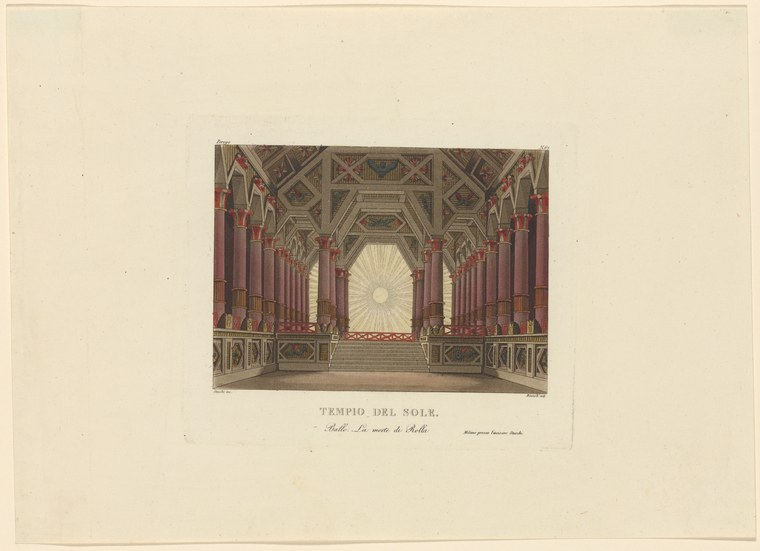
Tempio del sole, ballo La morte di Rolla
Unknown artist
- Collection:
- Prints depicting dance
- Source:
- New York Public Library
- Rights:
- Public domain — free to use, share and adapt.
- Recorded as:
- Public Domain
Theatrical designs like this are primary sources for understanding how ballet was staged and experienced in the 18th century—what the audience saw, what architectural or symbolic language surrounded the dancers, and how designers positioned the human body within classical space. The work is also evidence of the international circulation of ballet productions and designs across European theaters during the period of Enlightenment neoclassicism.
What you are looking at
A grand interior in neoclassical style unfolds in perfect perspective: a long colonnade of deep red or burgundy columns recedes toward a vanishing point marked by a bright circular window or oculus. The columns are topped with ornamental capitals and connected by an ornate ceiling coffered in geometric patterns of gold and blue. The walls between the columns feature panels of pale green or grey. The floor appears to be polished stone. The architecture is entirely empty of figures, yet the scene is theatrical and ceremonial in bearing—this is the stage set rather than a moment of performance. The print is hand-colored in watercolor or gouache, with careful attention to the volumetric quality of the columns and the depth of the receding vault. The image is a costume or scene design rather than a record of an actual dance.
The dancing
No figures are visible in the composition. This is a architectural drawing or stage design, not a depiction of dancers in motion.
The dance depicted
The subtitle indicates this was the stage set for *La morte di Rolla* (The Death of Rolla), a ballet performed in the late 18th century. The work is part of a tradition of neoclassical ballets with tragic or dramatic themes. However, the print shows only the architectural setting—the Temple of the Sun—and not the ballet itself. The design suggests a formal, processional context appropriate to a tragic or ceremonial narrative, but no choreography, costume, or dance movement is visible. This is a document of the theatrical machinery and visual environment, not the dance.
How it was made
This is a hand-colored engraving or etching, likely from the late 18th century, characterized by fine line work and careful perspective construction. The coloring in watercolor or gouache was applied after printing, a standard practice for theatrical designs of the period. The technique was well-suited to the circulation of stage designs among theaters and to documentation of celebrated productions. The precision of the linear perspective and the classical vocabulary of the architecture suggest this was a design of some importance and intended for a educated audience familiar with neoclassical aesthetics.
About this work
This is a stage design for the neoclassical ballet *La morte di Rolla*, representing the Temple of the Sun interior as it would have appeared to the audience. The work is part of the visual apparatus of late 18th-century theatrical dance—the architecture that framed and contextualized the choreography rather than a representation of the dancers themselves. It documents the aesthetic environment of Enlightenment ballet, when classical architecture and tragic narrative were seen as inseparable from the art form. The image is held as part of a broader collection of dance-related prints, which may include other designs, cast portraits, or scene documentation from the same or related productions.
How to look at it
View this as you would a stage plan or architectural elevation: the eye is meant to travel back through the colonnade into depth, just as a spectator in the theater would have looked. Notice the care taken to show light falling through the oculus and illuminating the architectural recession. The symmetry and absence of human figures emphasize the monumental, timeless quality of the setting—the design establishes a world of ceremony and fate rather than a moment of individual action. The colored capitals and ceiling patterns are the visual ornament that distinguished an expensive or celebrated production.
The period
This design dates to the height of neoclassical influence in European theater, roughly the 1770s–1790s. Ballet in this period was deeply influenced by archaeological interest in Greco-Roman civilization, and stage designers competed to create historically 'accurate' or evocative classical architectural settings. *La morte di Rolla* appears to belong to the tradition of ballets d'action with tragic or exotic themes—works by composers and choreographers like Gasparo Angiolini and Jean-Dauberval, which used classical or oriental settings to frame narratives of love and loss. The Temple of the Sun suggests either an ancient Roman or an exotic (possibly Egyptian or Asian) locale, both fashionable in ballet of this era. Hand-colored prints of such designs were distributed among theaters, dancers, and patrons, and served both documentary and promotional functions.
Where it lives
The work is held in the New York Public Library's collection of prints depicting dance. Such collections typically include theatrical designs, cast portraits, and contemporary engraved records of celebrated productions, assembled over time as documentary evidence of dance history.
Dance in this work
Questions about this work
Why doesn't this print show any dancers?
This is a stage design—a blueprint or specification for the physical setting in which the ballet took place. Theater designers and choreographers circulated such prints to document and publicize their productions, and to share designs among theaters. A separate portrait or action scene might have shown the dancers themselves, but this image records the architectural context that framed their performance.
What was *La morte di Rolla*?
This appears to be a late 18th-century neoclassical ballet with a tragic or exotic theme, performed in a Temple of the Sun setting. The title and the architectural grandeur suggest an influence from the ballet d'action tradition and from Enlightenment fascination with classical and non-European aesthetics. Without further documentation, the specific choreography, composer, and premiere venue cannot be confirmed from the print alone.
How would a dancer use an image like this?
A dancer or choreographer of the period would understand the spatial and symbolic grammar of the setting: the classical temple registers as sacred, tragic, or ceremonially important space. The symmetry and recession invite processional or formal movement. For modern dancers and scholars, the design is evidence of what kinds of bodies and movement were valorized during this era—movement that could command and inhabit monumental neoclassical space.
More dance artwork





