49 works in this view — arrow keys or swipe to move between them.
Dance in Art
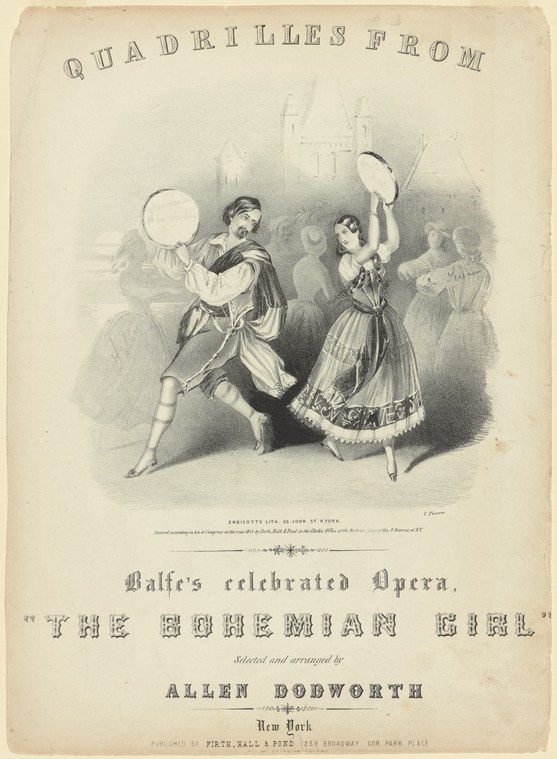
Quadrilles from Balfe's celebrated opera, The Bohemian girl, selected and arranged by Allen Dodworth
Unknown artist
- Collection:
- Prints depicting dance
- Source:
- New York Public Library
- Rights:
- Public domain — free to use, share and adapt.
- Recorded as:
- Public Domain
This image documents the ballroom quadrille at its height of commercial dominance and shows how operatic repertory shaped social dance in the mid-19th century. It is evidence of a large, profitable industry in dance and music publishing that made theatrical entertainment accessible to amateur performers and served as a major vector for the spread of choreographic ideas.
What you are looking at
This is a lithographic title page for a set of quadrille dances arranged from Balfe's opera *The Bohemian Girl*. The composition shows two figures in an interior setting with architectural details—towers and buildings—visible in a hazy background. The figure on the left, dressed in a dark coat and light breeches, holds a large circular tambourine or similar percussion instrument aloft. The figure on the right wears a voluminous skirt with horizontal striping or pleating and a fitted bodice, also raising a circular object (possibly a fan or small plate). Both figures are captured in animated, gestural poses suggesting performance or entertainment. The scene has a theatrical quality enhanced by the soft shading and the glimpsed architecture, suggesting an opera or ballroom setting. Additional figures are faintly visible in the middle distance. The print uses the tonal range typical of mid-19th-century lithography, with careful gradation of light and shadow to create depth.
The dancing
The two principal dancers are in open positions rather than closed hold, each occupying their own space. Their postures are upright and lively, with raised arms drawing attention to the objects they hold—likely stage properties. The woman's skirt displays the characteristic full silhouette of 1840s–50s dress, with pronounced horizontal pleating that would move dynamically in performance. The man's pose is more angular and playful, suggesting comic or character business rather than formal ballroom technique. Neither figure shows the squared shoulders and precise frame of classical ballroom form; instead, both convey a lighter, theatrical energy suited to an operatic context.
The dance depicted
This is sheet music or a dance instruction work derived from Balfe's 1843 opera *The Bohemian Girl*, arranged as quadrilles for social dancing. Quadrilles were the dominant ballroom form of the mid-19th century, typically consisting of five figures danced by two to four couples in a square formation. The operatic source material was common: famous airs and scenes from successful operas were repackaged as quadrilles for amateur and professional dancers to perform at balls and assemblies. The theatrical costumes and exaggerated gestures in this image suggest either a performance version or an illustration intended to make the music visually appealing to consumers. The specific choreography cannot be determined from the image alone, but the open, expressive poses indicate a style more ornamental than the restrained elegance of pure ballroom quadrilles.
How it was made
This is a lithograph, identifiable by the soft, crayon-like tonal modelling, the way light gradates across form, and the characteristic grain of stone printing. The artist has worked in greyscale with careful attention to atmospheric perspective—the background architecture fades into mist, focusing attention on the sharply rendered foreground figures. Lithography was the dominant commercial print medium for theatrical and dance imagery in the 1840s–50s, allowing rapid, relatively inexpensive production for mass circulation. The print was published by Firth, Hall & Pond of New York, a major music publisher, meaning this image was distributed as part of a music package—likely a cover or advertisement for the quadrille set itself. The technique allowed for the subtle modulation and detail that made these images appealing both as performance reference and as decorative objects for the home.
About this work
This lithograph is a commercial print advertising a set of quadrilles arranged from Michael William Balfe's opera *The Bohemian Girl*. Created in New York by the music publisher Firth, Hall & Pond, it represents a common 19th-century practice of repurposing operatic music for ballroom consumption. The work sits at the intersection of theatrical and social dance: it documents both the repertory that ballroom dancers performed and the way popular opera was translated into choreographic form for amateur dancers. The image is evidence of how dance functioned as entertainment across multiple contexts—stage, ballroom, and domestic music-making—in the mid-19th century.
For dance historians, this work illustrates the mechanics of cultural transmission: a successful opera generated derivative commercial products within weeks or months, and dance arrangements were among the most popular. The theatrical costume and staging in the illustration signal that this was not abstract music notation, but a visual performance object intended to inspire, instruct, or simply entertain purchasers who might never perform it themselves.
How to look at it
Notice the theatrical staging—the architectural background, the exaggerated gestures, the way both figures hold aloft the circular objects as though presenting them to an audience. This is not a documentary record of ballroom technique but a theatrical visualization meant to attract buyers and to suggest the operatic source. The woman's costume with its distinctive horizontal pleating is the key to understanding how 1840s ballroom dress moved; the weight of fabric and the gathering would create the cascading motion typical of the period. Observe also the asymmetry of the composition: the two figures occupy different spatial planes and have contrasting poses, reflecting the theatrical rather than formal nature of this arrangement.
The artist
No artist signature is visible on the print. The work was arranged and likely illustrated by staff or contracted artists working for Firth, Hall & Pond, one of the largest American music publishers of the era. The company, founded in the 1820s, specialized in operatic arrangements and quadrille sets, commissioning lithographs for cover and advertisement. Attribution to a specific illustrator is not possible from available information.
The period
The quadrille dominated ballroom dancing from the 1820s through the 1870s, with a particular peak in the 1840s–50s. Michael William Balfe's *The Bohemian Girl* premiered in London in 1843 and became one of the most performed operas of the Victorian era, triggering dozens of musical arrangements and dance adaptations. The practice of creating quadrilles from popular opera airs was a standard part of the music publishing business; publishers issued new sets weekly to meet demand from ballrooms, dance masters, and amateur musicians. The United States, particularly New York, was a major center for this production. The image dates to the era when lithography was at its commercial peak, before photographic reproduction displaced it in the 1890s.
Where it lives
This print is held in the New York Public Library's collection of prints depicting dance. It is a commercial music publishing artifact—one of thousands produced in similar form during the mid-19th century—and represents the standard format and distribution method for dance music of the era.
Dance in this work
Questions about this work
What is a quadrille?
A quadrille is a ballroom dance for four couples arranged in a square, consisting of five distinct figures or sections, each with its own musical theme. It was the dominant social dance form of the 19th century, performed at balls, assemblies, and private dances. The choreography was highly codified, though variations existed. Quadrilles were often arranged from popular opera airs and folk tunes, making them a bridge between theatrical and social dance.
Who was Michael William Balfe?
*The Bohemian Girl* was composed by Michael William Balfe (1808–1870), an Irish composer and conductor who was one of the most successful opera composers of the Victorian era. The opera premiered in London in 1843 and became enormously popular, spawning countless arrangements and adaptations. Balfe's music was known for tuneful, singable melodies that were easily adapted for non-operatic contexts.
Why would sheet music have an illustration like this?
Publishers added lithographic covers and advertisements to music packages to make them visually appealing, attract buyers, and suggest the operatic or theatrical context of the work. For dances, a visual representation of dancers helped customers understand how the music should look and move when performed. These images were also sold and displayed as decorative objects in their own right.
How do we know this is a quadrille arrangement?
The title page explicitly states 'Quadrilles from Balfe's celebrated Opera, The Bohemian Girl, selected and arranged by Allen Dodworth.' Dodworth was a prominent New York dance master and composer; the arrangement credits indicate this is a professional musician's work adapted for ballroom performance, not an operatic score.
More dance artwork





