49 works in this view — arrow keys or swipe to move between them.
Dance in Art
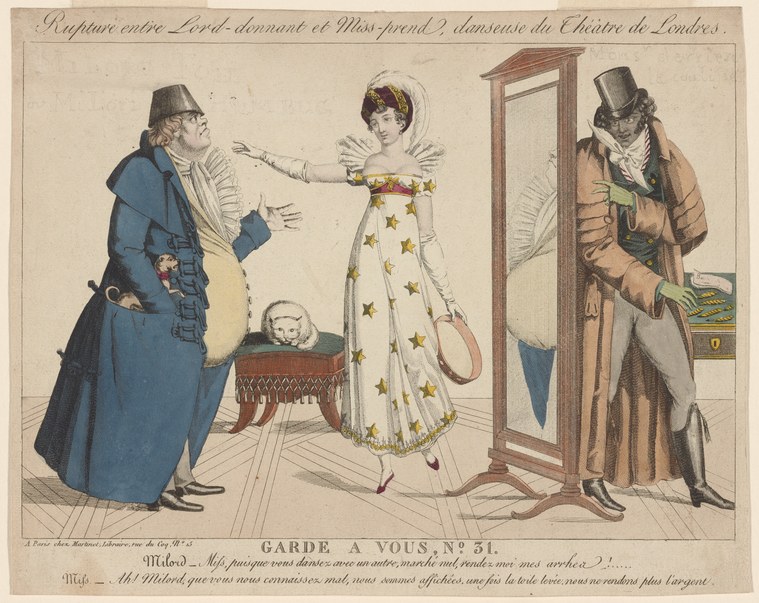
Rupture entre Lord-donnant et Miss-prend, danseuse du Théâtre de Londres
Unknown artist
- Collection:
- Prints depicting dance
- Source:
- New York Public Library
- Rights:
- Public domain — free to use, share and adapt.
- Recorded as:
- Public Domain
This print documents theatrical dancing as a site of social transgression and scandal in 18th-century London, showing how a female performer's body and public gesture were read as markers of moral or social rupture. It preserves evidence of how dance functioned in narrative entertainment and satire, outside the ballet academy—the embodied language of theatrical performance as a vehicle for social commentary.
What you are looking at
This is a hand-colored engraving depicting a theatrical scene of social rupture, likely satirizing a fashionable London scandal. Three figures occupy a shallow interior space with a wooden floor and doorframe visible at right. A corpulent gentleman in a blue coat and tall hat stands at left, gesticulating in apparent dismay or anger toward the central figure—a woman in an elegant white gown decorated with gold stars, wearing a gossamer wing-like collar. She extends her arm toward him in a gesture of confrontation or farewell. At right, a second gentleman in brown and orange tones peers through a doorway, holding what appears to be a ledger or document, his expression suggesting he is witnessing or recording this dramatic moment. The woman's pose—arms spread wide, one leg extended—suggests she may be in the act of dancing or performing, her costume's theatrical nature emphasized by the starred fabric and elaborate collar. The composition captures a moment of social tension rendered in the conventions of 18th-century satirical print culture.
The dancing
The central female figure dominates through her pose: standing in a near-frontal plane with both arms extended laterally at approximately shoulder height, creating a wide, open frame. One leg appears to extend forward, suggesting a step or glide. Her posture is expansive and theatrical rather than naturalistic. The two male figures flank her, the left one leaning forward with one arm raised in expostulation, his body angled toward her in confrontation; the right one remains more static, half-framed by the doorway. The asymmetrical composition and the woman's arrested gesture suggest a moment frozen mid-performance or mid-argument.
The dance depicted
The print's title promises a rupture (quarrel) between a male character and a female dancer identified as from the London theatres. The woman's pose—wide stance, extended limbs, deliberate positioning—suggests she is either dancing or performing a theatrical pose that conveys defiance or independence. The style resembles neither court dance nor the ballet technique codified later in the 19th century; this appears to be theatrical or social dancing of the mid-to-late 18th century, possibly a moment of choreographed performance inserted into a domestic or theatrical comedy. The engraving is likely illustrating a specific theatrical work, possibly a pantomime or satirical play.
How it was made
This is a hand-colored engraving, identifiable by its linear hatching, fine detail, and the subsequent application of watercolor or gouache to the printed line. The technique allowed for mass production and circulation—this type of print was affordable and widely distributed to document fashionable scandals and theatrical gossip. The coloring, done by hand after printing, varies slightly in finish, suggesting production for a popular audience rather than a luxury market. The inscription in French indicates European circulation and likely publication in Paris or London catering to a cosmopolitan public interested in theatrical and social satire.
About this work
This is a satirical engraving documenting a theatrical or social scandal, probably from the 1770s–1790s, depicting a confrontation between a gentleman and a fashionable female dancer. The image captures a moment in which the woman performs or enacts a theatrical gesture—arms spread, leg extended—in defiance or performance, while two male figures witness or react. It belongs to the long tradition of theatrical satire in print, using dance-like posture to convey independence, scandal, or moral commentary. The work is valuable not as documentation of codified technique but as evidence of how theatrical and social dancing functioned in 18th-century popular culture, and how women's agency and public performance were satirized through the body's position in space.
How to look at it
Observe the woman's pose: this is not a ballet position, nor is it a courtly dance frame. She is displayed in a moment of deliberate self-presentation—arms akimbo, leg extended, frontal and exposed. This posture, in the context of the title's emphasis on rupture and scandal, suggests her body is being read as transgressive or defiant. The engraver has chosen a moment of maximum theatrical exposure, not graceful flow, emphasizing the performance of attitude and emotion rather than technical virtuosity. Notice how the male figures' reactions frame her body as the site of the scene's drama.
The period
This engraving belongs to the mid-to-late 18th century period of theatrical satire in popular prints. The costume, the hairstyle, and the interior furnishings place it in the 1770s–1790s. During this period, London theatres were sites of fashionable scandal, and prints documenting theatrical feuds, affairs, and professional rivalries circulated widely among the urban public. The theatrical dancing visible here—expansive, gestural, performed for an audience—predates the Romantic ballet aesthetic but sits within the long tradition of pantomime and comedy dancing that dominated English and European stages before ballet's codification as a serious art form.
Where it lives
This work is held in the New York Public Library's collection of prints depicting dance. It is a hand-colored engraving, likely a single sheet publication distributed as a theatrical satire print.
Dance in this work
Questions about this work
What scandal does this print document?
The title references a rupture between 'Lord Donnant' and 'Miss Prend,' identified as a dancer from London theatres. The specific historical scandal is not recoverable from the image alone, but this type of print was made to capitalize on well-known theatrical feuds and affairs. The woman's theatrical pose and the title's emphasis on rupture suggest her public performance or behavior was the site of social controversy.
Is this woman actually dancing?
She appears to be performing or enacting a theatrical pose rather than executing a specific dance step. Her stance—wide, frontal, arms spread—is deliberate and performed rather than naturalistic. In 18th-century theatrical comedy and pantomime, such poses conveyed attitude, defiance, or emotion. She may be mid-gesture within a theatrical scene rather than performing a dance proper.
What does this tell us about 18th-century theatrical dance?
This print shows dance as a tool of social satire and theatrical narrative, performed by women whose bodies were read as sites of scandal or transgression. The expansive, gestural quality of the pose contrasts with later ballet aesthetics; this is the vocabulary of pantomime and comedy, not classical technique. It reveals how public female performance—and dancing in particular—was entangled with questions of respectability and sexual morality.
More dance artwork





