49 works in this view — arrow keys or swipe to move between them.
Dance in Art
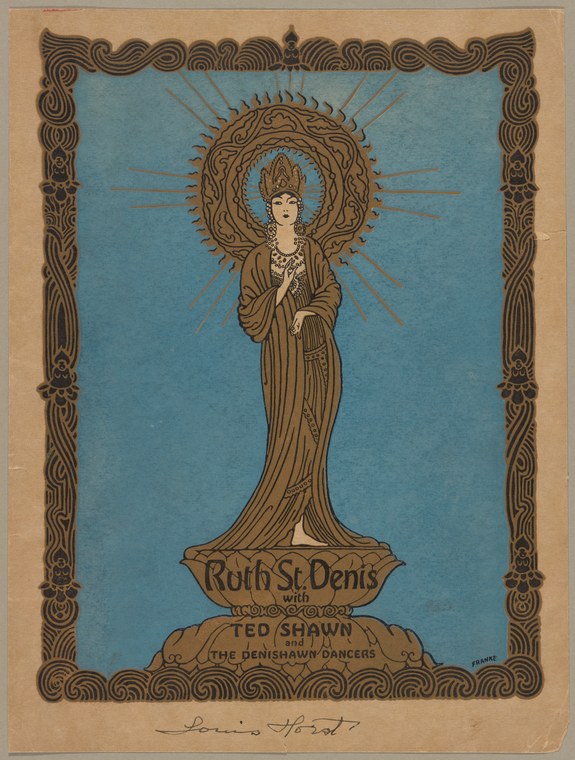
Ruth St. Denis with Ted Shawn
Unknown artist
- Collection:
- Prints depicting dance
- Source:
- New York Public Library
- Rights:
- Public domain — free to use, share and adapt.
- Recorded as:
- Public Domain
This work documents a pivotal moment when American dance was reinventing itself around the figure of the solo female dancer as artist-philosopher, moving away from both ballet conventions and vaudeville entertainment toward what was marketed as serious theatrical art. Ruth St. Denis was instrumental in establishing the dancer as an intellectual and cultural authority, and images like this one shaped how the public understood the dancer's role and body. For historians of modern dance and early 20th-century visual culture, this piece reveals how dance and visual design converged to construct a new public identity for the performing dancer.
What you are looking at
A single female figure dominates the composition, posed in a graceful contrapposto stance against a luminous blue ground. She wears a flowing, classical draped gown in warm brown tones that falls to her feet, with the fabric gathering in soft, repeated folds that suggest both weight and movement. Her left arm hangs naturally at her side while her right arm is raised and bent, the hand positioned near her torso in a gesture of repose or introspection. Above her head rises an elaborate, ornamental circular halo or headdress—a sunburst form with radiating spikes and concentric decorative rings in darker brown, creating a striking visual echo of Art Nouveau pattern-work. Her face is serene and idealized, framed by an elaborate upswept coiffure. The figure stands on a simple rectangular pedestal inscribed with text. The entire composition is enclosed within a dense, sinuous border of interlocking organic curves typical of early 20th-century decorative design, rendered in brown and gold against the paper's natural cream tone.
The dancing
The single dancer is captured in a pose of dignified stillness rather than active movement—her weight appears evenly distributed, with a slight S-curve through the torso that suggests classical contrapposto. Her raised right arm bends at the elbow with a relaxed hand position; her left arm hangs freely. The pose reads as contemplative or monumental rather than dynamic, emphasizing vertical line and graceful proportion over any suggestion of footwork or traveling movement. This is an image of a dancer as an idealized figure or icon rather than a body in motion.
The dance depicted
This appears to be a theatrical or promotional image of early modern dance as practiced in the late 19th and early 20th centuries, likely in the Denishawn tradition or similar theatrical dance contexts. The inscription identifies the subject as Ruth St. Denis, a pioneering figure in American modern dance, with Ted Shawn associated as a collaborator. The pose and costume suggest the kind of orientalizing or classicizing movement vocabularies that characterized interpretive dance of the era—postures influenced by both Greek revival aesthetics and romanticized Asian dance forms. The image documents not an action but a static moment of performance presence or a programmatic figure, emphasizing the dancer's role as an embodiment of an idea or artistic vision rather than the execution of a codified technique.
How it was made
This is a color lithograph or color woodcut, identifiable by the flat areas of color (the blue ground, brown of the gown and ornamental frame), the precise linear detail of the decorative border, and the overall aesthetic of early 20th-century Art Nouveau print design. The technique allowed for mass production of theatre programs, publicity images, and posters while maintaining strong graphic impact and rich color. The presence of hand-written text at the bottom suggests this may be a signed or annotated proof or special copy. The medium's association with theatrical publicity indicates this was made for broad circulation among theatre audiences and collectors.
About this work
This is a color lithograph celebrating Ruth St. Denis, one of the most significant figures in American dance history and a pioneer of theatrical modern dance in the early 20th century. The work exemplifies the aestheticizing of the dancer's body through Art Nouveau design conventions—the ornate frame, the flowing classical drapery, and the hieratic pose elevate St. Denis to the status of an artistic icon rather than depicting her engaged in specific choreography. The image belongs to a genre of theatrical publicity and program art that documented and promoted the emerging modern dance movement, making the dancer's name and image inseparable from the artistic vision she represented.
How to look at it
Observe how the artist has frozen the dancer in a pose of maximum visual grace but minimum kinetic energy—this is a portrait of an artist rather than documentation of movement. Notice the way the decorative frame and the figure's pose mirror each other, both built on curves and symmetry; the ornamental border is as important to the image's meaning as the figure it contains, suggesting that St. Denis was understood as an embodiment of aesthetic principle itself. The upward gaze and the placement of the hand near the heart invite reading the pose as expressive of emotional or spiritual depth, common in the romantic rhetoric surrounding early modern dance.
The artist
The artist is not recorded in the catalogue. However, the style is consistent with early 20th-century theatrical poster and program design, likely by a commercial lithographic workshop or artist associated with theatrical publicity. The Art Nouveau aesthetic and the specific treatment of the decorative border suggest familiarity with contemporary European design movements and their adaptation for American theatrical marketing.
The period
This work dates to the early 20th century, a period of ferment in American dance when Ruth St. Denis and Ted Shawn were establishing Denishawn, a school and company that taught and performed a fusion of classical, orientalist, and interpretive movement vocabularies. This era saw dance being repositioned as a serious art form deserving of the same aesthetic investment and promotional apparatus as music or painting. Simultaneously, Art Nouveau design conventions—with their emphasis on organic line, decorative abundance, and the idealization of the human figure—were dominant in theatre design and print culture, creating a visual language that aligned the dancer's body with contemporary artistic values.
Where it lives
The work is held in the New York Public Library's collection of prints depicting dance, indicating it was preserved as an artifact of theatrical and dance history rather than as fine art. The handwritten signature at the bottom (possibly the artist's or a later annotation) remains unconfirmed by the catalogue record.
Dance in this work
Questions about this work
Who were Ruth St. Denis and Ted Shawn?
Ruth St. Denis (1879–1968) was an American dancer and choreographer who pioneered modern dance in the early 20th century, creating a fusion of classical, orientalist, and interpretive movement. Ted Shawn (1891–1972) was a dancer and choreographer who became her partner in life and art; together they founded Denishawn, one of the most influential dance schools and companies of the era. Their work established the conceptual and technical foundations for American modern dance as a serious theatrical art.
What does the ornate headdress or halo mean?
The elaborate sunburst form above the dancer's head functions as both a stylistic flourish in the Art Nouveau idiom and a symbolic marker of the dancer's spiritual or intellectual elevation. Such imagery was common in early modern dance publicity, where dancers were often presented as muses, priestesses, or embodiments of abstract ideas rather than as entertainers. The halo suggests that St. Denis was understood not merely as a performer but as a conduit of artistic or spiritual truth.
Is this a photograph or a drawing?
This is a color lithograph, a printmaking technique that allowed artists to create images with flat areas of color and precise linear detail. It is not a photograph, though it may have been based on photographic or live reference. The technique was widely used for theatrical programs and publicity in the early 20th century, making images like this affordable to produce and distribute to mass audiences.
What dance is being performed?
No specific dance is being performed—this is a static portrait of the dancer as an artistic figure rather than documentation of choreography in action. St. Denis was known for dances with orientalist, classical, and spiritual themes, but this image presents her as an idealized icon rather than showing her executing any particular movement vocabulary.
More dance artwork





