49 works in this view — arrow keys or swipe to move between them.
Dance in Art
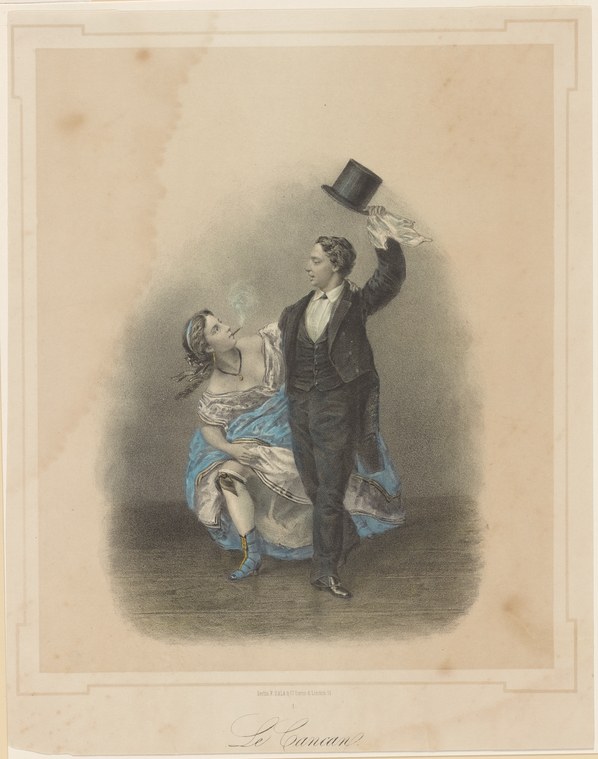
Le Cancan
Unknown artist
- Collection:
- Prints depicting dance
- Source:
- New York Public Library
- Rights:
- Public domain — free to use, share and adapt.
- Recorded as:
- Public Domain
The cancan is one of the first dances in European history to be driven by the visibility and movement of women's legs and bodies, and one of the first to be documented and circulated through mass-produced prints. This image shows why the dance scandalized authorities and captivated audiences: the physical intimacy, the visible exertion, the architectural use of fabric, and the sheer energy of the movement challenged contemporary norms of feminine modesty. Understanding the cancan is essential to any history of sexuality, gender, and entertainment in the 19th century.
What you are looking at
A couple dances in a shallow theatrical space, lit dramatically from behind. The man, in formal black tailcoat and top hat held aloft in one hand, leans back with his body in a deep arch. The woman, in a white corseted dress with blue silk sash or skirt panels, is caught mid-movement with her skirts swirling; her body twists upward toward her partner. The composition isolates the pair against a neutral ground, with soft shading suggesting interior studio or stage space. The moment is one of exuberant lift and turn—the woman appears nearly horizontal, supported by the man's extended arm, her weight thrown into the dance with abandon. The print is hand-colored in subtle tones: flesh, the woman's blue drapery, and darker values for the man's coat, while the background remains pale and atmospheric.
The dancing
The man stands with legs apart for stability, his torso arched backward, his free arm extended to support the woman at her waist or hip. The woman is nearly lifted clear of the floor, her body rotated and leaning back into his frame, her head tilted back, one arm extended. Her skirts are animated and billowed, catching the movement. The connection is a close theatrical hold rather than a ballroom frame—his arm wraps around her, suggesting both support and the intimate partnership required for this figure. The pose conveys both the technical demand and the theatrical showmanship of the dance.
The dance depicted
This is the cancan, the most visually distinctive French social and theatrical dance of the 1840s–1880s. The title confirms it. The cancan was danced by couples (and sometimes by women in groups) and was known for high kicks, rapid turns, splits, and dramatic lifts that made skirts fly—exactly what this image captures. The man's formal black dress and the woman's corseted silhouette with full skirts are canonical for mid-to-late 19th-century cancan, which began as a rowdy quadrille variant in Paris dance halls and was popularized as theatrical entertainment. The exaggerated arch, the lift, and the swirling skirts are signature moves of the dance as it was staged in popular entertainment.
How it was made
This is a hand-colored engraving or lithographic print, likely a reproductive print from the mid-19th century. The delicate line-work, the tonal modeling through cross-hatching and soft shading, and the restrained hand-coloring (particularly the blue of the woman's skirts) are consistent with commercial theatrical prints of the 1850s–1870s. The technique allowed rapid, affordable distribution of dance imagery to a broad public, making these prints key documents of popular entertainment and fashion. The soft vignetting and atmospheric background are typical of period theatrical portraiture.
About this work
This is a print documenting the cancan at the height of its popularity in mid-19th-century Paris. The dance had emerged from the quadrille as a transgressive, exuberant spectacle—prized for the visibility of women's legs and bodies in motion—and by the 1860s was both a scandalous popular attraction and a staple of theatrical entertainment. The print captures the essence of the dance: the dramatic lift, the swirling skirts, the close partnership between man and woman, and the theatrical heightening that made it a sensation. As a reproductive print, it served to circulate images of the dance to audiences who could not see it performed, making the cancan a phenomenon of both live entertainment and visual culture.
How to look at it
Watch the geometry: the artist has chosen the moment of maximum dramatic height—when the woman is nearly horizontal and fully lifted, when her skirts have billowed maximum, and when the man's theatrical arch is most pronounced. This is not the everyday cancan of the dance hall; this is the cancan as spectacle, heightened and posed for visual effect. The top hat held aloft is a period detail and a signature of the man's formal preparedness and showmanship. Note how the print isolates the couple in space, with no setting or other dancers—a compositional choice that emphasizes the partnered virtuosity and the eroticism of the lift.
The period
The cancan emerged in Paris in the 1840s as a variation on the quadrille, danced in working-class dance halls and by entertainers. By the 1860s, it had moved to the stage, becoming a fixture of revue and musical entertainment at venues like the Moulin Rouge (opened 1889). The dance was condemned by clergy and conservative critics as immoral, but it was wildly popular, especially among soldiers and young men, and it made stars of dancers like La Goulue and La Môme Fromage. The image dates from this period of rapid popularization and theatrical consolidation. Mid-19th-century prints of dance were booming as commercial products, distributed to supplement theater programs and to feed public appetite for images of performers and fashionable entertainment.
Where it lives
The work is held in the New York Public Library's Prints collection, which holds extensive 19th-century dance imagery. It is part of a large body of theatrical and social-dance prints from the period, assembled to document performance and fashion.
Dance in this work
Questions about this work
What is the cancan, and why was it controversial?
The cancan was a high-energy couple or group dance that emerged in 1840s Paris, characterized by kicks, spins, and dramatic lifts. It was controversial because it involved the visible, energetic display of women's legs and bodies—and because it was danced in working-class venues and by women entertainers. Conservative authorities saw it as scandalous; popular audiences found it thrilling. It became a symbol of modernity, transgression, and Parisian entertainment culture.
Who danced the cancan, and where?
The cancan began in Parisian dance halls frequented by soldiers, students, and working-class men. It was danced by professional dancers and amateurs alike, and by the 1860s it had moved to the stage, becoming a signature feature of revue at theaters and cabarets. By the 1880s, the Moulin Rouge and other large venues made the cancan a major tourist attraction and an international phenomenon.
How does this image compare to how the cancan was actually danced?
The image captures authentic elements—the close hold, the woman's arched back, the visible skirts, the man's formal dress—but it is heightened for theatrical and visual effect. The extreme lift and arch are typical of cancan as performed on stage, but everyday cancan in dance halls would have included more rapid footwork, higher kicks, and wilder group energy. This print emphasizes the spectacular and partnered dimension of the dance.
How do prints like this shape our understanding of 19th-century dance?
Prints were the primary visual media through which most people encountered dance; they were widely distributed and relatively affordable. This means our image of 19th-century dance is partly shaped by what was deemed marketable and theatrical. The emphasis on costume, dramatic pose, and the couple-as-spectacle in this print tells us as much about how the dance was sold and imagined as about how it was actually performed.
More dance artwork





