49 works in this view — arrow keys or swipe to move between them.
Dance in Art
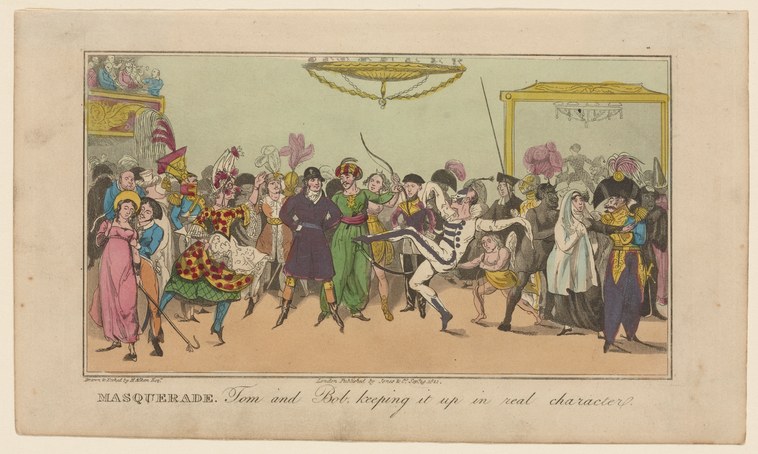
Masquerade. Tom and Bob, keeping it up in real character
Unknown artist
- Collection:
- Prints depicting dance
- Source:
- New York Public Library
- Rights:
- Public domain — free to use, share and adapt.
- Recorded as:
- Public Domain
This image captures a moment when dance and social transgression were openly linked—when the masquerade ball was understood as a space where movement itself could be anarchic and ridiculous. For anyone interested in the history of how bodies were allowed to move in society, or how social conventions were mocked and inverted, this print is a vivid primary document. It shows that even in an era of rigid deportment and formal dance instruction, there was hunger for the grotesque and the uncontrolled.
What you are looking at
A crowded masquerade ball captured in a hand-colored engraving. The composition is densely packed with figures in elaborate costumes and masks, arranged across a wide interior space with architectural elements—doorways and canopies—visible at left and right. The figures wear the dress of the late 18th or early 19th century: women in high-waisted empire gowns and feathered headdresses, men in coat-tails and breeches. At the center, a figure in skeleton costume with black and white striped clothing dances with exaggerated, limb-flailing movements—this appears to be the "Tom" or "Bob" of the title, the provocateur keeping the festivities "in real character." The surrounding crowd watches, gestures animatedly, and participates in the revelry. The color palette is muted—pale yellows, pinks, greens, and flesh tones—and the light is even and theatrical, typical of engraved reproduction work. The overall effect is chaotic carnival energy: costuming takes precedence over formal dance arrangement.
The dancing
The skeleton figure at center displays exaggerated, anarchic movement—limbs splayed and extended in wild, comedic postures that contrast sharply with any formal dance hold or frame. Surrounding figures are posed in varied attitudes: some standing, some gesturing toward the skeleton dancer, some appearing to dance with partners. There is no unified line or symmetric formation. The composition prioritizes visual spectacle and costume over dance mechanics; bodies are presented frontally and in profile, arranged for clarity of the colored detail rather than for anatomical precision of step or weight-shift. The skeleton's elongated, contorted posture suggests acrobatic or grotesque movement rather than ballroom propriety.
The dance depicted
This is a masquerade scene from the world of Regency or Gilded Age carnival entertainment, likely English in origin and audience. Masquerade balls were spaces where social conventions were temporarily suspended, and the skeleton costume—a stock "death" character—permitted rowdy, uninhibited movement. The title's reference to "keeping it up in real character" suggests improvised foolery within a structured social event. This is not a depiction of a specific dance form but rather a moment of carnivalesque license: the skeleton performs comedic grotesquerie while the assembled crowd participates in the spectacle. The work captures masquerade as social theater rather than choreographed ballet or country dance.
How it was made
This is a hand-colored engraving—the underlying line work is engraved in copper plate, and the color has been applied by hand or in multiple passes. The technique allowed for wide circulation at modest cost, making it a popular medium for social satire and entertainment commentary in the late 18th and early 19th centuries. The clean, uniform line work and balanced composition suggest professional production. The hand-coloring, evident in the varied application and slight imprecision of the pigment at edges, indicates this was a commercial print produced in quantity for a middle-class market familiar with prints as a source of social commentary and amusement.
About this work
This is a Regency or Gilded Age satirical engraving depicting the social theater of an English masquerade ball—a space where rank, decorum, and formal movement were temporarily suspended in favor of costume, foolery, and improvised revelry. The skeleton figure at center, identified as "Tom" or "Bob" in the title, embodies the licensed transgression of the masked ball: he performs grotesque, uninhibited movement that would be unthinkable in polite ballroom society. The work documents not a specific dance technique but a social ritual and its permitted anarchies.
For historians of dance and spectacle, this print is valuable as evidence of how masquerade was understood and represented in popular imagery. It shows dance and movement not as something codified and taught, but as something released and satirized. The wild posture of the skeleton is the point: it marks the boundary between the structured world of ballroom propriety and the carnivalesque space where bodies were permitted to become strange.
How to look at it
Attend first to the skeleton figure at the composition's center and trace the exaggeration in every limb: the extended arms, the twisted torso, the splayed legs. This is not the controlled, weight-centered movement of a minuet or waltz; it is movement designed to be visible from across a crowded room and to read as transgression. Notice also how the surrounding figures are arranged not in couples or lines but in a scattered crowd—the masquerade does not organize bodies into geometric formations the way formal dance does. Finally, look at the costumes: the elaborate masks, feathers, and fancy dress are as much the point as the movement itself. In a masquerade, costume and character permitted movement that the person's own station would not.
The period
Masquerade balls were a prominent feature of English social life from the mid-18th century through the Regency and into the Victorian era. They were occasions for class mixing, flirtation, and the temporary inversion of social hierarchy—the servant could address the lord, the unmarried woman could converse freely with strangers, and the skeleton or fool could perform with impunity. By the late 18th century, masquerades were the subject of extensive satirical commentary in prints, novels, and plays. This engraving sits within a tradition of social satire that used the masquerade as a lens through which to examine hypocrisy, excess, and the fragility of social order. Contemporary prints by Gillray, Rowlandson, and others documented masquerades and their excesses; this work follows that tradition.
In the context of dance history, the masquerade represents a persistent alternative to the codified ballroom forms (minuet, cotillion, quadrille) that dominated polite society. While those dances were taught, documented, and performed with precision, masquerade permitted—and celebrated—movement that was wild, improvised, and physically inventive. The skeleton's contorted posture speaks to a hunger for expressivity and grotesquerie that formal ballroom propriety did not permit.
Where it lives
This work is held in the New York Public Library's collection of prints depicting dance. It is part of a larger body of Regency and Georgian satirical prints that documented English social life for a popular audience.
Dance in this work
Questions about this work
What is a masquerade ball?
A masquerade ball was a formal social event where guests wore masks and fancy costumes, which permitted them to behave with greater freedom and anonymity than ordinarily allowed. Masquerades were especially popular in 18th-century England and were the subject of considerable moral anxiety and satirical comment. They were spaces where social hierarchy was temporarily suspended and where improvised, anarchic movement was not only permitted but expected.
Who is 'Tom' and 'Bob' in the title?
The title suggests these are comic character types—stock figures from popular entertainment and carnival tradition. The skeleton costume identifies the figure as a death or fool character, a traditional mask that permitted physical comedy and grotesquerie. Without additional documentation, it is not possible to identify these as specific performers or patrons, but the names suggest they are recognizable types to the print's original audience.
Is this an accurate record of how people danced at masquerades?
This print is satire, not documentation. It exaggerates and ridicules in order to entertain and critique. The skeleton's wild movements are presented as amusing transgression, not as realistic depiction of ordinary masquerade behavior. However, the image does tell us that masquerades were understood as spaces where movement could be uncontrolled and grotesque in ways that would be scandalous in formal ballroom settings.
What dance forms are shown here?
No specific ballroom dance—minuet, cotillion, quadrille—is depicted. Instead, the image shows improvised, characterful movement licensed by costume and mask. The skeleton's performance is comedic and physical rather than ballroom propriety. The surrounding crowd may be engaged in dancing or simply in the social theater of the masquerade; the composition does not distinguish clearly between the two.
More dance artwork





