49 works in this view — arrow keys or swipe to move between them.
Dance in Art
Le bal Bullier
Unknown artist
- Collection:
- Prints depicting dance
- Source:
- New York Public Library
- Rights:
- Public domain — free to use, share and adapt.
- Recorded as:
- Public Domain
The Bal Bullier was a crucial site of social mixing and cultural production in 19th-century Paris, and this print is one of the few visual documents of dance culture at a commercial, public venue rather than at elite balls or in theatrical contexts. For historians of dance, it provides concrete evidence of how the waltz and ballroom technique were actually practiced by non-elite dancers, and how the dancing body was depicted in popular visual media of the era.
What you are looking at
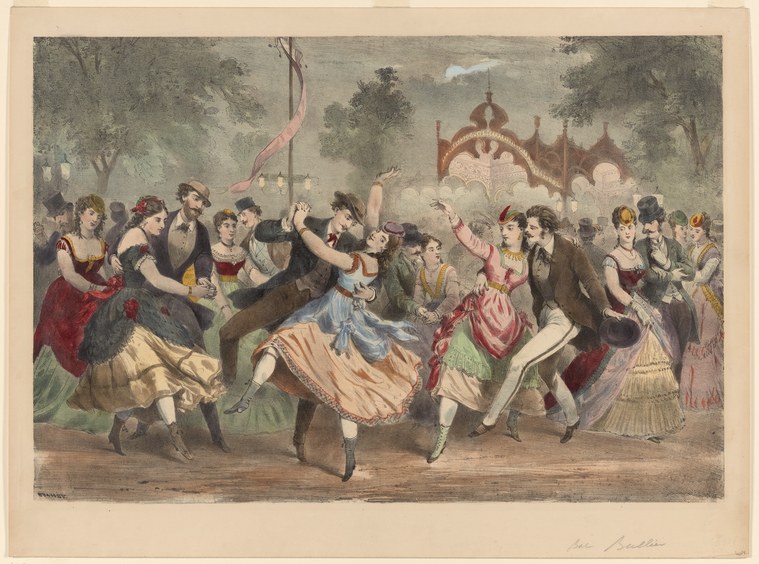
A crowded open-air dance pavilion or garden venue, with a striped awning structure visible in the middle distance. The scene captures a moment of social dance among well-dressed figures in what appears to be mid-to-late 19th-century dress. In the foreground, a woman in a peach-colored dress with full skirts is captured mid-turn or spin, her body angled dynamically, while a man in dark formal wear appears to be her partner. Around them, dozens of other dancers and spectators mill about in the space—some dancing in pairs, others standing and watching. The women wear a variety of colored dresses in reds, blues, greens, and yellows, all with the full skirts characteristic of the 1850s–1870s. The men are predominantly in dark suits. Trees frame the scene on either side, and the composition suggests this is a public or semi-public dance hall rather than a private ball. The hand-colored technique creates a festive, lively atmosphere with warm tones dominating.
The dancing
Dancers appear to be in closed or semi-closed positions typical of ballroom dancing—the central couple show the man's lead with the woman responding in a turned-away position that suggests a waltz or similar rotating dance. Most figures maintain upright posture with arms positioned for partner dancing. The woman in the foreground is caught at a moment of extension or spin, her skirts billowing, indicating active movement. Many dancers are arranged in pairs across the composition, though some solo figures and onlookers create depth and a sense of crowded social space. The general carriage suggests trained or at least practiced dancers rather than folk or vernacular dancers.
The dance depicted
This appears to document a public ball or dance hall scene, most likely the Bal Bullier referenced in the title—a famous open-air dance venue in the Latin Quarter of Paris known for its mixed-class clientele and lively atmosphere in the 19th century. The dance style visible is consistent with ballroom social dancing of the period, particularly the waltz, which was the dominant partner dance of fashionable society from the 1850s onward. The dynamic pose of the central figure and the paired arrangements of bodies throughout suggest rotational, turning dances rather than linear or processional forms. The public, semi-outdoor setting and the scale of participation indicate this was a commercial or institutional dance venue rather than a private aristocratic ball.
How it was made
This is a hand-colored engraving or lithograph, executed in the popular illustrated-journalism tradition of the 19th century. The technique allowed for rapid reproduction and distribution to a wide audience—prints of this type were sold individually, collected in albums, or published in illustrated newspapers and magazines. The hand-coloring, applied after the printing process, was a labor-intensive step that added market value and visual appeal. The composition's narrative clarity and the careful rendering of costumes and poses suggest the work was designed to convey information to a general public audience as well as to serve as a document of contemporary social life and fashion.
About this work
This engraving documents the Bal Bullier, a legendary open-air dance venue in 19th-century Paris where students, artists, and working-class Parisians gathered to dance. The work captures the spectacle and energy of public ballroom culture during an era when the waltz and closed-partner dances dominated fashionable dance practice. The composition reveals not only the style of the dance itself—the turning, the posture, the hold—but also the social world it inhabited: the mixed crowd, the density of bodies in motion, the visual importance of women's dress. As a hand-colored engraving, it is a document of how dance was portrayed in mass media and what aspects of the dancing moment were considered worth recording and selling to the public.
How to look at it
Look closely at the central couple in the foreground: the woman's position—her body turned away from her partner, her skirts in motion—reveals the rotational moment of a waltz or similar turning dance. Note how the artist has used the woman's dynamic pose and billowing skirts to convey the sense of continuous movement and spin. Observe how many of the surrounding couples are arranged in similar paired positions throughout the composition, which tells us this was a standardized, repeated dance form rather than a fluid or improvised one. The presence of spectators and the crowded, festive atmosphere were conventions of 19th-century dance-venue imagery: the point was to show both the dancers and the social spectacle they created.
The period
The Bal Bullier flourished from the 1840s through the 1860s as an institution of Parisian popular culture, immortalized in literature and visual journalism. The waltz had become the dominant social dance across Europe by the 1850s, though not without controversy—its close partner contact and rotating motion were still considered transgressive in some circles. The mid-19th century saw a boom in illustrated journalism and mass-market prints depicting contemporary life, fashion, and entertainment. Paris in particular was the subject of intense visual documentation, and dance venues—from elite balls to working-class guinguettes and commercial halls like the Bal Bullier—were frequent subjects for engravers and lithographers serving an increasingly literate and image-consuming public.
Where it lives
The work is catalogued within the New York Public Library's print collection depicting dance. It is a popular print, likely produced in multiple impressions and hand-colored examples, consistent with mid-19th-century commercial art production.
Dance in this work
Questions about this work
What was the Bal Bullier?
The Bal Bullier was a famous open-air dance hall in the Latin Quarter of Paris, established in the 1840s and known for its mixed clientele of students, artists, and working-class Parisians. Unlike elite aristocratic balls, it was a public, commercial venue where anyone could pay to dance. It became legendary in Parisian culture and is referenced frequently in 19th-century literature and visual media.
What dance is being shown?
The dominant dance appears to be the waltz or a similar closed-partner, rotational ballroom dance popular in the 1850s–1870s. The woman's dynamic turning pose and the paired positions of dancers throughout the scene are characteristic of waltz technique. The upright posture and formal dress indicate a ballroom rather than folk or theatrical dance.
Why are there so many people watching?
The Bal Bullier was as much a social spectacle as a dance venue. Attendance, dress, and visibility were part of the experience. The crowd in the image reflects the reality of public dance halls, where a mix of active dancers and onlookers (some waiting for partners, some simply observing) created the festive atmosphere that made these venues attractive.
How was this print made and distributed?
This is a hand-colored engraving or lithograph, a standard mass-market format in the mid-19th century. The image was first printed in black and white, then colored by hand, making each print slightly unique. Such prints were sold individually, collected in albums, or published in illustrated newspapers, reaching a wide urban audience curious about contemporary Parisian life and fashion.
More dance artwork





