49 works in this view — arrow keys or swipe to move between them.
Dance in Art
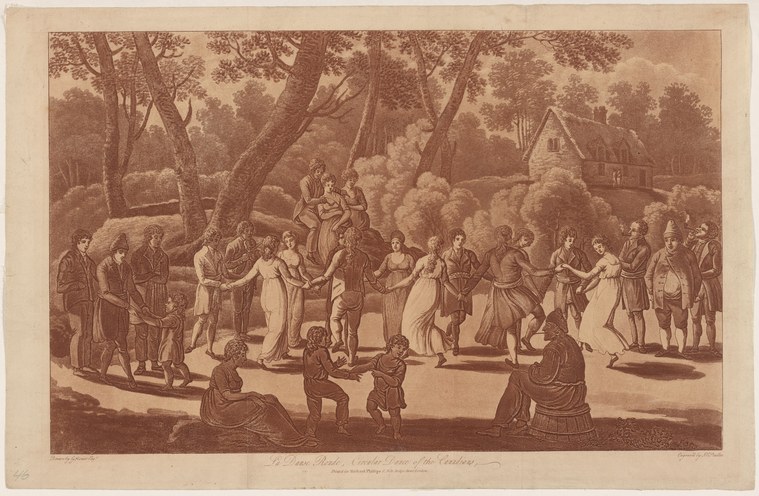
Ladanse ronde; circular dance of the Canadians.
Unknown artist
- Collection:
- Prints depicting dance
- Source:
- New York Public Library
- Rights:
- Public domain — free to use, share and adapt.
- Recorded as:
- Public Domain
The image provides rare visual evidence of round-dance practice in the 18th century, including its structure, costume, and social context—a form that left few written technical descriptions but was widespread across Europe and the colonies. The explicit mention of a Canadian variant documents the circulation and adaptation of European dance forms in colonial North America, revealing how diaspora communities maintained or modified traditional social practices.
What you are looking at
A large outdoor gathering beneath towering trees, rendered in sepia tones typical of 18th-century engravings. In the foreground, a ring of dancers moves in a circular formation, their bodies angled inward toward the center. The dancers wear flowing white garments—women in long dresses, men in breeches and coats—typical of European fashion of the period. In the immediate foreground, three small children sit or crouch on the ground, apparently watching or participating in a smaller-scale version of the dance. The assembled company numbers perhaps forty figures, distributed across a forest clearing with a modest cottage visible in the middle distance. The composition emphasizes the circular choreography; the dancers form a continuous ring, their arms and bodies oriented toward the communal center. The engraver has used fine parallel lines to suggest depth and atmospheric perspective, creating a sense of leisure and festival in a pastoral setting.
The dancing
The dancers in the ring maintain an open or semi-open hold, bodies upright and arms at approximately waist height, many linked or adjacent to their neighbors. The positions are relatively symmetrical and orderly, with no extreme tilts or elaborated arm gestures. The smaller figures in the foreground appear to mirror or replicate the adults' formation on a reduced scale. All visible bodies show a calm, processional quality rather than high energy or complex footwork; the emphasis is on collective synchronization and closure (the ring itself), not on individual virtuosity or dynamic weight shifts.
The dance depicted
This depicts a ronde or round dance, a participatory circle dance common across Europe in the 18th and early 19th centuries. The title explicitly identifies it as 'la danse ronde; circular dance of the Canadians,' suggesting either a Canadian variant or a European round dance performed in a North American colonial context. Round dances of this period were secular social forms, often danced outdoors at festivals, gatherings, or celebrations. The image emphasizes the inclusive, community-oriented nature of the form: the ring as a closed loop in which many can participate simultaneously without assigned roles or paired couples. The presence of children suggests intergenerational participation typical of folk and regional round dances.
How it was made
This is an engraving, identifiable by the fine parallel hatching lines used to build tone and shadow, the crisp linear quality of the outlines, and the overall tonal range from white paper to dark brown ink. The technique allows for precise linear detail in the dancers' garments and the forest setting while maintaining a uniform, reproducible image. Engravings of this type were relatively inexpensive to produce and distribute, making them suitable for publication in periodicals, travel accounts, or illustrated books about regional customs—suggesting this work was intended for a broad educated audience rather than a specialized collector. The uniform sepia tone and refined technique indicate professional production, likely 18th century.
About this work
This engraving documents a participatory social dance—the ronde or round dance—performed in what the title identifies as a Canadian setting or Canadian variant. The work captures the visual and choreographic essence of the form: a circular, inclusive structure in which community members of all ages link together in a ring, moving to a shared rhythm without the elaborate dress codes or paired-couple structure of formal ballroom dance. The forest setting and casual outdoor gathering place it within the folk or regional traditions, distinct from aristocratic court dance but part of the documented visual record of 18th-century leisure and festival culture. Its presence in the New York Public Library collection suggests it was part of a larger documentary interest in regional and colonial customs.
How to look at it
Observe the unbroken ring of dancers and the deliberate symmetry of their positioning; the artist has chosen to depict the ronde at a moment of sustained circular motion rather than a dynamic peak or moment of transition. Notice the inclusion of children and spectators: the dance is presented not as a performance for an audience but as a participatory event that can accommodate multiple generations and skill levels simultaneously. The forest setting and natural light (implied by the clear ground and open sky) distinguish this from the interior, illuminated spaces of ballroom and court dance imagery; this is a daylight, outdoor, seasonal leisure activity. The engraver's attention to the architecture of the ring itself—the geometry of closure and communal participation—reveals how the form was understood: its value lay not in individual display but in collective belonging.
The period
In the 18th century, round or ronde dances were among the most common participatory social forms across Europe and European colonial settlements. They differed markedly from the highly codified court dances (minuet, gavotte) and the emerging ballroom styles (quadrille, cotillion) documented in dance manuals and aristocratic portraits; instead, they belonged to the realm of village fetes, harvest celebrations, and outdoor seasonal gatherings. The engraving tradition of documenting regional and 'ethnographic' customs—what might now be called folklore—was well established by the mid-18th century, with publishers issuing illustrated accounts of trades, costumes, and customs from different regions and colonies. This work sits within that documentary impulse, recording a social practice considered worth preserving and circulating to a literate audience.
Where it lives
The work is held in the Prints collection of the New York Public Library, catalogued under the broader category 'Prints depicting dance.' No acquisition date, artist attribution, or publication information is recorded in the catalogue; it is identified only by title and subject matter.
Dance in this work
Questions about this work
What is a ronde or round dance?
A ronde is a circle dance in which multiple dancers link hands or stand adjacent, moving together around a shared center point. It is a participatory rather than spectatorial form, requiring no special skill level or prior training, and allows flexible numbers of dancers. Round dances were danced at outdoor festivals, celebrations, and seasonal gatherings across Europe and the colonies, and remained common folk and regional social forms through the 19th century.
What does 'circular dance of the Canadians' mean?
The title suggests either that this engraving documents a round dance as performed in Canada (a European form adapted in a colonial North American context), or that it depicts a Canadian variant or local version of the ronde. The phrase indicates the artist or publisher's interest in recording regional and colonial variants of European customs, reflecting the 18th-century documentary interest in cultural difference and diversity.
How does this differ from ballroom dances like the quadrille?
The quadrille and other ballroom forms were structured, often choreographed, and divided into fixed roles (pairs, sets, lines) with specific figures and sequences. The ronde shown here is fluid, participatory, and organized around a single geometric principle—the ring—rather than a sequence of named steps. Ballroom dances were performed indoors, in formal dress, with musical accompaniment and often an audience; the ronde was an outdoor, communal, seasonal form accessible to all ages and skill levels.
More dance artwork





