49 works in this view — arrow keys or swipe to move between them.
Dance in Art
M'lle. [Louise] Lamoureux, the celebrated danseuse [with accompanying article]
Unknown artist
- Collection:
- Prints depicting dance
- Source:
- New York Public Library
- Rights:
- Public domain — free to use, share and adapt.
- Recorded as:
- Public Domain
The image is significant as historical documentation of a living tradition—the dragon boat festival—and as evidence of how 19th-century Western periodical culture represented non-Western ceremonial and celebratory practice. For students of dance history, it offers a window into how festival culture, procession, and community movement were observed and aestheticized by foreign witnesses, and how such documentation shaped Western perception of Asian cultural practice. The engraving technique itself is historically important as the primary medium for global image circulation in the era before photomechanical reproduction.
What you are looking at
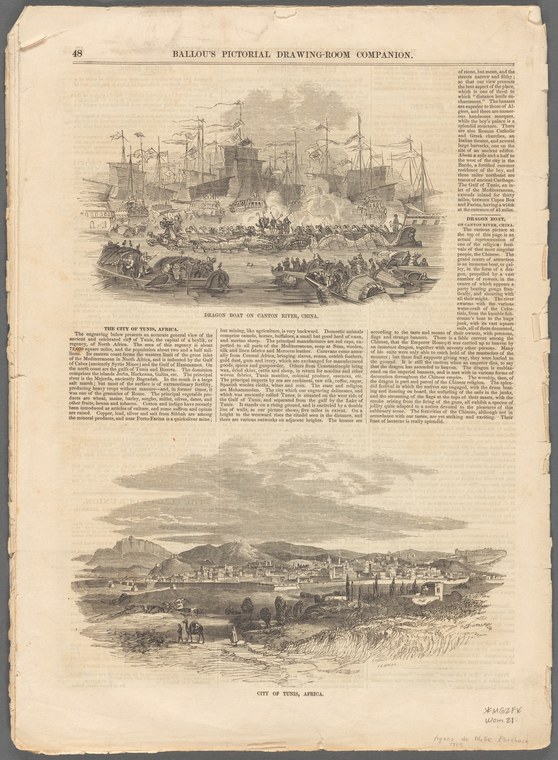
This is a two-part engraved illustration from what appears to be a 19th-century periodical. The upper scene depicts a bustling riverfront with numerous vessels—sailing ships, steamboats, and smaller craft crowded together at what is labeled as a dragon boat festival on the Canton (Guangzhou) River. The water is alive with activity: boats are packed densely, crowds of figures fill the vessels and shoreline, and the composition suggests celebration and spectacle. The lower scene shows a distant view of the City of Tien (likely Tianjin or another major Chinese port city), rendered as a panoramic landscape with fortified walls, numerous buildings with traditional architecture, mountains in the background, and agricultural fields in the foreground. Both scenes are rendered in fine engraved detail characteristic of Victorian-era periodical illustration. A substantial text block accompanies the upper image, indicating this is a documentary or journalistic work about Chinese life and culture.
The dancing
The figures in both scenes are rendered at small scale typical of engraved reportage, making detailed analysis of individual gesture difficult. In the river scene, clustered crowds are suggested through dense linework rather than distinct bodies. Some figures appear to be standing, others gesturing toward the water or the festival activity. The scale and composition emphasize the spectacle and crowd rather than individual dancers or performers, though the context of a dragon boat festival suggests ceremonial movement and celebration involving many participants.
The dance depicted
This is not a depiction of dance performance in the traditional sense, but rather documentary reportage of a Chinese festival—the dragon boat race on the Canton River—that involved processional, celebratory movement and was accompanied by music, performance, and ceremonial practice. The dragon boat festival itself is a global-east-asian tradition involving ritual procession and community participation. The image documents the festival as a cultural phenomenon rather than isolating or choreographing dance as such. The crowds and vessels suggest the participatory, celebratory movement that characterized such festivals, but the primary subject is the event itself rather than a codified dance form.
How it was made
This is a wood engraving or steel engraving, a reproductive technique common in 19th-century periodicals, likely from the 1850s–1870s based on style. The fine parallel lines and careful cross-hatching create tonal depth and atmospheric perspective, particularly visible in the landscape view. Engraving was the dominant method for reproducing images in newspapers and illustrated magazines of the era, allowing wide circulation to a reading public interested in accounts of distant places and exotic cultures. The technique's precision and capacity for fine detail made it ideal for both the crowded complexity of the festival scene and the architectural and geographical specificity of the city view. This page came from a bound volume or periodical series, suggesting it was part of a serialized or collected account of travel, trade, or colonial observation in China.
About this work
This engraved illustration documents a Chinese dragon boat festival on the Canton River, rendered as two complementary views—the crowded, active festival scene itself and a distant panoramic view of the riverine city. It is a work of 19th-century journalistic and geographical illustration, created to inform European and American readers about Chinese life, commerce, and culture during the era of increased Western contact with China. The work sits at the intersection of documentary reportage, cultural spectacle, and the festival traditions of global-east-asian celebration. While not a focused depiction of choreographed dance, it captures the movement, celebration, and ritual performance that characterize the dragon boat festival as a cultural practice.
How to look at it
Attend to the composition's division between foreground action and distant prospect—the engraver has chosen to show the festival as both immediate, chaotic activity and as a situated phenomenon within a specific geography. The density of figures and vessels in the upper scene conveys celebration and community participation rather than formal choreography. Observe the fine parallel lines and cross-hatching that create texture, atmosphere, and the illusion of depth across water and landscape. The engraver's decision to include both close and distant views suggests the work's function as geographical and ethnographic documentation—to teach the reader not just what the festival looked like, but where it was, how it fit into the urban and natural landscape of China.
The period
This work dates to the mid-to-late 19th century, a period of intense Western interest in Asian cultures prompted by colonial expansion, trade, and missionary activity. Illustrated periodicals like the Illustrated London News, Harper's Weekly, and similar publications devoted substantial resources to serialized accounts of distant lands, illustrated by engravings based on sketches by correspondents or derived from earlier traveler accounts. The dragon boat festival had deep roots in Chinese culture (traditionally associated with the Dragon Boat Festival / Duanwu Festival) but became an object of Victorian-era exoticization and touristic fascination. The rendering of the festival as a crowded, spectacular public event reflects both the genuine scale of such gatherings and the Western appetite for images of exotic mass spectacle and 'Oriental' otherness.
Where it lives
The work is held in the New York Public Library's Prints collection, cataloged as depicting dance. It appears to be a page from Ballou's Pictorial Drawing-Room Companion, a major American illustrated periodical of the 1850s–1870s, suggesting it was part of a serialized account of travel, trade, or natural history in Asia.
Dance in this work
Questions about this work
Is this actually a dance image?
Not in the sense of choreographed performance. It documents a Chinese festival—the dragon boat race—that involved ritual procession, community celebration, and movement as cultural practice. The dragon boat festival is a living tradition with deep historical roots and involves processional, celebratory elements. The image captures the festival as a social and ceremonial event rather than isolating dance per se, but it is relevant to dance history as documentation of how communities moved, celebrated, and performed together.
What is a dragon boat festival?
The Dragon Boat Festival (Duanwu Festival) is a traditional celebration in Chinese culture, historically linked to the summer solstice and commemorative practices. It centers on competitive boat races on rivers, with boats decorated as dragons and carrying many rowers. The festival involves music, celebration, crowds, and ritual elements. By the 19th century, when this engraving was made, such festivals had become objects of Western tourist and journalistic interest, and illustrations like this brought images of Chinese cultural practice to European and American audiences.
Why is this in a dance collection?
Dragon boat festivals involve movement, celebration, and community performance. While not 'dance' in the formal choreographic sense, they represent a form of cultural practice in which participants move, process, and celebrate collectively—activities that fall within a broad understanding of how bodies move in cultural contexts. The image documents one of the major festive traditions of global-east-asian culture and is valuable as historical evidence of how communities gathered, moved, and performed together.
More dance artwork





