49 works in this view — arrow keys or swipe to move between them.
Dance in Art
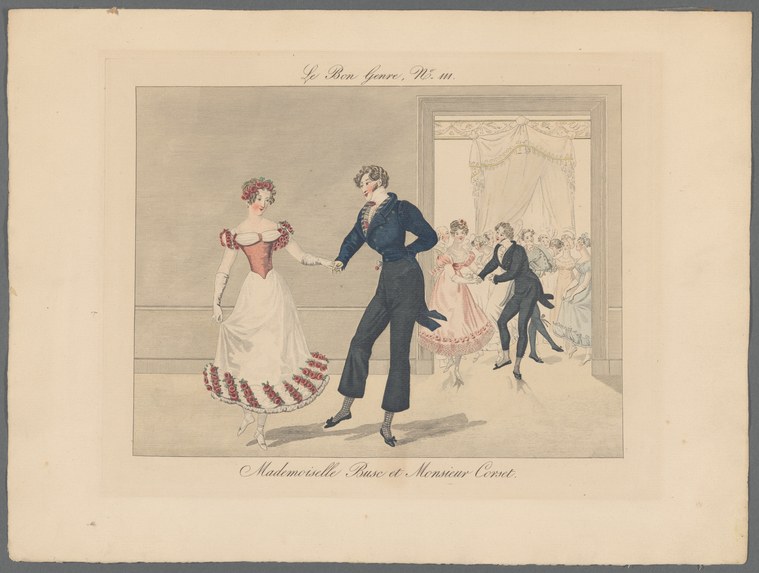
Mademoiselle Busc et Monsieur Corset
Unknown artist
- Collection:
- Prints depicting dance
- Source:
- New York Public Library
- Rights:
- Public domain — free to use, share and adapt.
- Recorded as:
- Public Domain
This print documents the social grammar of formal dance at a moment when dance was not primarily about virtuosity but about display, courtship, and social positioning. For dancers and historians, it offers evidence of how the body was dressed, postured, and staged in the ballroom, and how the moment of invitation and introduction was itself a performed ritual. The caricatural tone suggests this was a well-known scene, making it a potential window into celebrity or satire within the dance world of the period.
What you are looking at
A parlor scene showing a man and woman in the moment of a formal dance introduction or courtship ritual. The woman, in the left foreground, wears a high-waisted white Empire gown with puffed sleeves in a coral or salmon colour, the skirt trimmed with a distinctive striped border and sweeping train. She holds her skirt with one hand in a gesture of presentation. The man, center, wears formal dark tailcoat and white breeches, his posture upright and attentive. Behind them, a group of onlookers—mostly fashionable women in pale gowns and several men in dark coats—cluster near a doorway with draped curtains, watching the interaction with apparent interest. The setting is an elegant interior with pale walls and a formal threshold, suggesting a ball or assembly room. The composition captures the theatrical moment of social display rather than the dance itself.
The dancing
The two central figures stand apart in an open, promenade-like arrangement rather than in closed hold. The woman's weight is poised, her skirt lifted to display the ornamental hem—a gesture of presentation rather than active locomotion. The man stands in a formal, upright posture facing her, his arms at his sides or lightly extended, suggesting the moment of request or invitation. Their relative positions and the woman's lifted skirt indicate a moment of preparation or introduction before or between dances rather than mid-movement. The surrounding figures are stationary spectators, reinforcing that this is a pause in the social rhythm rather than active dancing.
The dance depicted
This appears to document a scene from a formal ball or assembly of the Regency or early 19th-century period, likely depicting the social protocol of dance invitation and introduction. The names in the title—Mademoiselle Busc and Monsieur Corset—suggest this may be a satire or known dancers from the period. The composition emphasizes the social theatre of the moment (the display of the woman's costly gown, the attention of onlookers, the formal posture) over the technical vocabulary of any specific dance style. If a particular dance is occurring, it is most likely a cotillion, quadrille, or minuet—all dances in which such formal introductions and processional moments were conventional.
How it was made
This is a hand-coloured engraving or aquatint, as indicated by the fine linear work defining the figures and setting, the subtle tonal gradations in the background, and the selective application of pigment to faces, fabrics, and key details. The technique allowed for wide circulation as a print and suggests this was a commercial publication, likely a satirical or fashion-focused series aimed at an urban, educated audience. The careful anatomical rendering and attention to dress detail indicate a skilled engraver working from a drawing or painting; the hand-colouring, likely applied in a workshop, heightens the appeal to buyers interested in fashion plates or social satire.
About this work
This is a Regency-era social satire or fashion plate depicting a moment of formal dance introduction at a ball. The engraving captures not the dance itself but the elaborate social ritual surrounding it—the presentation of the woman, the formality of the invitation, and the voyeuristic attention of witnesses. It belongs in a gallery of dance in art because it documents the social and sartorial conventions that framed dance as performance and display, and because the names of the figures suggest these may be known dancers or caricatures of dance figures of the period. The work reveals how dance in the early 19th century was inseparable from courtship, fashion, and social hierarchy.
How to look at it
Look at the woman's lifted skirt and the careful rendering of its ornamental border—this is the visual focus, not the movement of the couple. Observe the studied formality of the man's posture and the woman's presentation; this is not a moment of active dancing but of social negotiation. Notice the onlookers and the framing of the scene as theatre, with the couple on display and the background figures as an audience. The composition suggests satire: the exaggeration of formality, the prominence of dress, and the apparent importance of the social moment hint that the print may be mocking the rituals of the ballroom rather than documenting them straightforwardly.
The period
This work dates to the early 19th century, a period when the cotillion, quadrille, and other social dances were at the height of their popularity in European ballrooms. The Regency era (roughly 1811–1820) in England and the Napoleonic period on the continent saw an intensification of fashion, social display, and satirical commentary on courtship rituals. Dance was a primary social technology for unmarried women's display and courtship negotiation, and prints documenting dance scenes, fashion, and social folly were a major genre of commercial print culture. The hand-coloured engraving was the dominant medium for such works, allowing rapid reproduction and circulation to a broad middle-class audience.
Where it lives
This is a hand-coloured engraving from the Prints depicting dance collection at the New York Public Library. The catalogue record provides minimal information; the date and artist are unknown, though the style and subject matter place it firmly in the early 19th-century European print tradition.
Dance in this work
Questions about this work
Are these two people actually dancing?
Not in this moment. The composition captures a pause or introduction—the moment of invitation or formal greeting that preceded the dance. The woman's lifted skirt is a gesture of display and courtesy, not part of active locomotion. This emphasis on the social framing of dance rather than the dance itself is typical of Regency-era social satire prints.
What do the names in the title tell us?
Mademoiselle Busc and Monsieur Corset are likely satirical names or caricatures of known dancers or social figures of the period. The names themselves are comical (a corset is a garment; a busc is a wooden or whalebone stay), suggesting this print may be mocking specific individuals or the pretensions of the dance world. Without further research, we cannot identify the originals, but the names suggest the scene was recognisable and significant to a contemporary audience.
What is the woman's dress?
An Empire-waist gown typical of the Regency period, with a high waistline just below the bust, puffed sleeves in a contrasting colour (coral or salmon), and a white muslin skirt with a striking striped or floral border trim. The style was fashionable from roughly 1800 to 1820 and marked a dramatic shift from the structured gowns of the 18th century. The ornamental hem is prominently displayed, as was conventional in prints celebrating fashion.
Who would have seen this print?
Middle- and upper-class urban audiences interested in fashion, social satire, and dance. Hand-coloured engravings were affordable luxuries and were sold individually or in series by printsellers. This print's focus on fashion and social ritual suggests it was marketed to a public interested in both the latest styles and satirical commentary on ballroom society.
More dance artwork





