49 works in this view — arrow keys or swipe to move between them.
Dance in Art
La dansomanie
Unknown artist
- Collection:
- Prints depicting dance
- Source:
- New York Public Library
- Rights:
- Public domain — free to use, share and adapt.
- Recorded as:
- Public Domain
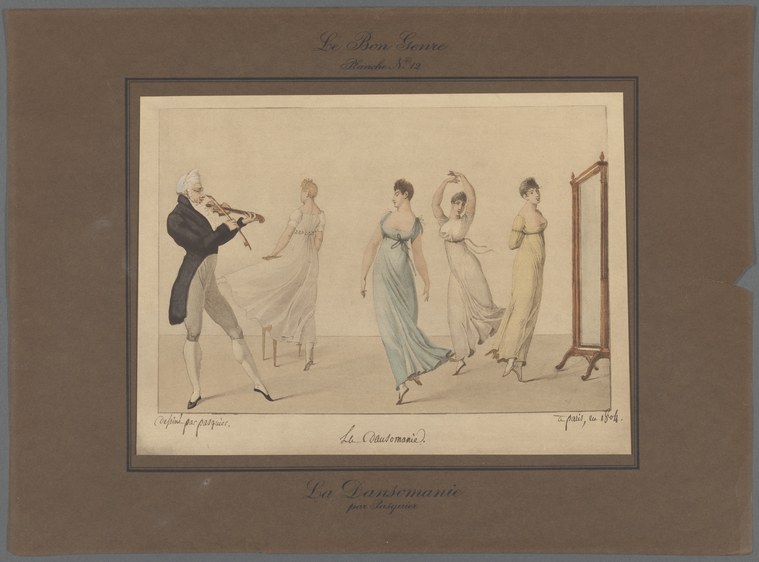
This image is invaluable for understanding how dancing was perceived and satirized in early 19th-century high society. It reveals that even among the fashionable classes, poor execution and social pretension in dance were recognized and ridiculed, suggesting that standards of technique existed and mattered. The print itself is a primary historical document of dance as a social practice and public concern.
What you are looking at
This satirical print presents a sequence of fashionable figures arranged across the composition to mock the social craze of dancing. At left, a thin man in dark coat and breeches plays a violin with exaggerated posture, his body contorted as he gazes upward. To his right, five women in high-waisted white or pale blue Regency-era gowns are shown in various stages of dancing or standing, each wearing bonnets or elaborate headdresses. Their poses range from actively dancing to awkwardly posed, some with arms extended or gestures stiff and unnatural. At far right stands a tall pier glass or standing mirror. The composition is rendered in pale wash tones with brown ink outlines, giving it the character of a contemporary caricature or fashion plate. The title 'La dansomanie' (the dancing mania) appears below, with French inscriptions at left reading 'Copied for purposes' and at right 'Finished in 1804', situating this as a comment on Regency-era dance fads.
The dancing
The figures are deliberately ungainly and exaggerated. The violinist's frame is contorted, his arms and torso twisted unnaturally. The five women display a range of awkward poses: one dances with stiff, elevated arms; another appears to float or prance with uncontrolled height; others stand in affected positions. There is no evidence of any formal ballroom hold or partnered technique. The poses suggest satire of fashionable but poorly executed dancing—the artist has captured a moment of social aspiration rather than technical skill.
The dance depicted
This is not a depiction of a specific dance form but rather a satirical commentary on the *dansomanie*—the dancing mania or obsession with dancing—that gripped Regency-era society around 1804. The image mocks fashionable society women and their dancing master or musician, presenting their efforts as ridiculous and affected. The exaggerated, unstable postures suggest that the artist is criticizing both the dancers' lack of true skill and the broader social phenomenon of dance-craze consumption among the leisured classes. The Regency gowns and setting locate this firmly in early 19th-century ballroom culture.
How it was made
This is a hand-coloured engraving or etching, rendered in fine brown or sepia ink with delicate wash toning applied to the figures' garments. The technique of outlining in ink and hand-colouring allowed for both precision in the caricature and the subtlety needed to distinguish the women's different gowns and poses. The inscription 'Finished in 1804' and the style of the print suggest it was produced as a satirical social commentary, circulating among educated, leisured readers of fashion and social satire—the audience for caricature prints of this period.
About this work
This 1804 satirical print documents the *dansomanie*, or dancing mania, of Regency-era society. Through exaggerated postures and affected poses, the artist mocks fashionable women and their dancing master as they pursue the latest dance craze with more enthusiasm than skill. The work belongs in a dance history collection not as a record of how to dance, but as evidence of how dance was consumed, satirized, and experienced as a social phenomenon. It captures a moment when dancing was aspirational rather than expert—a leisure activity caught between fashion and genuine accomplishment.
How to look at it
Attend first to the violinist's twisted posture—the artist has chosen to show the music-maker in a state of exertion and contortion that undermines his authority. Then scan the five women from left to right and note how each pose is slightly different and slightly wrong: the heights are uneven, the arms are stiff, the bodies lean at awkward angles. The mirror at right is key—it invites the viewer to recognize these figures as social performers, concerned with appearance. The pastel gowns and bonnets make them fashionable, but their bodies betray a lack of true mastery; the satire lies in that gap.
The artist
The artist is not recorded. The style, inscription, and subject matter suggest this is the work of a professional caricaturist or social satirist active in England or France around 1804, producing hand-coloured satirical prints for educated audiences familiar with Regency fashion and social critique.
The period
The early 19th century saw an extraordinary boom in dancing as a leisure activity and social marker among the European leisured classes. The Regency era (roughly 1811–1820 in England, but Napoleonic-era culture across Europe) elevated dance, particularly the cotillion, quadrille, and waltz, to a central place in courtship, social display, and entertainment. At the same time, satirical prints were a major form of social commentary, allowing artists to mock fashionable pretensions. The term *dansomanie* and the 1804 date place this work in the moment when dance fads were becoming a subject of public mockery—the dancing mania was real enough to be worth satirizing.
Where it lives
This print is held in the Prints collection of the New York Public Library and is catalogued as 'La dansomanie'. It is a hand-coloured engraving or etching from the early 19th century, part of a tradition of satirical social commentary circulated through illustrated prints.
Dance in this work
Questions about this work
Is this a real dance or made-up satire?
It is satire. The *dansomanie* (dancing mania) was a real social phenomenon—a craze for dancing in fashionable society around 1804—but this print mocks rather than documents it. The exaggerated, ungainly poses are intentional caricature, not instruction in how to dance.
What dance form is this?
No specific dance form is depicted. Instead, the image is a commentary on Regency ballroom culture in general, when quadrilles, cotillions, and waltzes were fashionable. The artist is satirizing not a particular dance but the fashion for dancing itself and the poor execution of it by fashionable amateurs.
Why is there a mirror in the picture?
The mirror reinforces the satire: it positions the dancers as performers concerned with their own appearance, watching themselves. It suggests vanity and self-consciousness, key targets of the mockery.
How was this circulated and who saw it?
This hand-coloured print was made for urban, educated, leisured audiences—people who frequented ballrooms and were familiar with fashion satire. Such prints were sold individually or collected in portfolios and circulated among the same social classes being mocked, making the satire a form of insider social criticism.
More dance artwork





