49 works in this view — arrow keys or swipe to move between them.
Dance in Art
La Poule
Unknown artist
- Collection:
- Prints depicting dance
- Source:
- New York Public Library
- Rights:
- Public domain — free to use, share and adapt.
- Recorded as:
- Public Domain
This print is rare documentary evidence of early 19th-century popular dance theater, a mode of performance—comic pantomime—that was central to the period but left almost no technical or choreographic record. The image shows us actual bodies, costuming, and the comedic poses that audiences paid to see. For historians, it demonstrates that dance in this period was not confined to the ballet stage but flourished in commercial theaters as narrative, gestural entertainment aimed at broad audiences.
What you are looking at
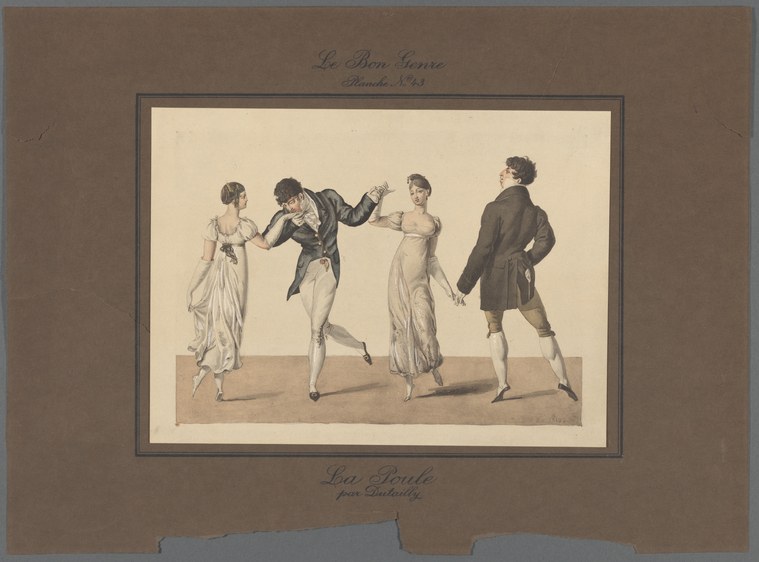
Four figures enact a comedic scene of flirtation and conflict on a bare stage. At left, a woman in a high-waisted Empire gown stands with arms extended, engaging with a man in dark coat and breeches who leans toward her with exaggerated galantry. To the right, a second woman in similar white muslin dress gestures outward, while a fourth figure—a man in dark coat—stands apart with hand on hip in a posture of jealous observation. The composition unfolds across the stage in a linear arrangement, with the figures caught mid-gesture against a neutral ground. The drawing is executed in fine pen line with delicate wash, rendering the fabrics with attention to the flow and transparency of the clothing. The title 'La Poule' (The Hen) inscribed above suggests this depicts a known theatrical piece, likely a pantomime or comic dance of the early 19th century.
The dancing
The central male dancer reaches toward the left woman with an arm extended in a gesture of seduction or courtship, his body angled and off-balance in a theatrical lunge. Both women stand with weight distributed lightly, their arms raised or extended in gestures of response—one receptive, one protective or dismissive. The standing male figure at right holds an upright posture with hand placed assertively at his hip, creating a visual contrast of stability against the animated playing of the others. The poses suggest rapid physical comedy rather than formal technique, with bodies in unstable, expressive positions.
The dance depicted
This appears to depict a scene from a comic pantomime or theatrical dance of the early 19th century, likely a French work given the title and the archive context. 'La Poule' as a dance or theatrical piece exploited the comedic potential of role-play and flirtation—stock characters in chase, seduction, and jealousy scenarios that were staples of the Théâtre des Variétés and similar venues. The gestural language is pantomimic and narrative-driven rather than balletic, with the figures' movements illustrating dramatic action: the male dancer's courting gesture, the women's varied responses, and the rival's indignation. Without further documentation, the specific dance vocabulary cannot be confirmed, but the scene belongs to the vernacular theatrical tradition of popular entertainment dance.
How it was made
This is a hand-colored engraving or etching—the medium is not stated in the record but appears to be intaglio from the fine, precise line work and the framing border typical of printed theatrical scenes from this period. The technique allowed for reproduction in multiple copies, making it a commercial print suitable for circulation among audiences and theater patrons. The selective hand-coloring—warm flesh tones, pale blue for the women's dresses, and ochre for the ground—was a common finishing technique for theatrical prints, adding liveliness to the black-line composition. This kind of print was produced rapidly and inexpensively, serving as a souvenir of popular performances and as visual record of costuming and choreography.
About this work
This hand-colored print captures a moment from a comic theatrical dance, likely French and early 19th century in date, titled 'La Poule.' It documents the kind of popular pantomime entertainment that occupied spaces between ballet and vaudeville—narratively driven, gestural, and designed to amuse through physical comedy and social satire. The print is evidence of how theatrical dance was consumed and remembered: not through written notation, but through the circulation of images that captured iconic poses and the recognizable stock situations of comic performance.
The work belongs in a gallery of dance in art because it preserves a mode of moving that would otherwise be invisible to us. Pantomime and comic theatrical dance have left almost no written record of their technique or choreography. Images like this one are among the only sources we have for understanding how bodies moved in popular entertainment, what scenarios were rehearsed, and how the audience saw the action. The print also documents the costume and grooming of the early 19th-century stage—the Empire silhouette, the men's formal dress adapted for movement, the lightness of gesture that the period valued.
How to look at it
Attend to the variety of poses within a single moment: the lunge of seduction, the varied responses of the women, the stance of offended dignity or jealousy at right. The artist has frozen a moment of dynamic action and emotion, relying on posture, arm position, and proximity to communicate narrative. Notice also the lightness of the figures' frames—no heavy drapery, no grand theatrical machine—which suggests that the comedy and interest lie entirely in the actors' bodies and their interaction. The print's framing and the way the figures are distributed across the stage floor tell us this was a small-scale entertainment, intimate and rapid, designed to register clearly from a distance.
The period
The early 19th century saw the dominance of Romantic ballet—ethereal, narrative, focused on the ballerina—but this occurred alongside a vigorous popular theater tradition in which dance, pantomime, and acrobatics provided comic relief and narrative propulsion for entertainments aimed at working and middle-class audiences. Theaters like the Théâtre des Variétés in Paris specialized in short, punchy pieces built around recognizable scenarios: seduction, jealousy, disguise, mistaken identity. These pieces relied on gestural clarity and physical comedy rather than technical virtuosity. The hand-colored theatrical print was the standard medium for documenting and promoting such works—cheaper and faster to produce than oil paintings, reproducible, and targeted at the very audiences who had seen the performance.
The style of dress visible in this print—high-waisted Empire gown, simple muslin, unadorned breeches—dates the work to the 1800–1820s period. The theatrical aesthetic of the era valued clarity of silhouette and ease of movement for pantomime, a sharp contrast to the encumbered dress of the late 18th century. The print's technical style—fine pen line, selective hand-coloring, framing border—is consistent with French and English theatrical print production of the decade 1805–1815.
Where it lives
This print is held in the New York Public Library's collection of prints depicting dance. The collection assembles printed images from across centuries and media, preserved as a visual archive of dance in its many forms.
Dance in this work
Questions about this work
What is 'La Poule' and was it a real dance?
'La Poule' (The Hen) appears to have been a comic theatrical piece, likely a pantomime or short dance-drama performed in early 19th-century Paris. It was the kind of entertainment mounted in commercial theaters for broad audiences, built around a recognizable comic scenario—in this case, apparently involving romantic rivalry or a woman's coquetry (suggested by the title's reference to a hen). We have no choreographic notation and very limited documentation beyond images like this one.
Is this a ballet?
No. This is popular theater dance—pantomime—not ballet. Ballet in the Romantic era focused on narrative and ethereal movement, often with female dancers en pointe, and was performed in opera houses for elite audiences. This piece belonged to the vernacular entertainment tradition, performed in theaters of varieties for working and middle-class audiences, and relied on clear gestural storytelling and physical comedy rather than technical vocabulary.
Who performed this and where?
We do not know from this print alone. The work appears to have been French, and likely performed in theaters like the Théâtre des Variétés in Paris, which specialized in such short comic entertainments. The cast would have been professional actors and dancers trained in pantomime and theatrical movement, but without additional documentation, we cannot name them.
Why was this printed?
Theatrical prints were cheap, rapid souvenirs of popular performances, sold to audiences as mementos and to people who had not seen the show. They also served as visual advertising. This print preserved an iconic moment from the piece—recognizable to anyone who had seen it—and made it available to a much wider audience. For us now, it is one of the few visual records of popular dance from this period.
More dance artwork





